



Data Centers: Looking Beyond the Headlines
 Data centers continue to generate headlines and strong opinions across our region. They were also a frequent topic during our September member appreciation events. I enjoyed talking with many of you about the opportunities and concerns surrounding these projects, and I appreciated the thoughtful questions you brought to those conversations.
Since I wrote about data centers in February, the discussion has not slowed down. Our team receives inquiries about potential projects nearly every week.
That does not mean a data center is coming to Platte-Clay’s system. Most inquiries never become actual projects. These developments are complicated, and many questions must be answered before one can move forward.
Cities and counties determine whether a proposed development is appropriate for a particular location. Planning and zoning officials consider land use, roads, water, noise and other effects on the community. Those are important discussions, but they are not decisions made by your electric cooperative.
Our responsibility is to determine whether we can safely and reliably serve the electricity a project requires. We are grateful that local officials handle land use decisions so we can remain focused on our role as your electric utility.
Platte-Clay is receiving inquiries primarily about small and medium data centers requiring less than 50 megawatts (MW) of capacity. Loads larger than 50 MW are evaluated through the Large Load Program established by our generation partner, Associated Electric Cooperative.
For perspective, some agricultural, manufacturing and energy businesses use between 5 and 20 MW. Many are intermittent loads, meaning their electricity use starts and stops at irregular intervals. PCEC already serves several intermittent loads that reach around 20 MW.
Data centers are different because they generally operate around the clock. Smaller facilities may require between 1 and 50 MW, while the hyperscale and artificial intelligence data centers receiving national attention can require 100 MW to 1 gigawatt. At the highest end, that is comparable to the electricity needs of a city.
The size of these projects calls for careful planning, and each proposal deserves to be evaluated on its own merits. A data center is a business seeking electric service, just like a farm, manufacturer, school or local store, although potentially on a much larger scale.
One of our cooperative principles is Open and Voluntary Membership. That principle reminds us that it is not our role to judge a prospective member based on the type of business it operates. If a project receives the required local approvals, our job is to determine whether adequate capacity exists and whether the load can be served without shifting costs or risks to our current members.
Large electric loads can bring real benefits to a cooperative. Many costs associated with operating our system are fixed. Poles, substations, equipment and other infrastructure must be maintained regardless of how much electricity moves across the system. Additional energy sales can spread those costs across more usage and help reduce upward pressure on rates.
That opportunity can be especially meaningful for rural electric cooperatives. Unlike urban utilities, rural cooperatives often serve fewer members across many miles of line. With less customer density, the cost of maintaining the electric system is spread among fewer accounts. A responsibly served large load can add significant energy sales without requiring the cooperative to add thousands of miles of new line, helping rural cooperatives manage costs for all members.
We have already seen that benefit from the large loads on our system. If PCEC responsibly added a load twice the size of those we serve today, the additional revenue could help offset future rate increases.
That distinction matters because PCEC is a not-for-profit, member-owned cooperative. Investor owned utilities may pursue large loads to generate returns for shareholders. We do not have shareholders. When our cooperative benefits financially, that value remains with our members through stable rates, system investments and capital credits.
Our goal is straightforward: provide the most reliable electric service possible at the lowest reasonable cost. If a new large load helps us accomplish that goal without placing additional costs or risks on existing members, I believe it deserves careful and objective consideration.
The same standard applies to projects above 50 MW. Associated Electric’s first obligation is to meet the needs of existing cooperative members. Any prospective large load must undergo extensive capacity and transmission studies, make significant financial commitments and pay the costs of the infrastructure required to serve it. Only after member needs are protected would Associated move forward, and only if the project clearly benefits cooperative members.
Missouri’s three tier cooperative system gives us an important advantage. Together, electric cooperatives own the generation, transmission and distribution infrastructure used to serve our members. We are not controlled by outside shareholders or organizations whose priorities may differ from yours. We can evaluate opportunities based on what provides long term value to cooperative members.
Data centers may be a newer type of development, but responsibly serving large electric loads is not new to us. We understand how to plan for growth, protect reliability and structure service so current members are not asked to subsidize a new project.
We will continue to approach every opportunity carefully and transparently. If a project cannot be served responsibly, we will say so. If it can strengthen the cooperative and provide meaningful value to our members, we should be prepared to consider it.
Whatever opportunities come our way, your interests will remain at the center of every decision we make.


Third Grade Safety Poster Submissions Due End of October
Platte-Clay Electric Cooperative is committed to helping our youngest members learn the importance of electrical safety. This October, in celebration of National Co-op Month, we’re inviting third graders from across our communities to take part in a fun and educational safety poster contest.
At PCEC, safety is always a top priority, and this contest is a great way to encourage students to think creatively about staying safe around electricity. The top three student entries will be awarded prizes, and winners will be recognized on our Facebook page as well as in a future edition of Northland Connection.
We’re also excited to celebrate the teachers who support this effort— three participating teachers will be selected to win a $100 gift card for their classrooms!

Wyatt, from Edgerton, was a 2025 contest winner.
Submission guidelines
- Submit original artwork on 8.5×11 inch paper
- Poster must use the theme, “How do I stay safe around electricity?”
- Print the child’s name, phone number, school and teacher on back of poster
- One entry per student
- Posters must be received no later than October 31, 2026
Three options to submit entries
- Mail poster to: Platte-Clay Electric Cooperative, P.O. Box 100, Kearney, MO 64060
- Hand-deliver to our Kearney or Platte-City office
- Scan poster and email to addys@pcec.coop

Help Save Lives in Our Community: PCEC to Host Blood Drive Oct. 21

PCEC will host its annual blood drive in partnership with Community Blood Center on Wednesday, Oct. 21, from noon to 6 p.m.
A single blood donation can make a meaningful difference for patients in our community. Members, employees and area residents are invited to roll up their sleeves and help ensure lifesaving blood is available when it is needed most. Everyone who donates will also receive a PCEC silicone spatula and spoon set.
Schedule your appointment at savealifenow.org/group and enter group code EF2R. Appointments are preferred, but walk-ins are welcome.
For additional information, call (816) 903-7355 or email mail@pcec.coop. We hope you will join us and help make this year’s blood drive a success.


Kendall Davis
Board President
The Principles That Bring Us Together
Platte-Clay has been part of my life for as long as I can remember. Over the years, I have seen our cooperative grow and change in many ways. What has not changed is the importance of the relationship between Platte-Clay and the members we serve.
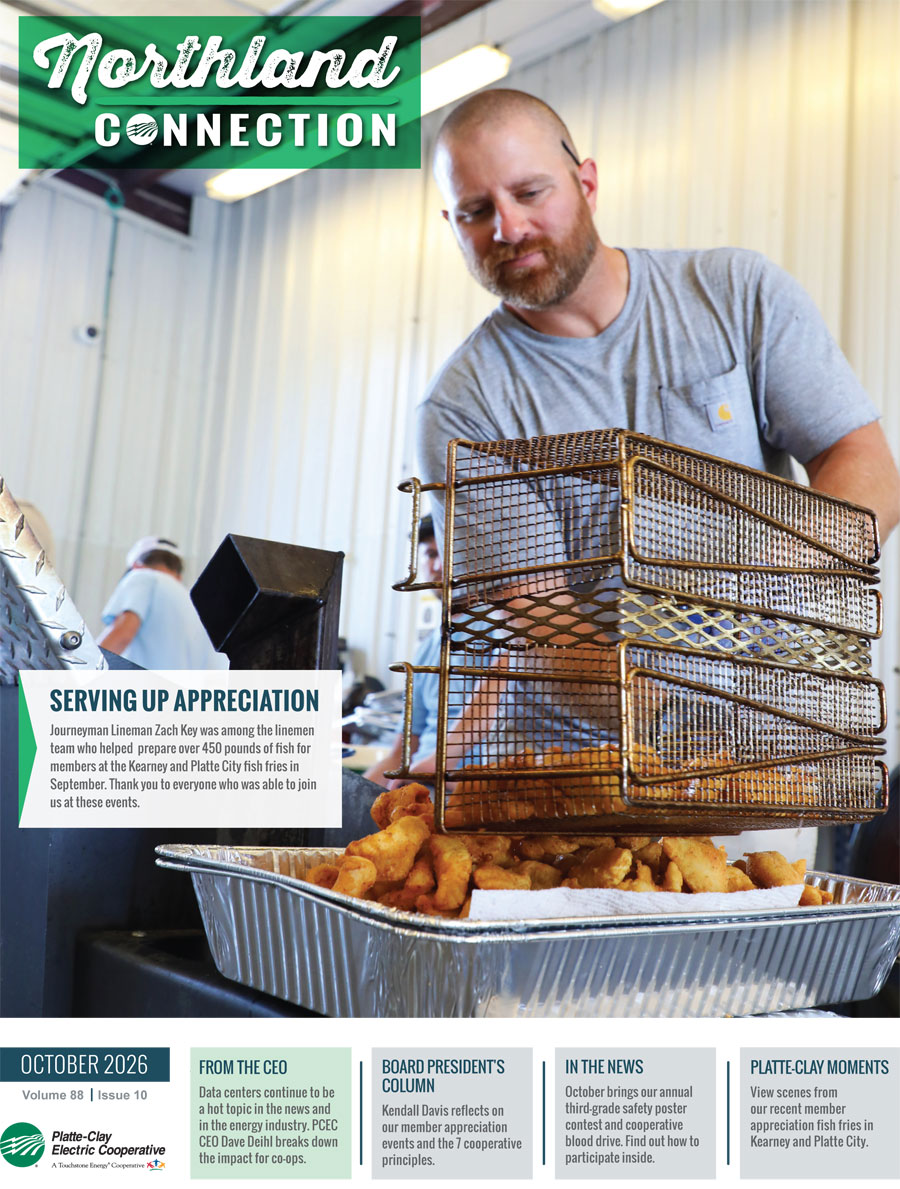
That relationship was on full display in September during our member appreciation events. We hosted fish fries at our Kearney headquarters and Platte City office, along with Pancakes in the Park in Plattsburg. I enjoyed visiting with so many of you at the Kearney event, and as always, the fish was delicious and generously prepared by our linemen.
Sharing a meal gives people a chance to slow down and talk. Members can visit with employees and directors, catch up with neighbors and ask questions about their cooperative. For those of us on the board, these conversations help us better understand what members are experiencing and what matters most to them.
I heard many positive comments about Platte-Clay’s service and reliability. Those comments mean a great deal because reliable electricity does not happen by accident. It takes careful planning, responsible investment and employees who take pride in serving our members. We also appreciate hearing your questions and concerns. Listening is part of our responsibility, and it helps us make better decisions on your behalf.
These gatherings lead us into October, which is National Co-op Month. It is a good time to reflect on what makes the cooperative business model different.
Platte-Clay is owned by the people it serves. Our members elect directors from within the cooperative’s service area to represent them. That is the cooperative principle of Democratic Member Control, and I have always believed it is one of our greatest strengths. Decisions are made locally by people who understand this area because they live here, too.
Members’ Economic Participation is another cooperative principle we put into practice. The money members pay for electricity supports the operation and improvement of their electric system. When the cooperative’s financial condition allows, margins are returned to members as capital credits. It is a reminder that Platte-Clay does not exist to generate profits for outside investors. It exists to provide value to its members.
We also follow the principle of Education, Training and Information. Whether we are answering questions at an appreciation event, teaching students about electrical safety or helping members better understand their energy use, sharing useful information is an important part of serving you.
Concern for Community may be the principle members see most often. It is reflected in our support of youth programs, schools, food pantries and local organizations. It is also present in simple moments when neighbors sit down together over fried fish or pancakes and enjoy being part of the same community.
During my time with Platte-Clay, I have remained proud of how these principles guide our cooperative. Technology has changed, our membership has grown and the electric system has become more complex. Still, the cooperative’s purpose remains all about neighbors working together to provide an essential service and strengthen the communities we call home.
Thank you to everyone who joined us in September and thank you to the employees who worked hard to make each event possible. Most of all, thank you for your continued trust and participation. Platte-Clay has always belonged to its members, and that connection will continue to guide us in the years ahead.




The Northland Connection is published monthly by Platte-Clay Electric Cooperative, Inc., 1000 W. 92 Highway, Kearney, MO 64060. Postmaster: Please send address changes to: Northland Connection, PO Box 100, Kearney, MO 64060 or mail@pcec.coop.
Platte-Clay is an equal opportunity employer.