


May 2017 | Volume 79 | Issue 5
Planning for your summer demand
We have no way of knowing if the Old Farmer’s Almanac summer weather prediction is going to be accurate, below,
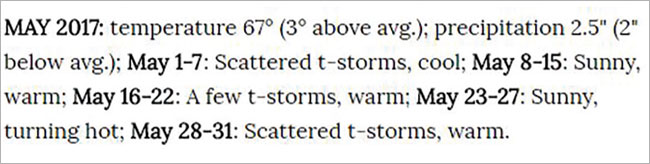
And really it doesn’t make any difference unless we’re planning on leaving town because of the weather.
But what does make a difference is how we manage our household power, because that makes a difference in our budget, which we can control.
Demand billing
Platte-Clay now has three components in the monthly bills:
- The customer charge, which helps pay for the infrastructure of lines and poles that connect us to the grid.
- The energy charge, now $.079 per kWh–down from the previous $.1165 for the first 200 kWh and $.0828 for all usage above 200 kWh. The old blended rate was $.1125/ kWh, so $.079 is a considerable savings.
- The demand charge is $2.50 per kilowatt.
The unbundled rate helps members save money by not using all appliances or devices at the same and lowering the demand rate.
One of the easiest ways to see how demand can affect the monthly bill is to go online, pcec.coop and use the demand calculator. Use the link from the home page to reach the Energy Demand FAQs and scroll down to the gold bar.
No internet? Great opportunity to visit one of the local libraries or stop by the Platte-Clay office for a demonstration.
If there are kids in the house, the demand calculator is a great opportunity for them to learn how to save on demand costs if that’s important to your family.
Some families are just too busy to set appliance timers and for them, the reduction in energy cost will be the best part of the new Platte-Clay rates.
The reason for making the change to unbundle the elements of the electric service bills is because Platte-Clay is billed in part, based on demand.
Our power provider has to be able to meet our collective demand, which could mean additional power plants or firing up “peak” plants to meet demand, both on the expensive side.
Demand billing is fair to all members. With the old combined billing, members with low demand were in essence subsidizing members who created high demand.
Using timers and a programmable thermostat will help manage demand and home energy expenses.
While temperatures are moderate in May it’s a good time to start managing devices, learning the demand they create and how to use…
Cooperation among cooperatives

Dave Deihl
General Manager
From the General Manager
Every day at Platte-Clay we see examples of the Seven Cooperative Principles which guide the organization, but perhaps not as vividly as in early March when an EF2 tornado churned destructively through the area.
That tornado was one from a line of storms that wreaked havoc from as far south as Arkansas and Oklahoma north through Missouri and on to Wisconsin and Minnesota. By Saturday the National Weather Service had confirmed 53 tornadoes from that storm system.
In addition to the EF2 tornado that ripped up Platte-Clay members homes and co-op infrastructure, Missouri had seven EF1 tornadoes. The tornado that spun its way east through the Platte-Clay service area had winds of up to 132 mph, putting it just under the EF3 category.
Platte-Clay immediately started calling in crews as members began calling to report their lights were out. In short order, as the extent of damage became known, it was all hands on deck, with crews working overnight, assessing damage and repairing what could be fixed.
The next morning dawned with cloudless blue skies and two things were clear: there was much work to be done and people—members and employees—were hard at it.
Homeowners were out picking up debris to make burn piles and touching bases with neighbors to see how they fared during the storm.
The Platte-Clay management group, working through the state co-op association, requested assistance from other co-ops that could spare a crew.
Neighboring co-ops, Atchison- Holt, in Rockport; Boone Electric, Columbia; Grundy Electric, Chillicothe; and United, in Savannah, which hadn’t suffered as much damage, sent crews to help.
N-W crews started replacing downed poles and the high voltage lines that stretch out from substations to the lower voltage Platte-Clay distribution lines that ultimately serve members.
The Red Cross sent in teams to assist.
In many cases, members said that Platte-Clay crews were “first responders,” the first group of what would become many over the next few days as the community started to rebuild, replace roofs, windows, doors, siding, fences, lives.
In some cases, the home was completely gone, and at that point crews noted the information in the database and moved to the next address.
Although the storm delivered a blow to our sense of safety and security, it also brought out the best, cooperation among cooperatives, which helped Northland families gain a sense of normalcy and power to rebuild their homes.
I am both humbled and proud to be a part of Platte-Clay Electric and the rural electric program.
Together we’ll move forward.
If you have questions or concerns, please e-mail me, generalmanager@pcec.coop
Cooperative Principle 6
Cooperatives serve their members most effectively and strengthen the cooperative movement by working together through local, national, regional and international structures.
Lights Out August 21
Total Solar Eclipse to Cross Area
The thing about a total solar eclipse is that even though they occur about every 18 months, it’s not an everyday occurrence, especially in northwest Missouri in particular, and the U.S. in general.
But this year is different. On August 21, the moon’s shadow will create a path about 70 miles wide from west to east and leave Missouri in the dark for just about 2 and a half minutes as the sun continues to revolve around Earth.
And that’s a generous experience, according to eclipse experts.
What’s all the fuss? Well, according to Belgium’s Jean Meeus, a spherical and mathematical astronomist, we’ll only see a total eclipse on Earth every 375 years on average.
Earlier astronomists, H. N. Russell, R. S. Dugan and J. Q. Stewart in 1926 said the chance to see a total eclipse is once every 360 years. And we only see total eclipses on Earth because of the position of the sun in relation to the moon. The last total solar eclipse that graced Missouri was in 1869, when the moon’s shadow crossed the northeast corner of the state.
So it’s a big deal. Especially when it’s in our backyard, literally. Plus there are activities all along the path, from St. Joseph to Cape Girardeau so expect company, perhaps long-lost cousins and grade school pals to be in touch.
For many of us, the eclipse is simply a natural phenomenon gift. For others, it is the chance to cross off a bucket list nature adventure—which we may not even have known we had.
So, first things first: in Missouri, the eclipse is projected to begin at 11:40 a.m. at Lewis and Clark State Park, near St. Joseph, so that means we need to be where we’re going to watch, parked, seated and in place and situated way before then.
The eclipse will start in the northwest corner of the state and angle south and east, leaving the continental U.S. in South Carolina.
According to Front Page Science, an astronomy magazine hosting an eclipse watching event in St. Joseph at Rosecrans Memorial Airport:
- The eclipse begins at 11:40:34 a.m. with the Sun 54.1º high in the southeast.
- The total eclipse starts at 1:06:19 p.m. when the Sun is 61.9º high in the south.
- Maximum eclipse occurs at 1:07:38 p.m. when the Sun is 61.9º high in the south.
- The end of totality is at 1:08:57 p.m. with the Sun 61.9º high in the south.
- The eclipse ends at 2:34:27 p.m. when the Sun is 57.9º high in the southwest.
Experienced eclipse watchers will be comfortably seated, some with their cameras on tripods or telescopes to see or get the best photos and we’ll want to be wearing our special eclipse glasses—available from most of the area communities’ web sites. Experienced eclipse watchers report that because we’re watching the sun and moon that only eclipse glasses are needed to appreciate the event.
Since for many there’s camping available, there won’t be any excuse for not being up and about and in place by that time.
And for many of us it will only be a matter of going outside of our home or office and pulling up a lawn chair.
Missouri has a lot to offer its eclipse guests. The total eclipse can be seen from 42 of the state’s parks and historic sites. Plus, for bicyclists, 22 of the KATY Trailheads will go dark for a little more than 2 minutes.
Closer to home, area communities are preparing activities and rolling out the welcome mat.
Excelsior Springs is planning a two day Solar Fest along with a barbeque and Fly-in on the River, the annual downtown festival.
Lathrop is planning a four-day celebration, which will include the double opportunity of celebrating the community’s sesquicentennial—150 year birthday and the eclipse—complete with souvenirs.
The Lathrop fairgrounds has full RV hookups available for eclipse fans, while other landowners are offering tent camping and space for self-contained RV camping.
Neighboring Plattsburg is opening up Perkins Park for guests, offering food and souvenirs through vendors that will be located on the north end of the park. Visitors will be parked to allow tailgating while waiting for the moon’s shadow to darken the sky. Groups and tour busses must pre-register with the city for park space.
Some local property owners are planning to open their fields for eclipse viewing. For more information, visit www.plattsburg-mo.gov
St. Joseph will host an eclipse-viewing event at the airport, which expects to attract some 100,000 sky watchers, including guests from other countries who will fly in on chartered aircraft.
Front Page Science will have astronomers available to explain the phenomenon and provide free safe filtered telescopes for viewing.
For more information and to reserve parking or RV space, visit stjosepheclipse.com
For more information on other locations, visit regional community or chambers of commerce web sites, the local Astronomical Society of Kansas City,
https://nightsky.jpl.nasa.gov/event-list.cfm?Club_ID=452 which hosts local meetings and the NASA site, https://eclipse.gsfc.nasa.gov/eclipse.html
How to Watch an Eclipse

To best enjoy the eclipse, the expert eclipse watchers at Front Page Science have these recommendations:
1. Plan now to take eclipse day, Aug. 21, off
The point to consider is that August 21, 2017, may turn out to be the most popular vacation-day request in history.
2. Make a weekend out of it
Eclipse day is a Monday. Lots of related activities in locations touched by the Moon’s inner shadow will occur on Saturday and Sunday. Find out what they are, where they’re being held, and which you want to attend, and make a mini-vacation out of the eclipse. Events like cruises to exotic locations will allow you to experience the full social impact of the eclipse.
3. Attend an event
You’ll enjoy the eclipse more if you hook up with like-minded people.
4. Get involved
If your interests include celestial events and public service, consider volunteering with a group putting on an eclipse event. You’ll learn a lot and make some new friends in the process.
5. Watch the weather
Meteorologists study a chaotic system. Nobody now can tell you with absolute certainty the weather a specific location will experience on eclipse day. And don’t get too tied up in the predictions of cloud cover you’ll see for that date.
6. Stay flexible on eclipse day
There may be heavy traffic on eclipse day. Reports are our small towns will have 20,000-40,000 visitors. Each.
7. Don’t plan anything funky
Totality will be the shortest two and a half minutes of your life. All your attention should be on the Sun. You may want to consider enjoying a professional photographer’s work rather than fussing with a camera and missing the experience. And be considerate of those around you. Please, no music.
8. Have the entire family use the facilities before things get going
Don’t wait until 10 minutes before totality to start searching for a bathroom. Too much is happening then. Make a preemptive trip 45 minutes or so earlier.
9. Notice it getting cooler?
A point-and-shoot camera that takes movies will let you record the temperature drop. Here’s a suggestion: Point your camera at a digital thermometer and a watch, both of which you previously attached to a white piece of cardboard or foamcore. Start recording video 15 or so minutes before totality and keep shooting until 15 minutes afterward. The results may surprise you.
10. Watch for the Moon’s shadow
If your viewing location is at the top of a good-sized hill, you may see the Moon’s shadow approaching. This sighting isn’t easy because as the shadow crosses St. Joseph, Mo., for example, it is moving at 1,584 mph (2,550 km/h), or twice the speed of sound. Another way to spot the shadow is as it covers thin cirrus clouds if any are above your site. Again, you’ll be surprised how fast the shadow moves.
11. View the 360° sunset
During totality, take just a few seconds to tear your eyes away from the sky and scan the horizon. You’ll see sunset colors all around you because, in effect, those locations are where the sunset (or sunrise) are happening.
12. Get a filter in advance
Cardboard “eclipse” glasses with lenses of optical Mylar cost about $2. Such a device — it’s not a toy — will let you safely look directly at the Sun. It filters out most of the light, all of the dangerous infrared (heat) and ultraviolet radiation, which tans our skin.
Buy eclipse glasses well in advance, and perhaps a couple of extra pairs in the event someone misplaces theirs, and you can look at the Sun anytime. Sometimes you can see a sunspot or two. That’s pretty cool because to be visible to our eyes, such a spot has to be larger than Earth.
Another safe solar filter is a #14 welder’s glass, which also will cost you $2. Want to look cool at the eclipse? Buy goggles that will hold the welder’s glass. People have even been seen wearing whole helmets. Either helmets or goggles serve one purpose — you won’t need to hold the filter, so you can’t drop it.
How do mothers know these things?
 We used to wonder how our mothers knew what we were doing. She would be in an entirely different part of the house and then we’d hear her say, “Don’t get into the…” whatever it was.+
How did she know?
Times have changed, and in many households, with both parents working outside the home, moms and dads can use a little help.
Technology now gives parents a helping hand and an extra set of “eyes” on the household.
Wireless security systems make for easy installation for homes that haven’t been pre-wired or have stucco or designer walls.
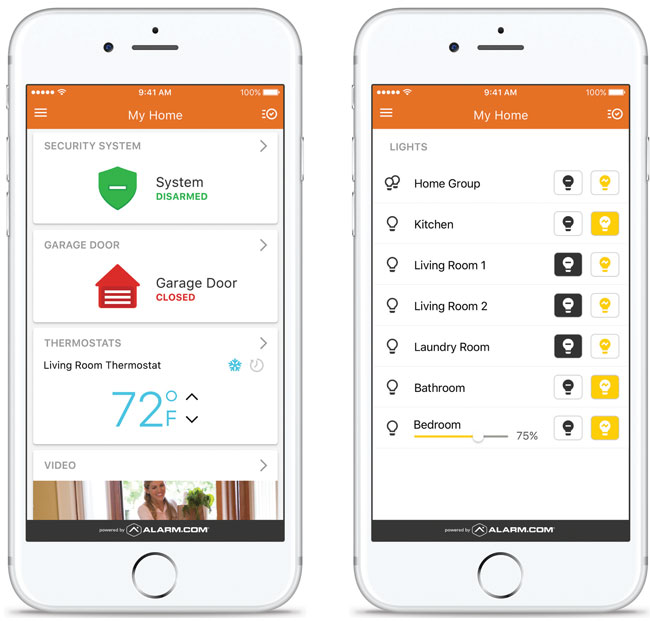
Platte-Clay uses the Alarm.com system, which for a limited time includes a free image sensor, an integrated still camera with a motion sensor.
When the image sensor detects movement, it snaps a photo. It will answer the question, “Who was in dad’s office?” The image sensor knows and will send a photo to mom or dad.
The dashboard works through an Alarm.com app available at the App Store or Google Play site.
The app includes features such as the ability to control temperature settings, to lock and unlock doors, checking on if doors are locked or unlocked, if the lights are on or off.
For more information on PCEC Security, call 628-3121.
Premium fuel is back
Back by popular demand, Platte-Clay Fuel stations now are offering premium fuel.

Many manufacturers and enthusiasts recommend premium fuel for their high compression engines, such as:
- motorcycles
- boats
- new Chevy 2.0 engines
- vintage automobiles
- heavy-duty vehicles
- small engines
- power equipment
Premium gas is available at both the Platte City and Kearney fuel stations.
‘tis the season for everyone to be outside working – safely
Because of safety concerns, do not cover, build around or attach anything to the meter or transformers.
Treat the utility meter and transformers like a refrigerator door and don’t block it or put anything in front of it.
Crews need about 3’ around co-op electrical equipment, a shock protection boundary, for a safe work space.
PCEC continues meter change outs
Platte-Clay will continue changing out meters for the next three years as part of an integrated system upgrade.
Platte-Clay crews in marked co-op vehicles will change out meters as time allows during regular work hours. Members will lose service for a few minutes when the meters are replaced and crews will leave a door hanger if no one is home.
The Northland Connection is published monthly by Platte-Clay Electric Cooperative, Inc., 1000 W. 92 Highway, Kearney, MO 64060. Postmaster: Please send address changes to: Northland Connection, PO Box 100, Kearney, MO 64060 or mail@pcec.coop.
Platte-Clay is an equal opportunity employer.