


January 2017 | Volume 79 | Issue 1

Glad to meet you

Dave Deihl
General Manager
From the General Manager
This column is like opening a door to the membership and stepping out onto a stage. One of the great things about it is that I’ve met many co-op members over the years—since I joined the co-op in 1994 in the member services department—so I feel like in many ways that I already know many people and that we’re already friends.
Going forward, I will be sharing information, challenges, opportunities and concerns that as a distribution cooperative, the last mile of the energy grid, the management of your co-op will be working on your behalf.
I think that communicating with the membership is one of the general manager’s most important responsibilities, and I will be doing that.
But don’t expect any major or radical changes: we will stick to our core values and activities, broadly defined in the Seven Cooperative Principles. They are how your co-op operates.
First and foremost, we will continue to work to provide reliable electric service. That work includes the basics: rebuilding and replacing aging lines and poles, maintaining the integrity of the rights of way to keep trees and vegetation out of the lines, the main reasons for outages.
As a result of those efforts, and at this time, Platte-Clay’s reliability is better than the national average and the Rural Utilities Services requirement. Of course, we know that could change with a big storm, but we’ve been lucky the past few years.
As a good community partner, we will continue to work on activities that benefit the Northland. Economic development, for instance, to help bring jobs to our communities and spending time with area chambers of commerce.
Because of the importance of household budgets, the co-op will work to educate members on energy efficiency, which will remain high on our list of priorities.
Energy audits and the rebate programs for ground source and dual fuel heat pumps and commercial lighting will continue.
And as good citizens, employees have volunteered to work on projects that benefit all of us. For example, the last two years PCEC employees have planted more than 50 trees in two county parks that will benefit many generations of park guests and wildlife.
With the New Year, and as general manager, I’m going to make some resolutions on behalf of your co-op that we intend to keep.
- We’ll work to meet and exceed your expectations.
- We’ll work to be responsive to member concerns.
- We’ll work to keep up our high reliability factor.
- We’ll continue working to serve our communities, a kind of continuous improvement plan that begins anew each day.
Please accept my personal best wishes for a Happy New Year.
Please feel free to contact me if you have any questions or concerns generalmanager@pcec.coop or call the office, 628-3121.
Platte-Clay Earns No Lost Time Accident Safety Award
To get a handle on rising workers’ compensation claims, Platte-Clay and other Missouri electric cooperatives formed MECIP–the Missouri Electric Cooperatives’ Insurance Program.
Because working on a line crew for an electric utility is considered one of the top 10 most dangerous professions, there is a heightened focus on safety.
For example, before starting a project, line crews review and discuss the work to be completed and any hazardous or safety concerns to be considered. In addition, there are monthly safety meetings and safety training activities.
The focus on safety resulted in Platte-Clay employees and management receiving the MECIP award at the Assoc. of Missouri Electric Cooperatives’ annual meeting for working 144,135 hours without incurring lost time.
The KC Remodel + Garden Show
 Platte-Clay will have a booth at the show, Feb. 10-12 in the American Royal Building. Stop by for info on products and how to save energy.
Your Co-op New Year’s Resolutions – 7 Cooperative Principles
1.) Voluntary and Open Membership
Cooperatives are voluntary organizations, open to all people able to use its services and willing to accept the
responsibilities of membership, without gender, social, racial, political or religious discrimination.
2.) Democratic Member Control
Cooperatives are democratic organizations controlled by their members—those who buy the goods or use the
services of the cooperative—who actively participate in setting policies and making decisions.
3.) Members’ Economic Participation
Members contribute equally to, and democratically control, the capital of the cooperative. This benefits members in
proportion to the business they conduct with the cooperative rather than on the capital invested.
4.) Autonomy and Independence
Cooperatives are autonomous, self-help organizations controlled by their members. If the co-op enters into agreements with other organizations or raises capital from external sources, it is done so based on terms that ensure democratic control by the members and maintains the cooperative’s autonomy.
5.) Education, Training and Information
Cooperatives provide education and training for members, elected representatives, managers and employees so they can contribute effectively to the development of their cooperative. Members also inform the general public about the nature and benefits of cooperatives.
6.) Cooperation Among Cooperatives
Cooperatives serve their members most effectively and strengthen the cooperative movement by working together through local, national, regional and international structures.
7.) Concern for Community
While focusing on member needs, cooperatives work for the sustainable development of communities through policies and programs accepted by the members.
Reducing demand is simple — just don’t use everything at the same time
 Thanks to all of the members who participated in the community meetings, attended the annual meeting and stopped by the video booth to learn about demand. Thanks also to those who read the articles in the newsletter, articles in the newspapers and took a look at the ads.
We’re pleased that your co-op— you—have made a successful transition to demand billing with only a few members expressing concern.
Fear of the unknown, especially when it comes to expenses, is powerful.
We thought we’d take this opportunity to recap the billing system because most of us will be making New Year’s resolutions and some members may want to make resolutions about saving energy and money. Of course, it’s not too late to start with each month’s bill.
First, all members have always been paying for demand. It was just blended in with the total power cost and averaged across all members. That meant that members with low demand—fewer numbers of “plugs” or items being used at the same time— were subsidizing those using lots of “plugs” at one time.
Parents who pay for the family’s gasoline can easily relate to this. Those who have a practical gas-sipping car and a teen with a V8 4 x 4, for example.
Second, by pulling out demand and billing accordingly, families can determine when they create high demand. For some it’s an easy change. For other families, it’s a constant challenge to get the kids where they need to be, laundry washed and meals on the table. Because of busy schedules, the cost savings may not be worth trying to schedule in one more thing to save a couple of bucks.
For members who want to see how they can reduce demand, we suggest the demand calculator on the co-op web site, pcec.coop There’s a link from the home page.
The demand calculator includes summer and winter appliances and devices to help get a reasonable picture of household demand.
The bottom line on how to reduce demand is to simply not use all appliances or devices at the same time. Please feel free to call the office, 628-3121, or stop by if you have questions or concerns.
Platte-Clay seeks members for 2017 focus group

Platte-Clay now is taking applications for the 2017 Focus Group.
Qualifications: must be a co-op member. If it is a family account, both responsible party’s names must be on the account.
Focus group members must be willing to attend four evening meetings a year and enjoy a meal, good company and interesting, and at times, lively conversation.
Dinner is served beginning around 6 p.m. and the evening usually wraps up by 8:30 p.m., 9 p.m. at the latest.
Members receive a stipend to offset the cost of gasoline to attend the meeting.
Typically the co-op will ask members to provide feedback and suggestions on possible activities and projects.
In 2015, members reviewed the solar survey results and shared their perspective on what community solar means to the co-op, to members and to the area.
For 2016, the group learned about demand billing, reviewed materials and plans on rolling out the new, detailed billing, including their take on the four community meetings held throughout the service area. During another meeting the committee discussed external communications, including the newsletter and web site.
The group is a representative mix of 12-15 co-op members who live throughout the service area; some youthful, some not so youthful, new members and other members who have had Platte-Clay service for some time.
The focus group plays an important role in co-op management as their comments and suggestions are shared with the various staff members and the Board of Directors.
The interactive application is on the web site, pcec.coop in the News section, or call for a hard copy and we’ll send or fax it to you.
Let’s make our homes user friendly
There’s nothing better than when common sense becomes a trend.
Hello, universal design.
The official definition is “the design and composition of an environment so that it can be accessed, understood and used to the greatest extent possible by all people regardless of their age, size, ability or disability.”
Interesting, and a bit like the 7 Cooperative Principles, there are 7 Principles for universal design, developed by a group of engineers, product designers, architects and environmental design researchers.
- Equitable Use
- Flexibility in Use
- Simple and Intuitive Use
- Perceptible Information
- Tolerance for Error
- Low Physical Effort
- Size and Space for Approach and Use
Every day we see practical applications with ramps, handrails, safety rails in showers and tubs and restrooms.
 While there are any number of young, nimble parents, without a doubt everyone appreciates a ramp when negotiating sidewalks and entry ways with a stroller.
Add to that those who use a walker, wheel chair or shopping cart, and universal design’s value radiates throughout society.
Today we have the advantage of universal design considered from the planning stages in any number of products. In fact, we’re so used to the convenience, we don’t give it a second thought.
For example, OXO, the housewares company, started in 1990 when Sam Farber noticed how difficult it was for his wife, Betsey, who had arthritis, to use a vegetable peeler. He saw an opportunity and started making the now familiar kitchen utensils.
It wasn’t always that way, and there always has been grumbling, especially by the able-bodied, about making concessions for others.
But taking a broad look, we find any number of disabled veterans, for example, returning home to a house, apartment building, parking lots and walkways that made it difficult for them, and others, to navigate.
Starting with consideration for WWII veterans, awareness of the aging population and the visibility of those with disabilities, government at all levels started developing laws requiring accessibility as part of anti-discrimination legislation.
Today, many thoughtful builders and remodelers start with the end user in mind and the value of homeowners being able to age in place.

Universal design makes life easier for everyone. Easy access bathroom with hand-held shower, walk-in shower with seat and taller commode.
Unfortunately young home buyers often forget that a broken leg will put them or their children on crutches, and in a few short decades they may be making the difficult decision to leave a home and neighborhood where they feel safe and comfortable because they no longer can easily manage the steps.
A quick look at statistics bear out the importance of building and remodeling homes and facilities using universal design: by 2029, a little more than a decade from now, all of the Baby Boomers (1946-1964) representing 20 percent of the total U.S. population at 76 million, will be 65 or older.
And time marches on. The 55 million in Generation X, born 1965-1980, also are edging into maturity, with the oldest in their 50s now, and they will pass the Boomers in population by 2025, when the first turn 60.
The Millennials, (1981-1997) the next largest generation, aren’t far behind.
In short, incorporating universal design into all housing and community design will only become more important as the millions of Americans make the march to and through maturity.
By simply planning for ease in accessibility and eventually aging in place, families can stay in their home and live independently so long as it’s practical.
With the area home and remodeling shows coming up, it’s a good time to look for area architects, builders and remodelers who understand how important it is to build or remodel a home that works for all families and friends through all stages of life.
Good stories to share
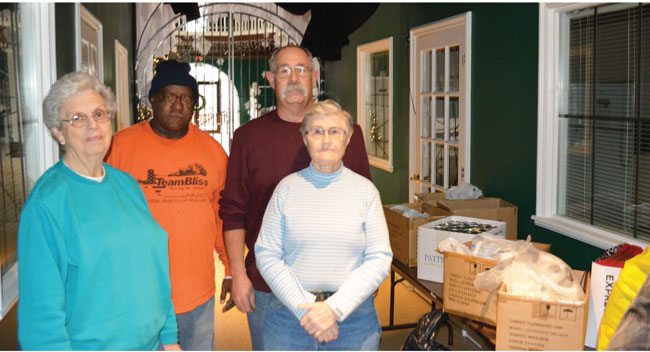
Plattsburg Food Bank volunteers, L-R Maureen Bodenheimer, Clyde May, John Langeneckert and Judy McKown will help with distributing some of the food Platte-Clay members donated at the Holiday Open House Dec. 4. The co-op divides the food and coats collected among three Northland food banks. (Jamie Lawson photo)

Above and below: Lathrop students from two of the four sessions who stopped by during Future Mules Day to learn about careers at a rural electric cooperative. Thanks to substitute teacher Samantha Lester, last person on the right, for hosting the classroom.

The Northland Connection is published monthly by Platte-Clay Electric Cooperative, Inc., 1000 W. 92 Highway, Kearney, MO 64060. Postmaster: Please send address changes to: Northland Connection, PO Box 100, Kearney, MO 64060 or mail@pcec.coop.
Platte-Clay is an equal opportunity employer.