


August 2016 | Volume 78 | Issue 8
Best seats in the house for the 2017 eclipse are here
Some of the area Chambers of Commerce now are making plans to host eclipse watchers from all over the world who travel thousands of miles to experience a total solar eclipse.
The curmudgeons among us will shrug and say, “who cares.”
But for those interested in natural phenomena, it is a gift of the universe, and for most of Platte- Clay members, it will mean that all we need to do that Monday is step outside with our protective eye gear and look up.
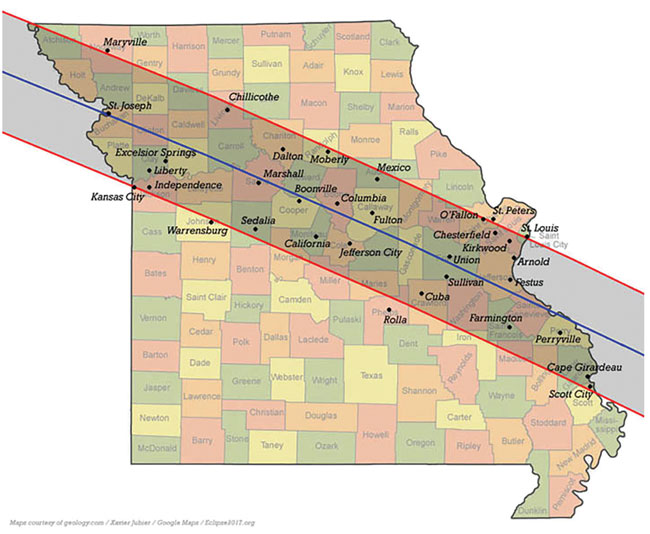
The best seats in the house may be in our front yard as the August 21, 2017, eclipse Path of Totality passes right over the Platte-Clay service area.
The moon will cover the sun entirely which eclipse watchers along the “Path of Totality” will be able to see. When the moon covers the sun in its entirety, we can take off our eclipse glasses and view the sun’s corona for a few fleeting seconds.
Only those within the path, which for this eclipse is only in the United States, will be able to experience the true eclipse.
Some of us may not be familiar with eclipse chasers, but after August 21, 2017, we may be saying that we had eclipse chasers camping in our pasture or sleeping on our couches.
Although total solar eclipses occur every 18 months, many times in remote areas, eclipse chasers are delighted to find the Path of Totality in 2017 will cross civilized areas–including Missouri.
Enthusiasts report that trying to observe total solar eclipses can become a way of life.
In the meantime, we can prepare for a two to seven minute celestial show with modest effort.
Continuous Improvement

Mike Torres
From the CEO
It’s back to school for many of us, from children who have just mastered two wheels to those who have surveyed their skills and decided on what they need to do to stay current, a form of personal continuous improvement.
A recent jobs recovery report said that by 2020, 65 percent of all U.S. jobs will require education or training beyond high school according to a Georgetown University publication.
Like individuals, your co-op must rely on demographic, industry and economic forecasts on social and economic trends to prepare for the future. I agree with Will Rogers, who said, “Even if you’re on the right track, you’ll get run over if you just sit there.”
One of the ways your co-op is working to stay on the right track and preparing for the future is by supporting the Metropolitan Community College Electric Utility Line Technician program, where students can earn a certificate or degree.
As a result of labor reports that projected 45 percent of the workforce would be retiring as the baby boomers reach their sixties, Platte-Clay, along with Kansas City Power & Light, worked with the college to develop a line technician program. It’s hard, physical work in challenging conditions, and not everyone is cut out to deal with everything from rattlesnakes to physics in one day. The program has excellent results with an 85 percent placement rate.
Another important trend is the focus on saving energy. To help members manage energy and save money, Platte-Clay continues to encourage members to install efficient geothermal and dual fuel heat pumps, both with significant rebates to offset costs.
Your co-op also sold compact fluorescent lights and gave away bulbs at annual meetings to help members reduce usage. More recently, as LED lights have entered the marketplace, Platte-Clay now is offering them in a variety of sizes and shapes to help members save energy and reduce costs.
One of the results of reducing the amount of energy used is that the old simple formula of blending infrastructure costs with the energy costs and averaging demand no longer works. The simple billing was averaging the cost-of-service to members and hearkens back to 1938 when the co-op first began.
As a result, beginning with the November billing, Platte-Clay will show three line items on the bill: the customer charge of $25.38, the energy charge billed at $.079/kWh and demand, billed at $2.50/kW.
We encourage members to review the Demand Q & A on your co-op’s web site, pcec.coop, or call or stop by the office if you have questions.
As always, if you have questions or concerns, please feel free to contact me.
Back to school safety tips
 Drivers
There are any number of reasons why parents would get up early and drive their children to school when there’s a perfectly good school bus with a driver holding a commercial driver’s license to do that work for them.
Those reasons are all over the place, from the very sweet idea of sharing some quiet time with a child to making sure a student gets to pre- and post-school day activities.
But for many families, the school bus handles that activity, taking one more chore and worry off of a parent’s list. As important, statistics say that school buses are eight times safer than passenger vehicles.
Because we’ll have both some new students and new drivers on the road, it’s a good opportunity to review school bus etiquette for riders and drivers.
Yellow flashing lights mean that the school bus is slowing and we should be prepared to stop.
When the bus stops and there are flashing red lights, all vehicles on a two-lane street going the same direction and on a two-lane street going either direction are required to stop.
Don’t crowd the school bus—the law says to stay 12 feet away from the school bus. Remember these are our kids or our neighbor’s kids and we want to keep them safe.
Vehicles on a separate roadway going the opposite direction or who are driving in four lanes of traffic in the opposite direction aren’t required to stop.
So in our area, we stop everywhere except I-29 and I-35.
A 2013 study reported that in Missouri, 3,747 people ignored school bus stop signs and flashing lights, placing students in danger.
There are two things to note with that number: 1) children under 10 generally aren’t prepared to handle an emergency situation; and 2) it is a Class A misdemeanor with a fine up to $1,000, imprisonment up to a year and two points on the driver’s license. The vehicle owner, note mom and dad, may be charged with the violation.
School bus riders
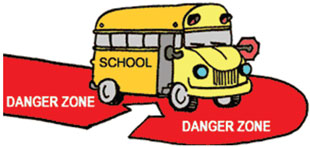
- Stay away from the danger zone of the bus—drivers can’t see riders in those blind spots – see the red danger areas shown in the picture
- When getting off the bus, students need to check both directions to make certain no one is driving on the shoulder, trying to make an illegal pass
- When crossing the street in front of the bus, riders need to walk forward until they can see the driver’s face–that means he or she can see the student
- When crossing the street, students need to look both ways to make certain all cars are stopping for the bus signals
- If a student drops something, they need to ask for help so they don’t get left or worse, run over.
- If everyone thinks in terms of being safe and helping one another we’ll have safe bus rides
Insurance industry ranks Missouri drivers 16th worst in U.S.
 It’s the day parents dread and the day that teens wait for with such anticipation: the day that they get their driver’s license.
It signals independence. It signals a rite of passage into adulthood. And speaking of signals, everyone else on the road wonders why they can’t remember to use their turn signals.
But it may not be the teen’s fault. Look at how many careless adult drivers they have for role models and who may have “taught” their children how to drive, putting everyone at risk.
The National Highway Traffic Safety Administration has compiled statistics and the Car Insurance Comparison site has developed an interactive chart to show how each state’s drivers compare – www.carinsurancecomparison.com
Unfortunately, Missouri wasn’t so great. The lower the score, the worse the driving record.
Missouri ranks 16th on this national list of worst drivers.
Neighboring Kansas ranked 34th overall of states with the worst drivers; Iowa ranked 48; and Illinois ranked 22 with failure to obey traffic signals, use seat belts and invalid driver license topping their list.
The insurance group notes that while drunk driving rates are slowly dropping, largely because of public pressure, careless driving is an increasing danger.
For example, a Car and Driver magazine test using a professional driver texting while driving found that his reactions were the equivalent of drinking a few beers before getting behind the wheel.
For the record, the safest drivers are in Minnesota with the worst state Montana.
Knowing that our school parking lots will be filling up with our young drivers, we thought we’d offer a few tips, refreshers and suggestions.
First, parents are busy. Second, they may not be the best teachers. Third, they may have bad driving habits that need to be corrected, not passed on.
Because of that, perhaps a driving school makes more sense. An added bonus is there is usually an insurance break for kids who have passed a driver’s education course.
It’s important to find a driving school that will teach both courtesy and defensive driving techniques. Remember, there are bad drivers everywhere and we never know when we’ll need to take evasive action to avoid an accident.
New in town, new in Missouri, new in the U.S.?
A driver’s education course could be very beneficial.
The closest driving school, which requires learners to have a permit, is based in Liberty.
Although it comes with a mix of reviews, the Liberty Driving School offers a basic driving course and a driver improvement class to help improve specific skills such as parallel parking.
As with any new toy, teens will want to show off their driving prowess and skills. Everyone understands that.
But it would be a good idea to refrain from scaring everyone else on the road while acquiring actual driving skills and experience.
Our Northland roads can be hazardous: they are narrow, can be slick with ice, difficult to see because of varying light conditions and frightening because of other drivers who tend to use the middle of the road rather than their lane.
Still feel like a master of the universe when you fasten your seat belt?
May we suggest something along the lines of the Richard Petty Driving Experience based at the Kansas Speedway. For those who have a real need for speed and want to test their courage, there’s a time and a place for it.
Save energy and reduce demand
 For some famllies, the idea of trying to reduce demand is a simple invitation to make their lives more complicated.
It’s the very last thing they want to incorporate into new school schedules, different hours, carpools, new software at work and the possibility of a transfer to a distant city.
A couple of bucks more a month just isn’t very important. And everyone understands that.
But for those who squeeze the nickels before letting them go, here are some easy ways to incorporate saving energy and reducing demand into a household.
- Don’t use high demand appliances at the same time. Find appliance demand on the co-op web site, pcec.coop with links from the home page
- Space out household activities and avoid doing the laundry and using the dishwasher at the same time. The timer feature on newer appliances will help.
- Unplug small appliances with clocks or instant-on features that are constantly using energy. If it has a light, it’s using energy, sometimes called “phantom energy.”
- Use energy efficient lighting. LED bulbs use only a fraction of energy of the old incandescent bulbs, which are no longer in production. If you’ve moved to compact fluorescents, CFLs, when they burn out, replace with a LED. Platte-Clay has a variety of sizes for various applications available.
- Install a water heater blanket on the water heater so it keeps water hotter longer. If the water heater is on its last legs, check out the Marathon water heaters Platte-Clay carries. There’s great member pricing and they’re very energy efficient.
Infrared camera helps identify problem areas early
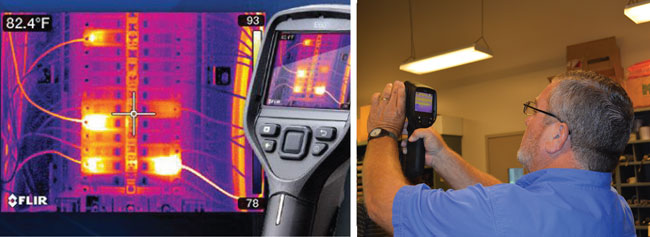
Infrared cameras (IR) show hot spots, the lighter colors, on electric equipment. The IR camera helps co-op technicians work proactively, one of the co-op efforts to keep outages to a minimum. Above left, thermal image courtesy Flir. At right, Harold Baker, chief technician, checks out an IR camera to be used primarily in substations.
Making hay while the sun shines —
co-op summer maintenance continues
Platte-Clay crews and contractors continue routine maintenance replacing damaged or aging poles and updating equipment, including meters.
Don’t be surprised if a Platte-Clay employee or contractor knocks on your door to let you know that they need to do some work near your home and that your power will be off. Although changing the meter only takes a few minutes, poles take longer.
We apologize in advance for all of the blinking clocks.
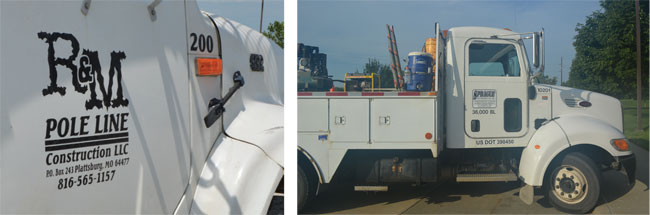
These familiar contractors are busy this summer. R&M employees are responsible for some of the overhead line construction work, including changing out poles. Sprague Excavating works on underground construction and excavating. Most of the foremen working for the companies will have their company name on the trucks as well as a Platte-Clay logo. If you ever have any questions about work being done at or near your home, please call the office, 628-3121, 24 x 7 x 365 for information and updates.
Platte-Clay announces new rates, 3-part bills
Rates effective with November bills, October usage
- Customer charge $25.38 – (Currently shown on bill)
- Energy – .079 /kWh – (New lower rate effective w/Oct. usage)
- Demand – $2.50/kW – (New, will be shown on November bills with October usage instead of included with energy)
The Northland Connection is published monthly by Platte-Clay Electric Cooperative, Inc., 1000 W. 92 Highway, Kearney, MO 64060. Postmaster: Please send address changes to: Northland Connection, PO Box 100, Kearney, MO 64060 or mail@pcec.coop.
Platte-Clay is an equal opportunity employer.