


February 2016 | Volume 78 | Issue 2
February is for our Hearts
 Since the 1600s in England when Valentine’s Day became a holiday, men and women have been using the shape of a heart to show love.
Over time designs have changed, and today we can find a variety of shapes and colors on our smart phones as an emoticon, and seen almost as frequently as the yellow smiley face.
With love in the air, it’s a good time to remember how important our heart is to us and to our loved ones.
The Centers for Disease Control and Prevention has developed a national program called Million Hearts with the goal of preventing 1 million heart attacks and strokes by 2017.
The first step in the Million Hearts program is for Americans to learn how to control their blood pressure, a leading cause of heart disease and stroke.
The CDC reports that more than 67 million Americans have high blood pressure and that we are four times more likely to die from a stroke and three times more likely to die from heart disease compared to those with normal blood pressure.
So, the first step to becoming a statistic on the right side of heart health is to manage our blood pressure.
The CDC says we should talk to our doctor(s) about our blood pressure and recommends that we get the answers to these questions:
- What is my blood pressure reading in numbers?
- What is my goal blood pressure?
- Is there a healthy eating plan that I should follow to help lower my blood pressure and lose weight?
- Is it safe for me to do regular physical activity?
- What is the name of my medication? What is the generic name?
- What are the possible side effects of my medication?
- What time of day should I take my blood pressure medicine?
- Should I take it with or without food?
- What should I do if I forget to take my blood pressure medication at the recommended time?
And then there’s the lifestyle changes the CDC recommends:
- Maintaining a healthy weight
- Physical activity
- Eating fresh fruits and vegetables along with low fat dairy products
- Reducing salt
- Minimizing alcohol intake
And while we can’t promise that this will allow everyone to live happily ever after, it could be the beginning of many more Valentine’s Day celebrations.
Members First

Mike Torres
From the CEO
Our new year is a continuation of a number of developments and changes in the electric industry that ultimately will affect Platte- Clay members. I want to assure you that we are working to keep your co-op financially secure and your rates low.
Because of the many issues that make up the forces affecting the industry, Platte-Clay now is working to minimize the impact on members, the possible financial impact on your co-op and laying the groundwork to meet the all but certain challenges of the next few years.
Because the industry is changing and those changes will affect the cost of electric energy, we believe it’s important that we serve as an information resource for members.
To that end, we will provide a series of articles explaining these issues to members. It’s your rural electric cooperative, and as a member you’re an owner, and an important participant in the co-op and the electric industry.
In addition to an explanation of why your co-op is making significant changes in the way it will bill members beginning in November, 2016, we’ll explain how breaking the monthly bill into three components—customer charge, usage and demand will benefit all members.
We’ll provide an industry-wide perspective to share concerns of the national organizations and how they see the industry evolving and the threats and opportunities your co-op faces.
We all are concerned about the amount we pay for our electric service each month, and we’ll continue to provide tips on how to save energy.
With demand—the total amount of energy a household or business uses at one time—now being measured, we’ll also be working to help members learn how to manage that cost portion of the bill.
With the three components of the bill, energy usage, customer charge and demand shown, the invoice will change, and we’ll walk members through the new look. And we’ll continue to offer online bill payment through the web site, pcec.coop
We’ll be providing additional information to you in the upcoming months through the newsletter, the web site and bill stuffers and our member services group will be glad to help if you call or stop by.
As always, if you have questions or concerns, please feel free to contact me.
2016 Annual Meeting
Thursday evening, May 12 – Doors open at 4 p.m.
Light meal, kids carnival, prize registration 4-7 p.m.
Business Meeting 7 p.m.
Kearney Office, 1000 W. State Route 92
Board of Director election – one from each District
By-Law changes for member approval
The Internet and bricks and mortar

Photo credit – Can Stock Photo/ Andres.
We recently had a member come to the office who remarked about the co-op’s emphasis on finding information on the co-op’s web site, pcec.coop
He’s retired. He has time to come to the office between 7:30 AM – 4:30 PM, and we are always delighted to see him, as well as the other members who stop by to check out products and services or to drop off their payments.
But for those who have busy schedules and may work or live miles from the Platte City or Kearney office, the web site is a pretty good electronic version of the co-op.
For those who don’t have Internet service at home, the libraries have computers and librarians can help get you to Platte-Clay (pcec.coop) via the Internet. The search function will help find specific topics.
Products and services are available on the web site and it’s possible to pay your bill free using the online billing program (pcec.coop – Services – Billing – Pay Bill Online).
There are a number of energy-saving tips and there is electrical safety information.
The site is designed to work on any size of screen, from the one just shy of the size of a billboard to a tablet to a smart phone.
And speaking of phones, the co-op has dispatchers scheduled for round-the-clock service every day of the year to help with after-hour emergencies.
So it’s not that we’re leaving anyone out, it’s that we’re making it possible for everyone to reach the co-op with the method that works best for each member, whatever their schedule and however they want to contact Platte-Clay.
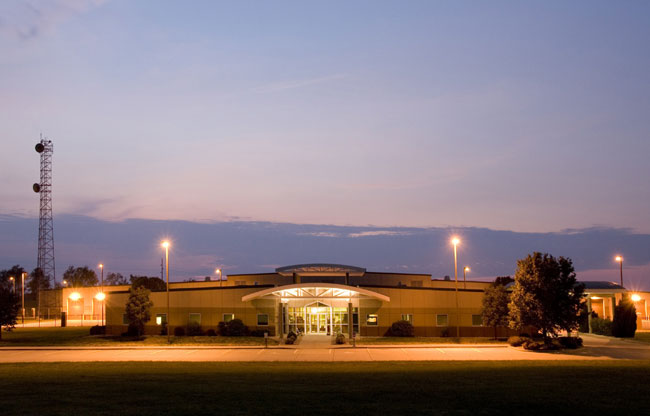
Kearney office at sunset, available 8-5, Monday-Friday; pcec.coop available 24 x 7.
Caulk and seal to save on energy bills
 We’re moving into the time of the year when winter comes roaring through the Northland and tiny chilly breezes in our home give us the shivers.
It’s a good time to take a look at some easy ways to stay warm and manage the cold, keeping it outside where it belongs.
One of the first things to remember is that the heat goes to the cold. So with that in mind, let’s look at how the heat can get out of our homes.
Almost every energy audit conducted by Platte-Clay finds that members need to caulk and seal around the openings in their home.
We’re sharing some of the common places for energy leakage, which runs up the heating bills in the winter and cooling bills in the summer along with suggestions on how to keep the cold at bay.
Window, window frames and sashes
There are a number of weather stripping products that come in different sizes to fit the space between the sashes. Local hardware stores have any number of products, and sites like Houzz, Pinterest and You Tube, for example, have photos and videos on how to install weather stripping.
One DIY suggestion to add R-value to a window is to use the small bubble wrap. Spray the window and place it over the glass.
Caulk is almost always needed around doors and windows.
Under doorways
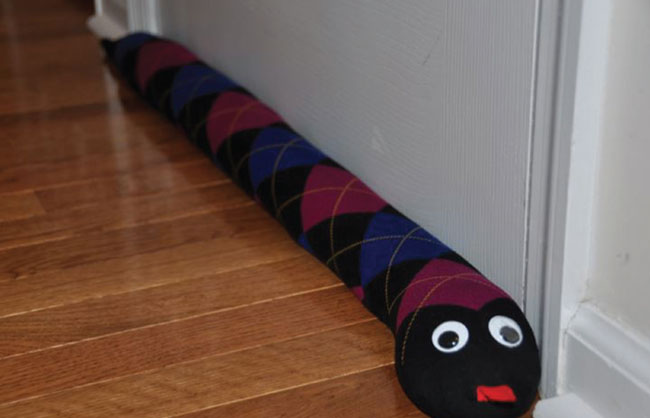
The draft snake is one of the easiest ways to stop cold air from infiltrating and will work where a weather strip would be difficult to install or not match the décor.

For those with a bit of sewing talent, they’re easy to make and could be a fun project with kids plus a good way to introduce the topic of saving energy.
Around pipes and wires
Use caulk or the canned spray foam insulation around building penetrations to help stop those tiny cold breezes. Wear old clothes, gloves and eye protection.
Around window- or wall-mounted air conditioners
Here’s a great place for either caulk or the spray foam insulation. An insulated wrap around the unit also will help keep drafts out.
Any opening from the outside through the exterior walls
Take a moment to seal with caulk or spray foam insulation to stop these tiny leaks.
Electrical receptacles/outlets/ switchplates
Because many of the outlets are near an outside wall, use specialty foam insulation backers to help keep cold air out.
Attic hatches
Since heat rises, it’s a good place to stop a big leak. Installing a foam backing and vinyl weather stripping will help seal the opening.
Baseboards
Use a candle (carefully) to find drafts around baseboards and use caulk to seal the space between the baseboard and the wall.
For the most part, these locations represent many small leaks, and added together, typically the energy auditor finds the equivalent of losing the same amount of heat as an open window.
We’re guessing most members wouldn’t leave a window open intentionally.
Platte-Clay Energy Audit
And last, but not least, get a Platte-Clay Electric Co-op energy audit for $50. The auditor finds these “energy opportunities” on just about every audit, so this is a good place to start and he can check your work.
The future of the electric utility industry
 First, we’re not making any predictions. Yogi Berra of the New York Yankees said it best, “It’s tough to make predictions, especially about the future.”
Your co-op is simply going to help members manage their energy, plan for what we know, plan to carefully manage our resources and plan to be adept as the industry changes.
And it is changing.
Because utilities are capital intensive and facilities have a long lifespan and a long payback of some 30 years, the industry tends to move cautiously and carefully plan for any long-term changes.
Those who see business publications may have read about “disruptive threats.” And while that makes for a scary headline, actually it’s just the gradual evolution of the industry, and as a progressive co-op, Platte-Clay is making changes now to accommodate the future.
Now, because of the way the co-op pays for wholesale power—based on demand—the co-op also will break out and bill members based on individual peak demand.
To a great extent, there will be little difference as we all have been paying for our collective peak demand over the years. The only change will be that beginning with the November bills, each member’s annual peak demand will be used and will be a new line item. For many there will be little effect; for others, it may be a gentle call to action to manage energy use.
For example, is it really necessary to plug in and use everything at once?
For some busy families, the answer will be yes; the same as the need for a large SUV to carry children and their friends, a gaggle of backpacks, sporting equipment and the pets all at the same time.
And just as SUVs cost more and use more gas per mile and are therefore more expensive than a compact car, we don’t think twice about miles-per-gallon cost comparisons between vehicles when we fill up. We do what works best for our family.
By breaking out demand—in essence separating the SUVs from the compact cars—your co-op will be billing all members more fairly.
Looking at the impact to the average Platte-Clay residential member for separating the demand component, we find the following:
Analyzing member bills for the change in monthly cost to each member, on the average, shows some bills may increase up to 4 percent, others may decrease up to 3 percent.
All of this being revenue neutral to Platte-Clay–meaning we will not bill or collect any more dollars in total as a result of this change.
Showing bills in three components, the customer charge, energy consumption and demand will help members understand and manage demand and give everyone our best opportunity to lower our monthly electric bill.
Educating members on demand and learning to manage it will help with overall co-op energy demand and individual member monthly bills.
While many families will simply turn off lights and other appliances when not in use, other members will integrate technology into their homes and manage demand with energy apps available through Google or the iTunes store.
Using technology to automate and manage energy and appliances is great for co-op members and is great for managing demand by determining the best time of the day or night to use appliances to minimize overall demand.
To get a start on managing demand and saving energy, we suggest going to www.energystar.gov and for those without Internet service, your co-op will have printed information available in the offices.
Energy Audit Program Update
MGE / Laclede opts out of Home Performance with Energy Star audit program
Platte-Clay program continues
Laclede Gas, formerly MGE in Kansas City, has terminated its joint programs with Platte-Clay Electric and KCP&L for energy audits effective March 1. The program provided an opportunity to receive up to $1200 in rebates for Platte-Clay members who also are Laclede natural gas customers.
Platte-Clay is continuing its decades-old energy audit program for co-op members.
The co-op energy audit is a $50 cost for a comprehensive audit and members can receive up to half of the cost of recommended energy efficiency improvements, up to $500.
The member must be at home and participate in the energy audit to learn about how to save energy.
Before scheduling an energy audit, members are requested to determine some basic characteristics of their home by completing the residential energy audit form, found on the web site, pcec.coop – Energy – Energy Services. Scroll down to the Energy Audit form link, print, complete and return.
For those without Internet service or a printer, please stop by or call the office and we’ll send a copy to you.
Board of Director Election Candidate deadline Feb. 18
Each year Platte-Clay members elect three members, one from each district, at the annual meeting, this year May 12, to serve as their representative. The term is for three years.
Members who wish to run for the Board of Directors must contact Angie Kinard (angiek@pcec.coop) or call the office, 816-628-3121 and speak with Ms. Kinard by February 18.
She’ll get prospective member’s information and share with the appropriate members of the Nominating Committee who will explain Board responsibilities.
Co-op members who miss the February 18 deadline may submit a petition at either office with 15 co-op member’s names by March 3 or may be nominated from the floor during the business meeting, May 12, 7 p.m.
The Northland Connection is published monthly by Platte-Clay Electric Cooperative, Inc., 1000 W. 92 Highway, Kearney, MO 64060. Postmaster: Please send address changes to: Northland Connection, PO Box 100, Kearney, MO 64060 or mail@pcec.coop.
Platte-Clay is an equal opportunity employer.