


January 2016 | Volume 78 | Issue 1
The survey says…your opinion counts
It’s not as much fun as a game show and you may get calls in the evening. But research and knowing how members feel about issues is important.
We hope you’ll answer your phone and talk to the individual conducting the every-three-year American Consumer Satisfaction Index (ACSI) survey.
Starting after the first of the year, Touchstone Energy’s survey company, Opinion Counts, will call Platte-Clay members to ask a variety of questions about your co-op’s operations.
Here are the basics and what you can expect.
Who will be calling?
The call center educates their employees to say they are calling on behalf of the local electric cooperative. They use the proper name of the cooperative. For example: “Good evening Mr/Ms___. I am calling on behalf of Platte-Clay Electric Cooperative.”
Where is the call center?
North Carolina
How long is the survey?
13 minutes
Why does the interviewe sound different?
The short answer is that most people in Missouri don’t sound like people who live in North Carolina.
Because of certain dialects, accents and phone service quality (cellular or landline), each call may have unique characteristics, common among telephone surveys.
Each survey team member at the call center has been instructed to speak clearly and slowly to ensure cooperative members understand them.
Periodic call audits will be conducted to address any issues that arise.
Why did they only ask me a few questions?
Because of the age stratification process, some age segments are complete with the exception of obtaining ACSI scores.
Some members may only be asked the five questions related to the score as well as their age range for verification purposes.
What time should I expect calls?
Most call centers operate weeknights from 5:00 p.m. to 9:00 p.m. and some calls will be made on Saturday between 10:00 a.m. and 5:00 p.m.
Why does Caller ID show Opinion Counts?
Most call centers that conduct telephone surveys set their outbound caller ID to identify their business type in order to reduce confusion from people who wish to return a phone call only to find out they cannot reach a person at the call center.
The call center area code will be also be displayed as “336.” Inbound calls to a call center are only accepted during regular business hours for business purposes and most surveys are conducted after regular business hours.
We hope you’ll participate in this important survey as it helps Platte-Clay improve customer service and helps identify any opportunities for improvements.
Managing Energy Our Resolution for 2016

Mike Torres
From the CEO
Every year about this time many of us take out a blank piece of paper or fire up one of our electronic devices and start to make a list of what we’d like to do in the New Year. Our 2016 New Year’s resolutions.
For this year, your co-op is making a New Year’s resolution: to help members manage energy.
This resolution has additional importance this year for two important reasons:
As we bring this year to a close, we are looking at a couple of changes that will affect all co-op members and make our billing fairer to everyone.
First, we will unbundle our rates and divide them into three components from the two that we now show on members’ bills. That will begin with next November’s bills. We’re telling you this now, as we’re announcing the billing change, along with a 4 percent rate increase, also to take effect next November, 2016 (October usage).
1. Customer charge
Right now we show the Customer Charge, what we generally think of as fixed costs. Fixed costs are the costs associated with the co-op such as depreciation, amortization, interest expense; or to make it simple, costs associated with the lines and poles that deliver electric service to the member.
2. Energy Reading and Usage
We also show the Energy Usage, how much energy in kilowatt hours (kWh) a member has consumed the past month. At present we show two energy usage components, one for the first 200 kWh and one for more than 200 kWh at differing rates. The first, and higher rate 200 kWh block will go away.
3. Demand Charge
New, beginning with the November 2016 billing, we’ll add a third component, demand.
We’ll take a look back over the past year to find the maximum rate at which each member has consumed energy. That’s demand. Demand charges will be based on the highest level of electricity supplied at one time during the year with members billed at their individual peak demand rate. Once demand is established, the cost for demand will remain the same for the year, when billing for 2017 will be adjusted, much like budget billing.
Why the Demand Charge is important
We’ll be showing individual member demand because that’s a key component in how Platte-Clay pays for its wholesale energy—the amount that must be available for all co-op members based on, in large part, the amount of co-op total peak demand.
For example:
Family 1 has four children, both parents work. When everyone gets home after work and school, they turn the heat up, they turn the lights on, they turn on all of the electronics including the TV, game systems, desktop and a laptop, put the washing in the laundry, put a load of clothes in the dryer and start preparing the evening meal. Just about everything that uses electric power is on. This family creates high demand; it is their family’s peak demand.
Note: this family could reduce their peak demand through meal planning, perhaps using something like a slow cooker and doing the laundry and the dishes later in the evening. Simply not using everything at one time. We’ll be working to explain peak demand to members over the next few months.
Compare Family 1 to a couple, Family 2. They both get home from work, turn on the TV to watch the evening news while they’re preparing the evening meal. Afterwards, she does some online shopping using the laptop and he watches ESPN to see the latest sports news. Their demand is significantly less: fewer plugs, less demand.
Platte-Clay pays for energy based on the co-op’s collective peak demand so it is simply fairer to members to base rates on the individual member’s peak demand. Technology now is available to do that.
Family 1 creates more demand than Family 2, and beginning in November they will be billed accordingly. In other words, Family 2 won’t be, in essence, subsidizing Family 1’s comparatively large demand. It is a fairer billing.
For most members, breaking out demand won’t make much difference, as it now is included in the Customer Charge and Energy Usage portions.
Another benefit of changing to the three charge components—Customer Charge, Energy Usage and Demand Charge, is that the co-op will combine all Energy Usage into one block, and the higher priced 200 kWh block no longer will exist.
The energy usage component will be less per kilowatt going forward, as demand will be broken out into a separate category.
We believe that showing members what their peak demand is will give them a better handle on managing their costs and help encourage reducing overall co-op peak demand, which in turn will help reduce Platte-Clay’s wholesale energy costs.
By identifying the actual costs, we can help members work on managing their true energy demand usage.
Rate Increase
The last co-op rate increase was in 2013 for 1.5 percent, and it now is time to adjust the rates to meet increasing costs. The rate increase will take effect based on October, 2016, usage and show on the November, 2016, bills.
We hope that 2016 will bring everyone a happy and prosperous New Year.
As always, if you have questions or concerns, please feel free to contact me.
visit pcec.coop forms and applications online
2016 Scholarship Form – for secondary education
Youth Tour essay contest deadline – Jan. 8 – info online
Focus Group application – for bright, engaged co-op members who want to know more about how a co-op operates and to share their thoughts, meets quarterly.
In Memoriam
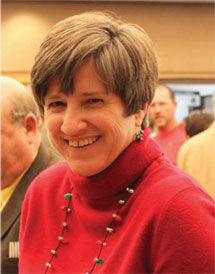 Sally McGinnis
We are sad to share that Sally McGinnis, 51, Platte- Clay’s manager of information technology, passed away Nov. 29, 2015, the result of a year-long struggle with cancer. She did not accept the doctors’ diagnosis that she had a short time to live and continued to work until the week before her passing.
That was in keeping with Sally’s sense of determination, a benefit for Platte-Clay and all co-op members.
She was on the employee teams that were responsible for most of the major, and challenging, infrastructure changes that have been made to integrate technology to improve efficiency and accuracy.
She was part of a transition team to new billing software, a major undertaking rolled out in 2009. The new software now allows the co-op to integrate multiple software platforms, increasing technology across many departments.
She was generous, sharing the harvest from her garden. She had a great sense of humor, which she attributed to her father, a ready smile and was devoted to her family.
Sally started with Platte-Clay in 1990 as an engineering coordinator, working in the then headquarters office in the Platte City office on Main Street. She moved to the new Kearney headquarters on Hwy. 92 when the building was completed in 1996.
Over time she took on additional duties with her final position responsible for evaluating and rolling out new software programs; introducing computers in all of the service vehicles in addition to the laptops, tablets, desktop computers, firewalls and multiple software programs used in a wide variety of applications.
In the spirit of the season, she was a gift to all of us and an inspiration for the New Year.
Proposed By-Law Change
Article IV-Directors,
Section 3(b)-Qualifications
(b) is in any way employed by an electric cooperative or has a financial interest in another electric cooperative, other than a current or past member, is in any way an employee, has ownership or has a financial interest in a competing enterprise or a business selling electric energy or supplies to the Cooperative, or a business primarily engaged in 1) selling electrical appliances 2) plumbing appliances 3) futures or 4) supplies to the members of the Cooperative; except where such ownership is in securities in widely-held corporations traded regularly in recognized security markets;
Proposed Revision
(change in bold italics underlined)
(b) is in any way employed by an electric cooperative or has a financial interest in another electric cooperative, other than a current or past member, is in any way an employee, has ownership or has a financial interest in a competing enterprise or a business selling electric energy, electric services or electric supplies to the Cooperative (in an amount in excess of $5,000 annually in the case of electric supplies), or a business primarily engaged in 1) selling electrical appliances 2) plumbing appliances 3) futures or 4) supplies to the members of the Cooperative; except where such ownership is in securities in widely-held corporations traded regularly in recognized security markets;
Proposed By-Law Addition
Article IV-Directors,
Section 9-Restrictions
For a period of seven (7) years after serving as a director of the Cooperative, no person shall be eligible to become or remain an employee or to hold any position of trust in the Cooperative. In addition, if a former director of the Cooperative becomes in any way an employee, has an ownership interest in or has a financial interest in an enterprise or a business selling products or services, the Cooperative shall not be allowed to do business with such enterprise or business in an amount in excess of $5,000 annually for a period of seven years after such former director’s service as a director of the Cooperative ended.
2016 Annual Meeting
Thursday evening, May 12
Kearney Office, 1000 W. State Route 92
Board of Director election – one from each District
By-Law changes for member approval
It will be here before we know it.
The 2016 Platte-Clay Electric Cooperative Annual Meeting. We’re sharing some dates to put on our new calendars.
Board of Director Election
Members who are considering running for the Board will need to get their names into Angie Kinard via e-mail, angiek@pcec.coop or call 628-3121 during regular business hours. She will give prospective Board members’ names to the Nominating Committee.
A member of the Nominating Committee will contact each interested member to review Board responsibilities.
Members who wish to run for the Board will need to get their names to Ms. Kinard by February 18.
Members who miss the deadline may be nominated from the floor during the business meeting.
Additional Solartech panels now available to co-op members
A year ago, the field on the west side of the Platte-Clay office looked just like the top photo below.
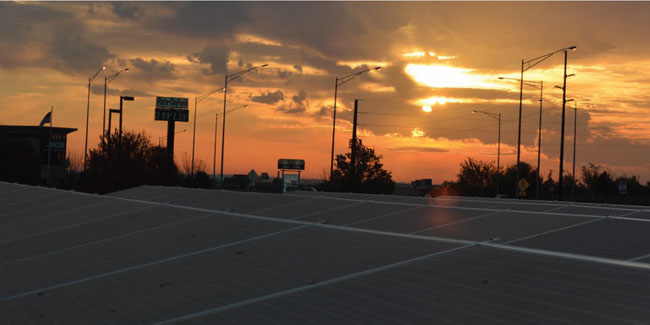
Today, the first community solar array in the State of Missouri looks like the lower photo and is producing solar power. The co-op now will open up the maximum number of panels available to members from five to just under a member’s normal consumption, which will vary by member.
It’s surprising how fast things in the electric industry can change. But major decisions, such as to explore renewable energy don’t come lightly.
The decision to build Solartech, the commercial name for your coop’s solar field, came after members said, in three surveys, that they were strongly interested in renewable energy.
Because of the initial response, the co-op limited the number of panels a member could lease to five.
After meeting with the Solar Committee and discussions with other interested members, the co-op now will lease more solar panels or sell solar energy from more panels. The only caveat is that it must be less than the normal consumption.
To lease a panel or to sign up for the output of solar panels, plese download the contracts available online, pcec.coop or stop by either office for a copy.
We’ll be glad to go over annual usage and determine the maximum number of panels.
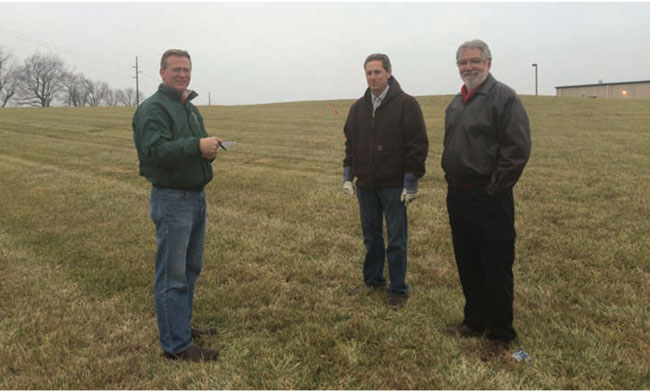
Platte-Clay managers look at the location for the pilot solar array to be constructed on the west side of the Kearney building. L-R, Ken Brown, Finance; Jared Wolters, Engineering and Mike Torres, CEO. Below, dawn at Platte-Clay. It’s a new day for the co-op in many ways, including providing solar energy for members.
Proposed By-Law Change
Article IV-Directors,
Section 4-Nominations
It shall be the duty of the Board of Directors to appoint, not less than thirty (30) days nor more than one-hundred twenty (120) days before the date of a meeting of the members at which directors are to be elected, a committee on nominations consisting of not less than five (5) nor more than eleven (11) members who shall be selected from different sections so as to ensure equitable representation. No active employee of any electric Cooperative may be a member of the nominating committee. No member of the nominating committee shall be a candidate for the office of director. The commit tee, keeping in mind the principle of geographical representation, shall prepare and post at the principal office of the Cooperative at least twenty days before the meeting a list of nominations for directors which may include a greater number of candidates than are to be elected. Any fifteen or more members acting together may make other nominations by petition not less than fifteen days prior to the meeting, and the Secretary shall post such nominations at the same place where the list of nominations made by the committee is posted. The Secretary shall mail with the notice of the meeting or separately, but at least seven days before the date of the meeting, a statement of the number of directors to be elected and the names and addresses of the candidates, specifying separately the nominations made by the committee on nominations and also the nominations made by petition, if any. The chairman shall invite additional nominations from the floor and nominations shall not be closed until at least one minute has passed during which no additional nomination has been made. No member may nominate more than one candidate. (Amended August 2, 2001)
Proposed Revision
(change in bold italics underlined)
It shall be the duty of the Board of Directors to appoint, not less than thirty (30) days nor more than one-hundred twenty (120) days before the date of a meeting of the members at which directors are to be elected, a committee on nominations consisting of not less than five (5) nor more than eleven (11) members who shall be selected from different sections so as to ensure equitable representation. No active employee of any electric Cooperative may be a member of the nominating committee. No member of the nominating committee shall be a candidate for the office of director. The commit tee, keeping in mind the principle of geographical representation, shall prepare and post at the principal office of the Cooperative at least twenty days before the meeting a list of nominations for directors which may include a greater number of candidates than are to be elected. Any fifteen or more members acting together may make other nominations by petition not less than seventy (70) days prior to the meeting, and the Secretary shall post such nominations at the same place where the list of nominations made by the committee is posted. The Secretary shall mail with the notice of the meeting or separately, but at least seven days before the date of the meeting, a statement of the number of directors to be elected and the names and addresses of the candidates, specifying separately the nominations made by the committee on nominations and also the nominations made by petition, if any. The chairman shall invite additional nominations from the floor and nominations shall not be closed until at least one minute has passed during which no additional nomination has been made. No member may nominate more than one candidate.
The Northland Connection is published monthly by Platte-Clay Electric Cooperative, Inc., 1000 W. 92 Highway, Kearney, MO 64060. Postmaster: Please send address changes to: Northland Connection, PO Box 100, Kearney, MO 64060 or mail@pcec.coop.
Platte-Clay is an equal opportunity employer.