


October 2015 | Volume 77 | Issue 10
Celebrating solar during Co-op Month

1. Breaking ground for Solartech, the first co-op community solar array in Missouri. L-R: Barry Hart, CEO, Assoc. of Missouri Electric Co-ops; Dennis Fulk, then president, Platte-Clay Board of Directors; Mike Torres, CEO, Platte-Clay; Dave McDowell, CEO, N.W. Electric Co-op; and Dave Ramsey, Energy Efficiency Manager, Associated Electric Co-op.

2. Solartech panels.
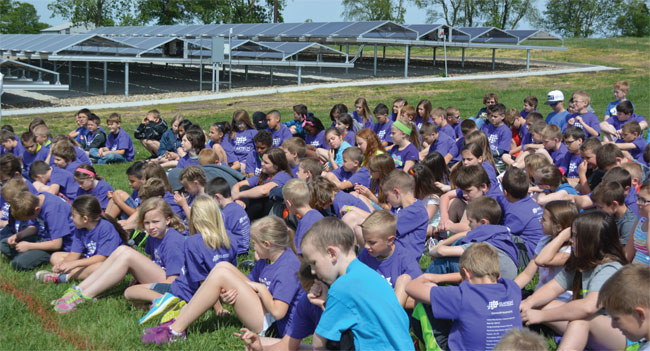
3. Hawthorne Elementary students were among the first visitors to learn about solar energy. They all left with Solartech t-shirts and information on solar energy.
Celebrating Co-op Month

Mike Torres
From the CEO
Your co-op began operations in 1938, when a group of area citizens decided it would make sense to have electricity in the Northland. So they established a rural electric cooperative and built the lines that deliver our power each day.
We understand from interviewing members who remember when they first got electric service that their families celebrated.
And we’re still celebrating in 2015: October is National Co-op Month. For a reasonably quiet and steady business, there’s a lot to celebrate.
Let’s start with how technology helps with member service. Your co-op is available 24 x 7 x 365 via its web site, pcec.coop, in addition to the round-the-clock member service representatives who answer the phone providing assistance.
Technology also allows your co-op to be more efficient: in 1997, Platte-Clay had 76 employees and 14,780 power locations, or meters.
By comparison, in 2015, your co-op now has 23,285 power locations, or meters, and using technology, 82 employees. Keeping expenses down is another reason to celebrate.
The Take Control Save program gives members tips on how to save energy, a cause for celebration each month.
And co-op membership has value: in 2014, your co-op returned $1.7 million to Platte-Clay members in cash, definitely a boost to our local economy.
And yet another reason to celebrate membership in a rural electric cooperative is that members have a say in co-op management via the Board of Directors and as always with a co-op, we ask what you think, or “surveys.”
In fact, it is because of the overwhelming response to three surveys that your co-op built the first community solar array in Missouri, and one of the first 100 in the U.S., another cause for a celebration.
So please consider this a personal invitation to stop by the co-op on Fridays during October for light refreshments as we celebrate National Cooperative Month. And to tell us what you’re thinking.
As always, if you have questions or concerns, please let me know.
Missouri solar power

Get a solar power purchase agreement with Platte-Clay and enjoy clean Missouri sunshine produced at your co-op for around $3 more a month. Call 628-3121 or visit pcec.coop for community solar information.
Budget billing helps busy families
The kids are in school, most supplies bought, schedules are settling down but, sigh, winter is just around the corner.
And with winter comes additional expenses, including Thanksgiving, the holidays and the increased cost of lighting and heating.
Your co-op sees the highest bills during the hottest and coldest months of the year–and the coldest months are in front of us.
Budget billing allows members to pay the same amount each month, based on the previous year’s energy use. A member must be in good standing and have lived in the same location for a year.
Putting budget billing on auto pay helps even more–the account is paid in a timely manner–members select the day of the month– and it’s one less thing to worry about.
For those taking care of a family member, it’s a great way to help them manage their expenses.
Members who use a credit card that offers refunds on purchases find that paying with that credit card has other budget benefits.
The co-op account is trued up each year and the amount paid adjusted to reflect increased or decreased usage. The co-op member is responsible for all charges when the account is trued up if service is discontinued.
To set up budget billing, e-mail memberservice@pcec.coop or call the office, 628-3121.
Electricity can be pretty scary

It’s the time of the year when, in addition to goblins and ghosts, we’re thinking about preparing our home for winter.
Leaves have started to fall and the stubborn ones will continue to fall through winter.
And we all know that keeping our gutters clear is important for our home.
So there are those among us who will get out the ladder, the leaf blower and other tools of choice to get the leaves out of the gutter so Fall rains can drain freely.
There’s a good reason we all get that tiny feeling of fear when we start to climb the ladder, and it shouldn’t only be the height of our roof and worries about falling.
It should be that little warning going off in our head about the possibility of getting electrocuted.
So before dragging the ladder out, check to see where the lines are coming in the house.
Anything touching a line can be energized.
In other words, anything touching an energized electrical line can conduct electricity. And that can kill.
Storms and summer tree growth may have created dangers that weren’t there last spring.
So always look up to find out where the lines are coming into the home. And if the lines are touching branches, the home or gutter, put the ladder away and call Platte-Clay.
Oh, the lines are buried at your home? Even more reason to be cautious, since we can’t see underground. Then it’s important to call 811, or 1-800-Dig-Rite — 1-800-344-7483. The Missouri One Call System also has online ticketing available; visit https://www.mo1call.com/
The Missouri law requires anyone digging call for locates. The utilities with facilities in the area will be out to mark where their underground lines run with bright colored flags.
The best idea is to plant or dig elsewhere to avoid any possibility of danger.
Remember, we want to be safe, not scared.
Always call before you dig.

1-800-344-7483
It’s the law. And it could save your life.
Planting trees? Plant away from the electric lines.
Member Viewpoint

Member Viewpoint is an opportunity for co-op members to share their thoughts on a variety of topics. To submit a Member Viewpoint, go to pcec.coop click on News – top tab and enter your Member Viewpoint.
Other Member Viewpoints appear on your co-op web site.
Member Viewpoint is for Platte-Clay Electric Cooperative members. We hope you’ll take a few minutes to share your comments and thoughts on issues that are important to you with your friends and neighbors.
Light up your students and goblins
We have it on good authority that the days are going to get shorter and with that in mind, we’d like to suggest that families “light up” with reflective gear so drivers can see kids waiting for the bus, bikers and walkers.
Reflective clothing is available at many hardware, big box and sporting goods stores, as well as via online merchandisers.
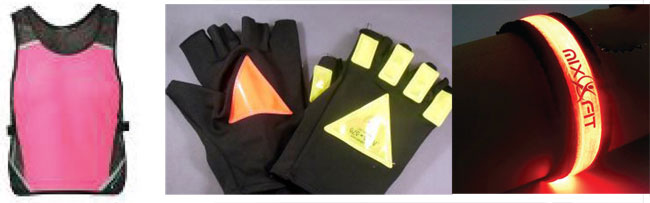
Above Left, reflective vests come in a variety of colors, including pink. Above middle, reflective gloves help outline students, walkers and on Oct. 31, trick or treaters. Above right, light and easy-to-use reflective wristbands are good for anyone who is out in the dark.
The 7 Cooperative Principles
1.) Voluntary and Open Membership
Cooperatives are voluntary organizations, open to all persons able to use their services and willing to accept the responsibilities of membership, without gender, social, racial, political or religious discrimination.
2.) Democratic Member Control
Cooperatives are democratic organizations controlled by their members, who actively participate in setting policies and making decisions. The electric representatives are accountable to the membership. In primary cooperatives, members have equal voting rights or are otherwise organized in a democratic manner.
3.) Members’ Economic Participation
Members contribute equitably to, and democratically control, the capital of their cooperative. At least part of that capital is usually the common property of the cooperative. Members usually receive limited compensation, if any, on capital subscribed as a condition of membership.
4.) Autonomy and Independence
Cooperatives are autonomous, self-help organizations controlled by their members. If they enter into agreements with other organizations, including governments, or raise capital from external sources, they do so on terms that ensure democratic control by their members and maintain their cooperative autonomy.
5.) Education, Training and Information
Cooperatives provide education and training for their members, elected representatives, manager and employees so they can contribute effectively to the development of their cooperative. They inform the general public, particularly young people and opinion leaders, about the nature and benefits of cooperation.
6.) Cooperation among Cooperatives
Cooperatives serve their members most effectively and strengthen the cooperative movement by working together through local, national, regional and international structures.
7.) Concern for Community
While focusing on member needs, cooperatives work for the sustainable development of their communities through policies accepted by their members.

There’s no better time than now for students to work on two projects that bring great rewards.
Seniors
Seniors – start your scholarship application. Platte-Clay will award three $1,000 scholarships, one for each District. The application is online at pcec.coop
The scholarship will be paid to your school. Scholarship applications are due Monday, Jan. 18, Martin Luther King Day.
Juniors and Sophomores
Juniors and Sophomores – write a 600-750 word (max) essay or produce a video on “What do you think the greatest energy issue is facing your generation and how can youth be a part of the solution?”
The video should be 2-3 minutes long and may be .mov, .wmv, .mp4 or .mpeg, limited to 1 GB. We’ll take a look at the videos on YouTube.
Platte-Clay could be one of the first steps in a video career and we’d really enjoy helping you launch it.
So start writing, start developing a script and start showcasing our local talent. We’d love to send you to Washington, D.C., for a week with other bright and talented students. The Youth Tour deadline is January 25.
Of the six finalists, sophomores and juniors, two will be sent to Washington, D.C., in June 10-16 and four can attend an award-winning leadership conference in Jefferson City, July 20-22.
Students will be notified of the results in late February.
Free graduate degree credits for teachers
Rural electric cooperatives are a pretty interesting bunch.
They understand that electricity can be complicated, safety is paramount and understanding how a rural electric co-op works may not be common knowledge.
So the cooperatives decided to offer to take one teacher per co-op to the University of Missouri at Columbia to learn about the industry and about how Missouri’s power is generated.
Teachers who participate will receive one graduate credit, with the course, stay and meals funded by the Missouri cooperatives.
Dr. Schumacher, professor and chair of the Agricultural Systems Management school, offered a second credit for teachers who complete a Special Problem.
There is no charge for the second credit project.
The fast-paced one-and-a-half day class, held Aug. 4-5 includes a a power plant tour.
Details will be in the Northland Connection and mailed to schools when available, early 2016.
The Northland Connection is published monthly by Platte-Clay Electric Cooperative, Inc., 1000 W. 92 Highway, Kearney, MO 64060. Postmaster: Please send address changes to: Northland Connection, PO Box 100, Kearney, MO 64060 or mail@pcec.coop.
Platte-Clay is an equal opportunity employer.