


September 2015 | Volume 77 | Issue 9
Community solar – it’s solar for everyone
The most important thing that all co-op members need to know is that a community solar array makes it possible for all co-op members to be involved with renewable energy.
In fact, this community solar array is one of the first 100 in the United States. Tip of the hat to Platte-Clay members who asked for renewable energy in three, count ‘em three surveys.
Community solar makes it easy, with contracts on the web site, pcec.coop.
It doesn’t take a lot of money and it doesn’t change the looks of your home, business or lawn.
Community solar is the great equalizer, and Platte-Clay is providing it for co-op members.
Your kids want to have solar energy — here’s their opportunity and your opportunity to share their interest in renewables for as little as $2.50 more a month.
Your church or school wants to participate in renewable energy — get community solar.
Your spouse likes the idea of renewable energy, doesn’t like the idea of solar panels on the roof.
Get community solar.
Platte-Clay has made it easy for all members to participate, at any financial level.
There are two options, and there are advantages to both.
But first, we need to say that solar energy will cost a little more than traditional power.
Even though sunshine is free, the solar panels aren’t and there are still some operating costs involved.
Option 1
Sign up for the output of up to five solar panels. Each panel is projected to produce about 525 kWh of energy a year, which will cost around $2.50 a month per panel. In addition, the Option 1 member will pay for all other energy consumed, in other words, the “regular” electric power used. The amount of solar energy generated will be determined each month and billed accordingly, a cost estimated at $2.50 per panel added to your bill.
Option 2
Members may enter into a long-term, but flexible, 25-year lease. Members will pay $815 per panel, up to a maximum of five leased panels. The energy cost from the leased panels will be zero each month, locking in no-cost energy, which will offset some of the “regular” energy consumed, (billed at $.10 per kWh) thus reducing the monthly bill by the amount of solar energy produced.
These solar members pay a modest charge for solar array maintenance and general distribution, which will be itemized on the leased solar members’ bill at 6.07 cents per kWh.
All solar members will be billed with the first of the month billing cycle as output is based on total monthly solar production.
Members as consultants

Mike Torres
From the CEO
At a rural electric co-op, it’s important to give strong consideration to what members have to say and to respond accordingly. Your co-op has done that in a number of ways, working to improve member satisfaction and to dovetail that with reliable electric service.
It’s always good to learn how other businesses operate, and we were pleased to find out that Platte-Clay fits right in with the other successful organizations.
McKinsey & Company, a global consulting company, advises top management on making good decisions.
We were struck by one of their studies recently released.
As part of the work the consulting firm does, McKinsey surveyed more than 2,500 managers working in more than 300 companies across the globe. In their report, the “Eight Essentials of Innovation,” they said that well-established companies find it difficult to be innovative.
McKinsey also found eight innovation drivers, which it says an organization needs: aspire, choose, discover, evolve, accelerate, scale, extend and mobilize.
We think that through member feedback and surveys, Platte-Clay has put these innovation techniques in practice at your co-op.
The community solar array is a good example of using the innovation drivers McKinsey reported.
Another example is the commitment to reducing the time of outages by being proactive. In a way, it’s basic problem-solving combined with meeting members’ needs.
So, with a nod to September and thinking that even at 77 years old, we’re never too old to learn.
Keep the comments and communication coming.
As always, if you have questions or concerns, please feel free to contact me.
Is your sophomore or junior high student smart? Likes to travel? Keep reading.
Sophomores and juniors can participate in the 2015 Youth Tour video and essay contest. The theme this year is “The greatest energy issue facing my generation and how youth can be a part of the solution.”
So, almost Twitter-like, here’s what will get Platte-Clay students a trip to Washington, D.C., or to an award-winning Leadership Conference that will liven up your college applications.
Who?
Platte-Clay Electric Cooperative, along with other rural electric cooperatives throughout Missouri and the U.S. participate in Youth Tour.
What?
Produce a video or write an essay on “The greatest energy issue facing my generation and how youth can be a part of the solution.” Don’t panic. The Department of Energy, the Solar Energy Industries Assoc., and every company that has anything to do with energy has a web site and a trade association.
When?
Don’t panic, but also don’t wait until the last minute(s) which will be Friday, Jan. 8. Finals will be held in February; that date will be decided in December or January included in the Northland Connection, on the co-op’s Facebook page and sent to instructors. A panel of judges will select the finishing order.
Where?
Students in area schools or home schooled working at the sophomore or junior level may participate. It’s best for Youth Tour to be a class project, however we understand the pressures on teachers.
Why?
Platte-Clay feels it’s important students have a chance to learn about both energy and rural electric cooperatives.
The trip to Washington, D.C., is an opportunity to see national heritage sites; the trip to Jefferson City for CYCLE, the Cooperative Youth Conference and Leadership Experience, teaches leadership skills students can use the rest of their life.
How?
We’ll judge the videos and essays during January. The top six students will be invited to Platte-Clay, along with their parents and siblings and any close relatives and friends, for a light dinner and to watch the finalists present their material in February.
Back to school safety tips for students and drivers
School buses – for drivers
It’s simple.
Flashing yellow lights means that the bus is preparing to stop and load or unload children.
Drivers should prepare to stop at least a car length behind the school bus.
Flashing red lights and the extended stop arms indicate the bus has stopped and that children will be getting on or off.
Drivers must stop and wait until the red lights stop flashing, the extended stop arm is withdrawn and the school bus begins moving.
School buses – for students
The National Highway Traffic Safety Administration (NHTSA) has these school bus safety rules for students.
Get to the bus stop at least 5 minutes ahead of the time the bus is scheduled to arrive.
- Don’t get on the bus until the driver says it’s safe to do so.
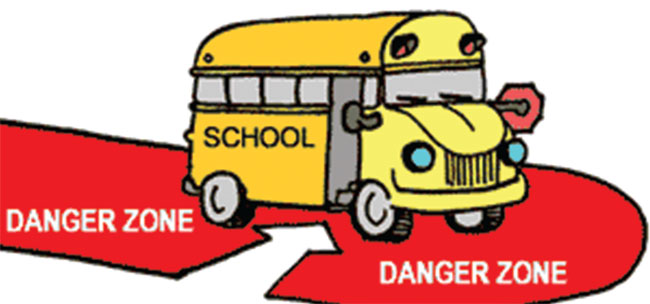
- Stay out of the Danger Zone – see illustration, above, courtesy of the California Department of Education’s Office of Transportation.
- Ask the driver for help when a student drops something while getting on or off the bus.
- Once on the bus, go directly to your seat and sit down, facing the front of the bus.
- Look for cars before walking away from the bus or crossing the street.
- Don’t wait at the bus stop alone.
- Use the handrails when getting on and off the bus.
- No eating, drinking, smoking or gum on the bus.
- No glass, aerosol products, flammable or controlled substances, laser pointers or sharp objects.
- Be polite and speak quietly.
- Keep your hands and feet to yourself.
- If you miss the bus, don’t run after it. Put the family or neighborhood back up plan into motion to get to school.
Riding bicycles
Although our Northland roads are pretty good, although narrow, sadly sidewalks are lacking and young students who want to ride their bike to school need to take additional precautions as they’ll be sharing the roads with motorized vehicles.
Bike equipment basics
Let’s start with bicycle equipment. Bicycles should have mirrors so the rider can see what’s coming up behind them.
Students should ride with helmets: since we only have one head, let’s give it some extra protection. Plus wearing a helmet could be the difference between life and death.
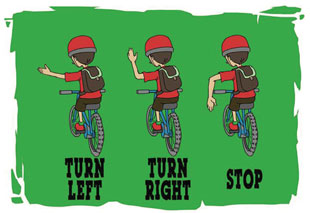
Bicyclists must travel in the same direction and follow the same rules as vehicles: stopping at stop signs and stop lights, signaling turns, using lights in the rain, at dusk, dawn and night for additional visibility. To help with bicycle visibility, mini flasher lights are available, as are LED arm and ankle light bands.
The well-dressed bicyclist will wear reflective clothing in bright Dayglow colors at all times. The yellow and lime green highway workers’ color is especially visible.
Other ways to make bike riders more visible is to use reflective gear, such a belt, arm or ankle bands. Reflective tape is available to personalize bike helmets and backpacks in addition to making the rider more visible.
While black is a “cool” color, it, along with brown, blue and gray, are hard to see after dark and on cloudy, rainy or snowy days. Backpacks and outerwear should be reflective, and if Dayglow orange doesn’t seem stylish, clip-on flashing lights or harnesses can make up for it.
Of all of this, the most important thing to remember is that it’s difficult to see a bicycle (or motorcycle) since drivers are accustomed to looking for cars and trucks. Let’s help everyone stay safe.
For shopping, most sporting goods stores and bicycle shops carry some if not all of these products.
Driving tips
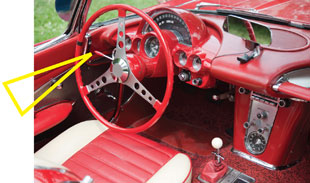
Turn signals haven’t changed much over the years, as shown in this vintage Corvette dashboard picture. The trick is to get each generation to embrace signaling.
In general, driving is much like having good manners. We signal turns so other drivers can drive accordingly—slowing down, for instance, when the car in front signals that it’s turning.
And for the car turning, the thought process should be something along the lines of: I am going to turn at the next street. Turn on the turn signal to indicate left or right turn. Apply brakes to slow to a safe speed to make the turn and to alert the driver in the car behind that we’ll be slowing down. Make the turn. Check to make sure the turn signal went off or turn it off.
Continue.
While that’s common sense for most older drivers, teens, many of whom haven’t had the benefit of driver’s education, may have picked up some less than desirable driving habits from the adults around them.
And along those lines: We’d like to see vehicles move to the right lane on four-lane highways so vehicles driving faster can pass.
Who cares if they’re speeding? It’s their ticket to pay.
We’d like to see drivers signaling intent to change lanes.
We’d like all drivers to remember that cars in the roundabouts have the right away. The bright red and white triangle signs that say “Yield” means exactly that. The slow-moving cars negotiating the roundabout need to be able to trust that the other drivers will slow and stop if necessary to allow them to continue.
We’d like tailgating to be an activity at the stadium, not on the roads because drivers following too closely might not be able to stop in time.
And there are other factors that make tailgating a bad idea. The road conditions—slick or wet—don’t provide a good braking surface. The driver in front may have defective or no brake lights.
In other words, we should never trust other drivers and drive as if our life depends on it. Because our family and friends are counting on us.
pcec.coop outage map works 24 x 7 x 365

Above, screen shot of the Platte-Clay outage map; information is updated every 15 minutes. The map, which shows on all devices, presents the same information that is available to co-op dispatchers and member service representatives. To report an outage, call 628-3121 24 x 7.
The web site works day and night for co-op members.
One of the best features is the outage map, which shows any outages and the estimated, when known, time of restoration.
The drop-down box, shown covering a portion of the map area at left, provides additional details about any outages.
Starting at the top, a time stamp gives the date and time of the last update.
Next, total outages, customers affected, customers restored, customers out now, customers called–to make certain that the power did come back on for all members, and the number of members called during the last hour.
Then the customers out by Zip Code, helpful to those who aren’t at home.
The map key shows the number of co-op families without power on the map in the area of the outage.
When possible, crews will call in and provide the estimated time of restoration, answering the one question almost all members without service have: “When will my power be back on?”
In short, the web site outage map answers just about all of the questions a member has.
And for those who want to know why there’s an outage: usually lightning, wind, trees or tree limbs, or someone failed to call Missouri One Call and cut a line and didn’t use safe construction practices.
Call before you dig – 1-800-DIG-RITE or 811

Member Viewpoint

Member Viewpoint is an opportunity for co-op members to share their thoughts on a variety of topics. To submit a Member Viewpoint, go to pcec.coop click on News – top tab and enter your Member Viewpoint.
Other Member Viewpoints appear on your co-op web site.
Member Viewpoint is for Platte-Clay Electric Cooperative members. We hope you’ll take a few minutes to share your comments and thoughts on issues that are important to you with your friends and neighbors.
The Northland Connection is published monthly by Platte-Clay Electric Cooperative, Inc., 1000 W. 92 Highway, Kearney, MO 64060. Postmaster: Please send address changes to: Northland Connection, PO Box 100, Kearney, MO 64060 or mail@pcec.coop.
Platte-Clay is an equal opportunity employer.