


February 2015 | Volume 77 | Issue 2
February is American Heart Month

February is a month for red—for Valentine’s Day, and we’ll be seeing hearts everywhere.
It’s also a month to think about heart disease and how it affects women.
There’s no shortage of awareness about men and heart attacks; it’s even a short cut to getting rid of male characters in movies and on TV, we understand it immediately when a man keels over grasping his chest.
So now is the perfect time to take stock of our health and to review some startling statistics.
- Cardiovascular disease (CVD) is the leading cause of death for American women, responsible for one in three female deaths in the U.S.
- More women than men die of cardiovascular disease each year.
- 26 percent of women older than 45 and 19 percent of men older than 45 will die within one year of a first recognized heart attack.
- 64 percent of women and 50 percent of men who die suddenly from coronary heart disease (CHD) had no previous symptoms of the disease.
- 42.9 million women are living with some form of cardiovascular disease.
- 6.6 million women are currently living with coronary heart disease.
- 2.6 million women have a history of heart attack.
- 4.1 million women will suffer angina, or chest pain.
Because of a lack of resources for women who had suffered a heart attack, three women who survived one started WomenHeart in 1999.
The women found there was little information for them, that heart disease was commonly misdiagnosed and that heart disease in women seemed invisible in the health care community.
Because of their pioneering efforts, that’s changed. Now Mayo Clinic trains volunteers who can help other women who have suffered a heart attack, serving as WomenHeart Champions.
Today the 35,000-member organization serves 42 million American women living with or at risk of heart disease.
The support organization starts at the hospital with a hand-knitted red scarf, called a HeartScarf, and a small bag, called the Red Bag of Courage, with information on how to cope after a heart attack.
Knitters who are interested in the program can contact WomenHeart at www.womenheart.org
The group lobbies for an increase in public health campaigns to educate all women about their risk of heart disease, the signs and symptoms of heart disease, the need for treatment and ways to prevent heart disease and to improve the quality of life for women living with heart disease.
Since some 40 percent of U.S. households are headed by women or a woman is the primary breadwinner, it’s important to have women on the job.
The group focuses on prevention and early detection, accurate diagnosis, proper treatment and quality healthcare.
For more information, visit the web site, www.womenheart.org
These are exciting times

Mike Torres
From the CEO
Most people don’t associate a utility with “excitement,” but that’s exactly what’s happening at Platte-Clay these days.
After three surveys that showed a majority of co-op members support and want to be a part of renewable energy, your co-op is building a solar system. It will be constructed just west of the Kearney office building on the ridge facing Hwy. 92.
These solar systems have a variety of names, but the most common is garden solar system or community solar system. For Platte-Clay members, perhaps Co-op Member Solar System is a better name. Interested members will be able to contract to buy solar energy from the solar system.
Right now, it’s a work in progress and we’re sorting out the details, and there are many. For one thing, this will be the first co-op-owned solar system in the State of Missouri.
Since we’re plowing new ground—starting with our power producer and ending with interested co-op members, and everyone and everything in between, we’re sorting out any number of issues. We want to get this right from the start. The numbers, the forms, the contracts, the renewable energy credits (RECs).
I want to personally thank those members who indicated on their survey that they are interested in being a part of the Solar Committee.
We anticipate meeting every other month with a couple of general meetings for the membership interested in the co-op solar project.
A letter and a committee form is being sent out and from the members who return it, we’ll select a group of members who represent the co-op’s demographics—male and female and a variety of ages. We look forward to hearing from you.
As always, if you have questions or concerns, please feel free to contact me.
Youth Tour
Thanks to the parents, teachers and home school students who sent in essays on “What do you think the greatest energy issue is facing your generation and how can youth be a part of the solution?”
We’re very proud of the work the students have done and will let everyone know the top six students who will represent Platte-Clay in Washington, D.C., and in Jefferson City next summer.
Solar and renewable energy on our minds
It’s no wonder that Platte-Clay members are interested in solar and renewable energy.
In Missouri, the two largest investor-owned utilities, KCP&L and Ameren, were required by the Public Service Commission to provide a portion of their power mix from renewables.
As a result, many homeowners and especially businesses, found a great opportunity to install solar systems at steeply-discounted prices.
At other customers’ expense–as all customers will pay to make up for their “revenue loss” with an additional cost on their bills.
By contrast, Platte-Clay’s pilot community solar system will be available only to co-op members who are interested in being a part of producing and using renewable energy.
It’s a difference in the mindset of a cooperative and how it operates–for the benefit of its members as opposed to the benefits and guaranteed income benefiting shareholders.
Platte-Clay members to elect three Board members at annual meeting May 7
Each year at the annual meeting, co-op members elect three members, one from each District, to the Board of Directors.
This year the annual meeting is Thursday, May 7, and will be held at the co-op office, 1000 W. Hwy. 92, Kearney, just west of the I-35 and Hwy. 92 intersection.
Your co-op has three Directors, who are co-op members, representing each District serving a three-year term.
Every year, one of the Directors is up for re-election.
This gives all members from all Districts an opportunity to run for the Board or to re-elect current Board members.
This year the candidates for re-election are Kendall Davis, South District; Dennis Fulk, West District; and Theresa Wren, North District.
The Platte-Clay Districts are North, Caldwell, Clinton and DeKalb Counties; South, Clay and Ray Counties; and West, Buchanan and Platte Counties.
If you’re interested in running for the Board, please contact Ms. Angie Kinard, 628-3121 or via e-mail, angiek@pcec.coop
Ms. Kinard will get in touch with the Nominating Committee and a member who represents your District will be in touch.
To allow time for an interview and to go over Board responsibilities, please contact Ms. Kinard by March 2, as the Nominating Committee will meet March 10.
Only co-op members may serve on the Board, and there are a few considerations.
Interested candidates will need to complete a biographical sketch, which will be included in co-op publications so members can review the candidates’ qualifications before making a voting decision.
Board member qualifications, guidelines

Apply by March 2
Platte-Clay’s Bylaws outline the criteria for co-op members who would like to serve on the Board.
The complete Bylaws text is on the co-op web site, pcec.coop in the About Us section.
The general guidelines are:
- Must be a member and a bona fide resident in the area served by Platte-Clay.
- Cannot be employed by an electric cooperative or have a financial interest in another electric cooperative, other than a current or past member.
- Cannot be an employee, have ownership or a financial interest in a competing enterprise or business selling electric energy or supplies to Platte-Clay or a business primarily engaged in selling electric or plumbing appliances, futures or supplies to the co-op, except for securities in widely-held corporations traded regularly on recognized security markets.
- Cannot be an incumbent or candidate for an elective public office that pays more than $100 per year.
- Cannot be an active employee of an electric co-op or have been a Platte-Clay employee in the past seven years.
- Cannot have been convicted of a felony or entered a plea of nolo contendere in connection with a felony charge or indictment.
The complete Board qualifications and restrictions are part of the co-op Bylaws. To review the information, visit the co-op web site, pcec.coop in the About Us section.
If you have questions about qualifications, please contact Ms. Kinard, angiek@pcec.coop or call 628-3121 during regular business hours.
Home sweet home

The Great Recession did a number on the housing industry and homeowners and finally we now are starting to see a light at the end of the tunnel. And we’re pretty sure it’s growth in the housing industry, one of the U.S. economic drivers.
Some of the housing industry experts are saying that characteristics of new homes will include:
- The average new single-family home will be smaller and have more “green” features
- The most common green features will include low-e windows, to provide more R value and engineered wood products
- There won’t be a “living room” proper, rather it will be merged with other spaces, perhaps a great room, perhaps a more open floor plan
- Homebuyers will see double sinks, recessed lighting and in-kitchen dining
- Builders said there will be more homes constructed with universal access features–so we can age in place without, as we get older, needing to remodel our homes for a walker or wheel chair.
Houzz, an Internet-based member site with photos of home designs recommends laundry rooms with pet-friendly designs that would also work well with small muddy children, cubbies for storage, drying racks, large, practical farmhouse-style sinks and pull out ironing boards that store away.
Builders are talking about Costco-sized storage areas in the garage, kitchen and master suites, in addition to walk-in closets in each bedroom.
Some of us, however, are quite content with where we live. We like our neighbors, we like access to the many stores and services locally and within a few minutes driving time.
Remodel rather than buy?
And then the discussion can turn to remodeling.
Everyone’s got a “top” list, and these keep appearing in any number of recommendations.
One of the most important seems to be universal design, making the home accessible as we age in place, or find ourselves on crutches, using a walker or in a wheel chair while we mend.
Some people are turning to quartz counters, rather than granite, as it’s less expensive, comes in many colors and is durable.
Energy efficient appliances are important and go right along with opening up the kitchen to the living room, blending spaces, a reasonably new home feature.
And then there’s the great outdoors.
The outdoor fire pit. An outdoor dining area on a nice deck. A lighted path leading to a quiet bench where you can watch the sun rise or set, the children’s play area. A new bird feeder and a nearby electric waterer. Maybe a decorative screen around the patio. A pergola. A swimming pool.
So the first step, after this dreaming would be the Platte-Clay web site, pcec.coop
A bit strange, you might think, but it’s important to take into consideration where the electrical lines are and, if needed, where they will run. For instance, we don’t want to run the electric lines where they will be inaccessible.
The second step using the Internet will be pcec.coop – Services – Engineering Services – Construction Site Form.
Happy buying and building.
High bill complaint?
Members are calling in, concerned about the amount of energy used during the cold winter months.
Some are angry, some scared about how the cost of electric service will affect the rest of the budget, and some are just surprised at how much energy they used.
Part of the reason is that we have had some unusually cold weather this winter; November was six degrees below normal, but December was 3.5 degrees above normal, January started out 7 degrees below normal.
The combination of cold temperatures and wind makes it more difficult for our furnaces keep up, and drafts make us feel cold.
If there are any cracks or openings in a home—the most common problems found with a home energy audit—the cold will find its way in.
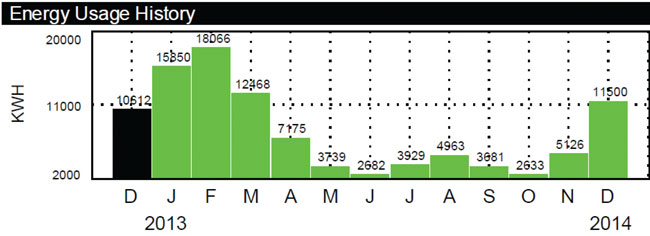
This is a Platte-Clay member’s actual usage. This member has called in for the last three years winters concerned about his bills and his energy consumption–which, in December at 11,500 kWh is much higher than the average of 1,473 kWh a month. An energy audit found he had considerable leakage–which requires weatherstripping, caulking and sealing, which hasn’t been done. We can see that his home still is leaking warm air in the winter and cool air in the summer, and that his usage is almost twice as much as the co-op member average even during the months with the lowest consumption.
Here’s where we can make some simple changes.
First, make certain that we’re dressing for the weather. If it’s cold, wear warmer clothes, don’t crank the thermostat up. Fleece, long underwear, socks. We’re not talking about a fashion show at home; we’re talking about how to save money and stay warm and comfortable in our homes.
For those who are not especially active, use a wool or fleece blanket to help keep in body heat. Sitting with a shawl, an afghan or wearing a quilted jacket or vest in the house makes sense. It’s less expensive to warm up an individual rather than trying to heat up an entire home.
At night, turn the heat down and the electric blanket on—about an hour or so before going to bed to allow it to warm up the bed.
A programmable thermostat is a real benefit during both winter and summer.
There’s no need to heat or cool an empty house while everyone is away at work or school. For those who are staying home, open the drapes to let the sun in to warm up the house and close them at night.
While we’re beginning to think spring, if summer is anything like this winter, we need to be thinking about what to do to keep our homes cool.
When the weather becomes favorable, it’s a good time to caulk and seal those air leaks.
Usually a home energy audit finds that most homes have enough air leaks equal to leaving a window open—and we’d never do that intentionally when the temperature is low and the wind chill making it feel even colder.
A sweater and some caulk can make a world of difference.

When building a house outside the Kansas City area, one concern was electricity.
Although Platte-Clay Electric Co-op is a little more expensive than KCPL, it has outstanding service and even more outstanding customer service.
Cost is always a factor and I hope Platte-Clay keeps costs down, but I just wanted to say great job!
Thanks.
– Tim Harris
Platte-Clay taking first steps to build pilot community solar array
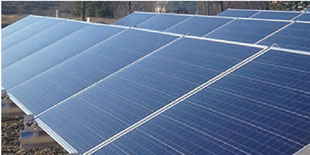
Platte-Clay line crews are doing soil tests for the pilot community solar array that will be located on the west side of the Kearney headquarters, just west of the I-35 – Hwy. 92 intersection.
The Kearney Planning and Zoning Commission has approved the project and the Kearney Board of Aldermen will make the final decision at the January meeting.
The soil tests are necessary to ensure the soil will hold the anchor bolts, which stabilize the solar panels.
To both help manage costs and gain experience with a solar array, Platte-Clay crews will install the 416 solar panels. The panels, which are approximately 78” x 30”, will be placed in a rectangle area 118’ by 102’.
Each panel will produce about 525 kWh a year.
Platte-Clay has contracted with Minneapolis, Minn.-based tenKsolar (correct spelling) which produces the solar panels at its Bloomington, Minn., factory, for the equipment.
Platte-Clay will break ground for the solar array in February and roll out the pilot solar system for co-op members at the May 7 annual meeting.
Once the system is up and running, the co-op will install a “dashboard” so members can see the co-op system’s solar output.
The Northland Connection is published monthly by Platte-Clay Electric Cooperative, Inc., 1000 W. 92 Highway, Kearney, MO 64060. Postmaster: Please send address changes to: Northland Connection, PO Box 100, Kearney, MO 64060 or mail@pcec.coop.
Platte-Clay is an equal opportunity employer.