


January 2015 | Volume 77 | Issue 1
For 2015: Save energy and save money
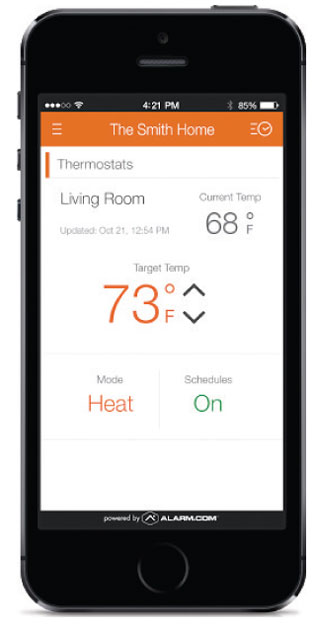
iPhone app allows us to control our thermostat from anywhere. Available through PCEC Security.
We all make them. In fact, the top New Year’s Resolutions could be put on T-shirts, coffee cups and bumper stickers:
- Save money
- Manage debt
- Lose weight / get fit
- Quit smoking
- Eat healthy food
- Volunteer to help others
- Get a better education / job
- Manage stress
- Reduce, reuse and recycle
Add a couple more and we’ve got a calendar going. So your co-op will try to help where we can and that will be to help save money, especially when it comes to energy.
That helps with the top two.
One of the easiest ways to save money and manage a budget is with levelized billing. That is, Platte- Clay figures the average amount of energy used over the course of a year, divides by 12 and bills members at that rate. For members without levelized billing, usage and expenses are higher during the coldest part of the winter and hottest times in the summer. Using levelized billing gives members a predictable cost each month. If the co-op member moves or must end the account, then they are charged for the actual amount of energy used consumed.
The bills are trued up each year; when the amount of energy used is more or less, the amount billed each month is adjusted. The other considerations are that the account must be current and the member must have lived in that specific location for a year.
Some members make it even easier and have that fixed amount taken from a checking or savings account. And for a gift, perhaps pay that amount for a friend or family member.
Members also can save by using a programmable thermostat, which can range in price from about $30 to $300 for a high-end unit, such as the alarm. com interactive thermostat available through PCEC Security.
Although easy to use, the techies in the crowd will appreciate the ability to set energy savings schedules based on the activity patterns in your home or on a set schedule.
The primary benefit of a programmable thermostat, simple or complicated, is setting the thermostat back and using less energy when we’re not home or when we’re asleep. No need to keep the heat at 72 or more when we’re not home.
It’s possible to save around 1 percent for each degree of the setback. So by setting a thermostat back 10 to 15 degrees for 8 hours, we can save 5 to 15 percent a year on our energy bill.
For the Platte-Clay member who uses the average of 1325 kWh a month, or $157.42 a month, at a savings of 10 percent drops the bill by $15 a month, or $180 a year. And there are many ways we could use that money.
Maybe meeting one of our New Year’s Resolutions of saving money or paying off another debt.
Get an energy audit. One of the great Platte-Clay benefits is that members can get a professional energy audit for only $50. And on top of that, your co-op will contribute up to 50 percent of the home improvements, up to $500. It just doesn’t get much easier when it comes to finding ways to reduce energy costs.
So we hope that Platte-Clay is helping members keep two of the standard resolutions: saving money and managing debt. Happy New Year.
2015: the year is off to an exciting start

Mike Torres
From the CEO
There aren’t many utilities as responsive as your rural electric cooperative is to co-op members and also responsive to how the industry is changing.
I’m proud to say that your co-op is very responsive on both fronts: it’s important to know how members feel about their electric service provider and important to plan for the future.
To quantify how members think and feel about issues, from customer service to renewable energy, your co-op routinely surveys members. It is one way, along with the Focus Group, Member Viewpoints, and new in 2015, the Solar Committee, that members can provide important feedback and share their ideas and concerns.
As a result of high member interest, your now is building a pilot community solar array for members who wish to use solar energy. More than half of the co-op members surveyed expressed support and interest for a community solar array.
The pilot project will provide important data for your co-op, co-op members and other Missouri cooperatives interested in exploring solar energy.
In a 2014 survey, electric industry executives said that coal power is being phased out; that electric sales growth is largely stagnant, an aging workforce is retiring and the old infrastructure is giving way to new.
Incidentally, the rural electric cooperatives have not found that to be the case.
Other predictions are that electric utilities will:
- Use more natural gas, as it is cleaner, plentiful and at today’s prices, a relatively cheap energy source.
- Use information technology so consumers can see and manage their energy consumption.
- See more solar installations.
- See more electric vehicles.
Your co-op is ahead of the game and already has embraced a number of what for them are predictions, for Platte-Clay, reality.
The pilot community solar project will come on line this spring and members will be able to buy solar energy produced in Kearney, Mo., on co-op land.
There is an electric vehicle charging station in Kearney.
Some of Platte-Clay’s energy comes from natural gas.
Members can review their daily energy usage online.
Programmable thermostats and energy-related apps on smart phones or computers allow members to control home electronics for convenience, safety and security.
Your co-op is involved in a line worker’s school at Metropolitan Community College.
And with the new pilot solar array, Platte-Clay will be among the first 100 co-ops in the U.S. to install a solar system and among the first in Missouri, along with the two other large investor-owned utilities.
So while some industry executives are crying the blues about what their future will bring, Platte-Clay is busy building the energy future for its members.
Happy New Year
As always, if you have questions or concerns, please feel free to contact me.
Industry Experts say housing market now is improving
According to the housing industry, it will continue improving in 2015. And knowing that the interest rates may begin a gentle, but upward climb may encourage families on the fence to start looking for their home or next home.
As far as energy goes, there are a few considerations for buyers in addition to the typical concerns.
One is to look at the amount of insulation. The more the better.
The R value is a measurement of how fast–or slow–the heat will escape out of our warm houses into the winter and how fast–or slow– the summer heat will get into our homes. The higher the R value the better.
If you’ve already got your heart set on a home, don’t panic.
A Platte-Clay energy audit can identify spots that can use more insulation and places to caulk and seal to keep out those annoying cold drafts that drive up the energy bill.
Another great resource is to check with Platte-Clay to see what the energy consumption has been over the years.
Children make a difference and a commitment to saving energy makes a difference, so while it’s not a foolproof way to estimate energy costs, it helps at least establish a general idea of how efficient both the house and the occupants are.
With the Remodeling Show coming up in February, it will be a good time to start thinking about how to make a home, present or future, more energy efficient.
Safety first. The password is…
Well, we know that our passwords shouldn’t be our children or any of our pets’ names as cute and memorable as they are.
That much everyone who is proudly carrying around a new tablet, laptop or smart phone probably understands.
But what a password should be to thwart hackers gets a bit more complicated.
Here are some tips from industry experts.
1. A word phrase using at least three words (no spaces) is better than a shorter password with letters and characters. Lifehacker, an Internet site that shares computer and Internet tips is a great resource and provided some of these suggestions.
2. Mix up numbers, uppercase letters and lowercase letters. Hackers’ software will be looking for a word, so a capital letter at the beginning will probably be followed by a vowel (a, e, I, o, u, sometimes y for those of us who don’t categorize our alphabet) so we’ll want to avoid that.
3. Make an acronym from a passphrase and change some of the letters to numbers that will be reasonably easy to remember. For example, “You Stay Out of My Account Bad Guys!” could become !yS00mab6, putting the punctuation at the beginning of the phrase, making the Y in you lower case, leaving the S an uppercase letter, changing the O and o of Out and of to zeros, using a lowercase b and changing the G in Guys to a 6, because a capital G looks a little like a 6.
The bottom line is to develop a strong password that we can remember but that is somewhat difficult to sort out, leaving out familiar names.
But trying to remember a lengthy, complex password, one for each of the sites we visit, such as shopping, e-mail, banking, Platte-Clay and other online bill payment sites, is enough to make our eyes roll.
Enter software to store our passwords, ranging in price from free to less than $50. PC Magazine recommends these password managers.
Their editors’ top three choices were LastPass 3.0, free; LastPass 3.0 Premium, $12.00; and Dashlane 3, for $29.99.
LastPass 3.0 Premium and Dashlane 3 work on the most common smart phones; LastPass 3.0 Premium also will work with a Blackberry.
The free version of LastPass doesn’t work with mobile devices, so it could be limiting for some households because of the number of smart phones and tablets now in use.
LastPass 3.0 Premium also supports Windows Mobile, Symbian S60 and HP WebOS, Dolphin Browser and Firefox OS and some editions of Chrome Portable and Firefox Portable.
What’s great about it: LastPass will log us in to secure sites and use auto-complete to fill out forms. Once it’s set up, go to LastPass, and simply click on the application. LastPass will show a window and offer to fill in our credentials.
What about our passwords like “Fluffy,” the name of our cat?
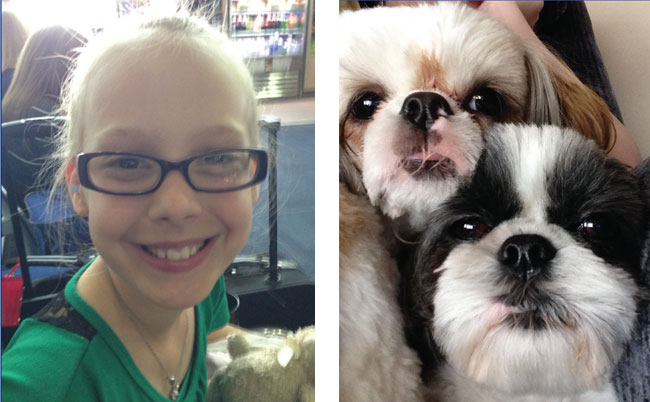
Who wouldn’t want to be reminded of Cheyenne, or Chloe or Carly above. Such sweet faces and personalities. Unfortunately using their names as passwords puts us in hacker land.
LastPass will let us know how strong our passwords are and suggest that we make it something stronger and more difficult if necessary since we’ll have a password manager to store our passwords.
For travelers, there are settings to limit the account to work only in specific countries, to automatically log off after so much idle time and to warn us about web sites that aren’t secure, or non-HTTPs.
Want a credit change alert? Even the free LastPass will provide that information.
Dashlane offers an important feature not available on LastPass: it will store emergency contacts who may need access to your online accounts. On the other hand, LastPass offers a Shared Family Folder for shared accounts, which could serve the same purpose.
It’s nice to have technology working for us once we set up the programs, and the editors who reviewed the software programs say that it’s easy. Or perhaps we can find a trusted teen to help out.
As with any purchase, we’ll want to make a selection based on our needs and wants.
So if Santa dropped off a new computer, laptop, tablet or smart phone, a password managing system could be one of the important pieces of software to add to it.

I have been a Platte-Clay member for over 38 years.
All of my contact with P.C.E.C. through the years has been nothing but professional.
Two years ago I purchased a new Freedom water heater from P.C.E.C.
After about 6 months or so my kitchen sink faucet aerator started clogging up with a jelly like substance.
I contacted P.C.E.C. and through conversations, I swapped out a aluminum anode rod for a magnesium anode rod in the water heater.
It’s been seven months and no more problems.
Also, no more jelly.
If you have similar problems as mine or any questions about water heaters I recommend you contact P.C.E.C. as they are very helpful.
Keep up the good work.
Thank you!
– Larry Ensign
visit pcec.coop forms and applications online
2015 Scholarship Form – for students of all ages
Focus Group application – for bright, engaged co-op members who want to know more about how a co-op operates and to share their thoughts, meets quarterly.
Solar Committee – for co-op members who are interested in learning more about solar in general and the PCEC pilot community solar project specifically, meets every other month.
Renewable energy survey: members support a pilot community solar project

Platte-Clay managers look at the location for the pilot solar array to be constructed on the west side of the Kearney building. L-R, Ken Brown, Finance; Jared Wolters, Engineering and Mike Torres, CEO.
The Solar Energy Industry Assoc. (SEIA) reported that in the third quarter of 2014 solar installations increased 41 percent over the same period in 2013, to 1,354 megawatts (MW), enough to power 3.5 million American homes.
SEIA says that at the end of the third quarter of 2014, nearly 600,000 homes are using solar and that sun power makes up 36 percent of the new electric generating capacity in the U.S. In other words, it’s not a passing fancy.
The Renewable Energy survey is still being tallied by the independent research firm as we go to press, but the survey company provided Platte- Clay with a snapshot of two important questions:
- Would you be interested in investing in a member-owned solar energy project?
The response: 51 percent of the members who responded said yes. Other members wanted more information, which will become available as the project moves forward.
- Would you support a Platte-Clay pilot community solar project?
The response: 67 percent of the members who responded support the pilot solar project.
The members have spoken.
As a result of the positive response for renewable energy in three surveys, your co-op will be one of the first in Missouri to establish a community solar array, and among the first 100 co-ops in the U.S. to build a community solar array.
Both Platte-Clay and our generation and transmission co-ops have taken the lead in introducing renewable energy in Missouri starting with a 20-year contract for the wind from Missouri’s first wind farms.
Now plans are underway to build a pilot community solar system on the west side of Platte-Clay’s Kearney headquarters.
We’ll be sharing additional information as it becomes available.
DIY renewables
PCEC connects members’ wind and solar systems to the grid
Currently there are about 25 co-op members with solar systems or solar and wind systems connected to our co-op’s lines.
It’s both good business and it’s part of Missouri law–the Net Metering Rules and Regulations.
Plus, interest in renewables and solar continues to grow as well as both commercial and residential installations throughout the U.S.
Generally the “barrier to entry” as it’s called in sales and marketing, is the upfront capital cost—a solar system that would provide almost all of the 1325 kW of energy an average Platte-Clay member uses would cost in the range of $40,000 to $50,000.
There’s a 30 percent tax credit, so that helps offset the cost. Another barrier to entry is the requirement for a good south – southwest facing area to take full advantage of the sun.
But for those members who can overcome those two hurdles and are thinking about installing their own solar array, the interconnection information is on the co-op web site, www. pcec.coop in the engineering services area.
Or you can be one of the pioneering members participating in Missouri’s first co-op’s solar arrays and let Platte-Clay do the heavy lifting.
Either way, you will be helping with renewable energy.
EPA Clean Air Regs bring challenges, opportunities
The only thing black and white, for sure, is a Holstein cow. And sometimes they are born brown and white, but this isn’t about genetics.

Holstein courtesy Shatto Milk Co.; solar system courtesy tenKsolar.
It’s about the U.S. energy policy and the opportunities to manage legacy power sources, such as the coal-fired power plants, in a way that meets clean air concerns and manages the cost of power. It’s about the opportunity to introduce ways of commercializing, monetizing, natural resources that peoples for thousands of years have been using.
Wind, to sail across the ocean.
Sunlight for light and heat.
But we need the ability to have heat and light all of the time, and that brings all of us to an important compromise.
With changing technology, now coal can be a reasonably clean power source. As with all industry improvements–from seat belts and air bags to content labeling on food to protect some of us from, say, peanut allergies–it hasn’t been without a fight. But as a result of those changes, we’re safer.
Both the economy and energy efficiency is playing a role in keeping energy demand relatively flat. Adding new energy sources, such as your co-op’s pilot solar system will help AECI, your co-op’s power provider, and Missouri meet clean air requirements as well as respond to high member interest and requests.
The Northland Connection is published monthly by Platte-Clay Electric Cooperative, Inc., 1000 W. 92 Highway, Kearney, MO 64060. Postmaster: Please send address changes to: Northland Connection, PO Box 100, Kearney, MO 64060 or mail@pcec.coop.
Platte-Clay is an equal opportunity employer.