


February 2014 | Volume 76 | Issue 2
Kearney’s WomanHeart Champion
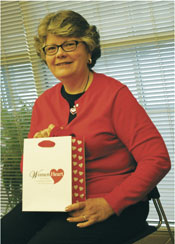
Velda McMorris
At a given point in their lives, women provide a welcome measure of certainty. They are the “been there, done that” women. Their children and spouses have given them a measure of patience that others just can’t appreciate; life experiences a depth of knowing. They bring a warmth they share with others, the knowledge of how to be encouraging, to be empathetic, to show care.
They are the women Helen Reddy and Ray Burton wrote about in their 1972 song, I Am Woman:
Oh, yes, I am wise
But it’s wisdom born of pain
Yes, I’ve paid the price
But look how much I gained
If I have to, I can do anything
I am strong
I am invincible
I am woman
The song could have been written for the volunteer women who work with WomenHeart, a support organization for women who have suffered a heart attack. Their purpose is to allay the fear and the sense of isolation a typical heart attack patient feels.
A national organization, WomanHeart volunteers visit survivors in their hospital rooms, providing support, encouragement and serving as inspiration for them.
WomenHeart volunteers listen to patient concerns and respond accordingly. They “have been there, done that” and they are on the other side of what it means to have suffered a heart attack—to have survived the leading cause of death for women.
Meet Kearney resident, heart attack survivor and now WomenHeart Champion Velda McMorris, pictured above. Trained by staff at Mayo Clinic, which makes her a “Champion,” she visits women in area hospitals, attends monthly support meetings and speaks about WomenHeart every chance she gets.
Velda’s story is similar to others who have had a heart attack. Her family has a history of heart disease; both grandfathers died from a heart attack in their 40s. She was overweight and not getting any exercise.
One Friday Velda wasn’t feeling well and called her doctor’s office. The nurse said that at 44, she was too young for a heart attack. But Velda was uncomfortable and wasn’t feeling well.
On Saturday, her husband became worried and took her to the emergency room at Liberty Hospital, which promptly sent her via ambulance to KU Medical Center. (This was before Liberty Hospital established its own cardiology department.)
She had been having a heart attack for nearly 12 hours; we’re lucky she’s still with us.
For many women, the first sign of heart disease is a heart attack, Velda says, and the woman dies.
Velda says that cardiac rehabilitation “saved my life.”
“All the stuff they tell you to do,” she said, “I do.”
As trained volunteers, WomenHeart Champions help heart attack victims understand the recovery of being “compliant patients” who follow their doctor’s orders.
 Volunteers take a WomanHeart bag filled with brochures produced by partner pharmaceutical companies with tips on moving to a healthy lifestyle and reducing the threat of another heart attack.
Plus a hand-made red scarf. Sometimes, Velda said, the best thing is a hug, and that’s where the Heart Scarves program comes into play.
A national program, area volunteers crochet or knit red scarves that are given to recovering heart attack patients. Invariably the patient pulls the scarf out of the WomenHeart bag and puts it on—because, many women have told Velda, the scarf feels like a hug. Velda noted that the local organization always can use red scarves.
Because two recent cardiac patients were from the area, Lawson and Excelsior Springs, one of Velda’s goals is to start a WomenHeart support group north of the river. The organization also will match survivors with WomenHeart “sisters.”
Women in rural areas face the dual challenge of time and distance. To help overcome that, online support includes the comprehensive web site, www.womenheart.org with links to other organizations and healthy lifestyle tips.
For those worried about their heart attack risk, there’s good news for women who need preventative care: the new health care law provides preventative care coverage and coverage for individuals with pre-existing conditions.
Individuals who don’t have health insurance can sign up at www.healthcare.gov
Those without Internet service may use computers at area libraries.
Today the substitute teacher is a picture of health, vibrant, engaged and available to speak to groups.
“I’ll come and speak to any group, any size,” said the heart warrior. “There are 42 million women living with heart disease or risk.
“We don’t take the place of medical people,” she continued, ”and when I speak, I tell them we can manage our risk factors with diet, exercise and medication.
In an interesting turn of events, the WomenHeart Champions now are getting referrals from doctors to help patients stay on course with their follow up recommendations.
“Women should not be afraid to seek treatment,” she said. “Heart disease can be managed and it’s possible to maintain normal work and leisure for most women.”
Risky business
Research shows that women tend to ignore heart attack signs and do not get medical attention.
The most common risk factors for men and women:
- 55 or older
- Family history of early heart disease
- High blood pressure
- High blood cholesterol
- Smoking
- Diabetes – about 75 percent of people with diabetes die from heart or blood vessel disease
- African American, Hispanic and Native American women
- Being overweight
- Being physically inactive
Happy Valentine’s Day
 From the CEO
It’s a great month for remembering a number of important events. We’ll remember two of our remarkable presidents, Washington, Feb. 22, and Lincoln, Feb. 12, who have been memorialized with a national holiday on the third Monday, this year Feb. 17.
We’ll take Valentine’s Day, Feb. 14, to tell friends and family members that we care about them. Statistics show that 73 percent of flowers, including the 196 million roses produced for the day, are bought by men. Women are out shopping too: they buy 85 percent of the 180 million Valentine’s Day cards exchanged for the romantic holiday.
And on another sweet note, we’ll share 58 million pounds of chocolate for the holiday.
In the spirit of giving, your co-op isn’t immune to remembering members at this time of the year either. Each year the co-op distributes capital credit checks at the annual meeting based on good business practices and the amount of power each member consumed.
The checks are given to those in attendance and then mailed to others.
Recently a list of members who could not be located appeared in the Northland editions of the Kansas City Star. (The list also appears on the co-op web site, pcec.coop) Sometimes we can’t locate members because they have moved out of the area and didn’t leave a forwarding address, sometimes it’s because his/her name has changed and any other number of reasons that between Platte-Clay and the Post Office, the member could not be located.
So if Cupid sends an arrow your way, please update your account, including all names responsible for both paying for electric service and receiving a capital credit check. And if you move, please let Platte- Clay know. Although there is no chocolate involved, a capital credit check is a welcome and sweet reminder that you really are an owner and you share in the profit for the last year.
As always, if you have questions or concerns, please feel free to contact me.
Moving? Name change?
Please share the information with your co-op.
Don’t forget that Platte-Clay will want to be in touch with you to send your capital credit checks in the future.
If you have changed your name and now have additional people responsible for your co-op account, please let us know so we can add them to your co-op records–or take them off if necessary.
Your co-op works for you
With luck the polar vortex will stay in the polar region and we won’t have to worry about it being as cold in Missouri as it was in Antarctica in January.
Unfortunately that brutal cold has played havoc with our energy bills.
There are a few easy ways to manage costs, and your co-op can help.
First, almost every energy audit shows that there are many little leaks where cold air in the winter and hot air in the summer comes in the house.
That makes it difficult for the furnace or even a toasty wood stove to keep up with cold sneaking in around and under doors, through the space where the rail of the lower windows meets the rail of the upper windows.
There are easy and inexpensive fixes. Use caulk or the spray insulating foam around openings. (Note: both are messy, so be prepared to wear old clothes, gloves and eye protection.) Put weatherstripping where windows meet each other and the casing.
An energy audit, best conducted when there’s mild weather, will help pinpoint other air leaks. The cost is $50 for co-op members, and Platte-Clay will help pick up the cost of improvements. Dual PCEC and MGE members may use an approved auditor and receive benefits from both utilities.
While it’s a little late for this winter, summer heat is around the corner and it’s just as expensive to chase the heat out as it was to chase the cold out this winter.
Universal Design benefits all ages
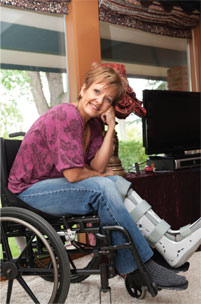 No one really wants to admit it, but at a certain age, and it varies for everyone, we notice that we’re slowing down a little.
The stairs make age a little more noticeable. Then the doc tells us to lose weight and that our cholesterol is too high. Our bones are breaking easier. There are more aches and pains.
In short, we’re getting older with all of the symptoms and concerns that come with an aging body.
One of the primary emotional concerns for older Americans is the ability to stay in our home. To be able to reach for our tools, cooking utensils and dishes without falling over. To safely get in and out of our bathtub.
To get in and out of our home without worrying about steps, and if necessary, to hop in on crutches or roll a walker or wheelchair through the door.
The best time to think about making those accommodations is before we need them.
An even better time is when young, able-bodied families are remodeling or building a new home.
Spring seems to bring out enthusiasm for swinging hammers, so here are some tips to make certain our homes will work for us.
The term “universal design,” means that what is built will work for everyone.
In fact, remodelers, designers and builders now are making homes accessible and more functional for everyone —including the young, the old and those with limited mobility. It’s a great sales pitch: no matter who lives in the home, it will work for them.
Let’s take a tour, starting with the entry. There should be at least one step-free entrance into the home that will allow everyone, including those using crutches, a wheelchair or walker, to enter easily.
Wide doorways and hallways—at least 36 inches wide allows us to move appliances and furniture in. Make the hallways 42 inches and no steps and everything can be moved around with virtually no difficulty. It’s a small thing, but something for your builder or remodeler to understand. We just don’t know when we’ll find ourselves learning to negotiate life in a wheelchair.
Lights switches and controls, including thermostats, need to be placed 42 to 48 inches above the floor, with electrical outlets 18 to 24 inches above the floor.
Handles and switches are fairly easy changes to make. Lever-style door handles and faucets and rocker light switches allows those with arthritic and otherwise compromised hand movement to take care of themselves.
If possible, having a bedroom, kitchen facilities and full bathroom with plenty of maneuvering space on one level is important, and can make the difference between a family member staying in the home and moving to an assisted living facility.
On to the bathroom, where we probably find more risk because of wet, slippery surfaces and the need to be able to safely sit and stand.
Fortunately there are great products to help us negotiate in that space.
To avoid an institutional look, place decorative, yet functional grab bars in the tub or shower area and next to the toilet. They will provide support to help people keep their balance and to easily sit and stand.
Looking at the new trends, now designers are making grab bars that match faucets and shower fixtures that will accommodate those who need assistance and not shriek “Institutional!” to the design minded among us.
Taller toilets, in the industry known as comfort height at 17 inches tall, make it easier to sit and stand. It’s also possible to put in a small platform to raise a standard height unit or find a seat that attaches if that’s more feasible while others may wish to install a wall-mounted fixture to get it positioned to just the right height.
To help with transferring in and out of the tub, experts suggest using a seat. Along the same lines, a flip up bench in the bath/shower unit allows individuals to enjoy a seated shower with less concern about losing their balance and falling.
If it looks like a major bath remodel is in order, a no-threshold shower in the space of a traditional bath tub is a great feature. It will be large enough to roll a wheel chair in and allow the resident to transfer to a bench and enjoy a shower. Plus, it will help little people enter the shower easily, and if any in the family manage to break a leg, they’ll find their daily ritual much easier.
The nice thing is that these features now are considered a new, trending benefit: many of the newest high end homes include these design details as upscale, but discreet details in the newest materials and colors.
Universal Design Safety Tips
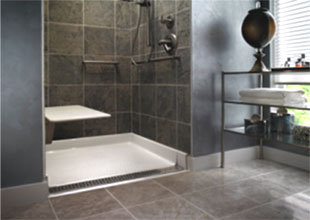
Above: stylish no threshold shower.
Use brighter light bulbs that don’t create excessive glare. New LED bulbs and compact fluorescent lights can provide more light at less cost than the inefficient incandescent bulbs.
Consider using illuminated light switches.
Have low wattage night lights that come on automatically when the room, hall or stairway is dark.
Have flashlights or other emergency lighting readily available and in easy-to-find places.
Install closet lights. Adjustable and pull-down rods will make it easy for everyone to get clothes off the hangers.
Place closet and other shelving at convenient heights.
Place handrails on both sides of all steps, inside and out.
Secure carpets and area rugs with double-sided tape or carpet mesh. And the fewer the rugs the better—they can be a tripping hazard and difficult to negotiate with a walker or wheelchair.
Use lever handles on doors and C or D-shaped handles for drawers and cabinet doors.
Missouri leads other states in lobbying database
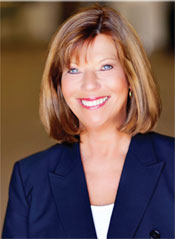
NRECA CEO Jo Ann Emerson
Former U.S. Rep Jo Ann Emerson and current NRECA CEO can be very proud of her home state: currently Missouri has more co-op members signed up to particpate in the national rapid response database than any other state.
At last count there were more than 50,000 Missouri co-op members in the 47 rural cooperatives who have allowed their names to be included in the sophisticated database and the national number was more than 100,000.
NRECA will use the names in the database to influence members of Congress on issues of concern.
In addition to distribution cooperatives’ efforts, the Association of Missouri Electric Co-ops, AMEC, is producing radio spots and billboards to reach the general public.
Locally, there is a billboard just north of Kearney, placed on the southbound side of I-35 which can be read by northbound vehicles. A second billboard is on I-29 near St. Joseph.
White River Valley Electric Cooperative, located in Branson, has produced a video. Associated Electric Cooperative, AECI, which provides power for Platte-Clay and other co-ops, is editing the video so local co-op managers, if they wish, can provide a local introduction and post on their web sites.
 In an effort to reach out to others in rural areas, the electric co-op organization will be working with FFA members and Ag teachers to help assist in the effort to stop the EPA’s regulations which will limit emissions for new U.S. coal-fired power plants.
Annual meeting, board election May 1
Platte-Clay’s 2014 annual meeting will be held on Thursday, May 1, at the Kearney office.
The theme for the 2014 annual meeting is “Your co-op, your community.”
Each year Platte-Clay elects three directors, one of the three representing each district. The rolling terms allow co-op members to maintain continuity and also for members who are interested in becoming more involved to run for the Board.
The co-op’s Nominating Committee will hold their organizing meeting in February and will go over Board requirements and responsibilities.
Members who are interested in running for the Board may contact Angie Bowers, angieb@pcec.coop who will contact the Nominating Committee member for that district.
For information on qualifications, please visit the co-op web site, www. pcec.coop Click on About, and in the drop-down box, click on Bylaws for complete information.
Sitting Board members who are up for election this year are Debi Stewart, North District; Gary Shanks, South District; and Jerry Hagg, West District.
The North District includes Caldwell, Clinton and DeKalb Counties; the South District includes Clay and Ray Counties and the West District includes Buchanan and Platte Counties. Directors must live in the District.
Classified Ads
To submit an ad, complete the ad form, use the website, www.pcec. coop, or send in a brief nine-word description of the item you wish to advertise no later than the 15th of the month, to Platte-Clay Electric Co-op, PO Box 100, Kearney, MO 64060, Attn. Northland Connection.
Ads run on a first come, first served basis.
Ads should be about 10 words or less and include a phone number. Please indicate the category, i.e., for sale, giveaway, wanted, and the topic, such as car or boat.
Please type or print your ad. If your ad does not appear, you may resubmit it for the next available edition. Ads are for Platte-Clay members only. No business or commercial ads. If your ad is time sensitive, we suggest using one of the local ad-supported publications.
Members may pick up an ad form at the PCEC office in Kearney or Platte City or use the website, pcec.coop. Click on Classified Ad or send directly to mail@pcec.coop.
The area code is 816 unless otherwise noted.
For Sale
Upright freezer: Kenmore, 5.1 cf. Exc. cond. $75. 630-3859.
Generator: WEN 5500, 5 hrs. use, $350 firm. 464-2759.
Dryer: Maytag 9000 series w/steam. 3 1/2 yrs old. $250. 415-3834.
Hay: Large bales, brome orchard grass. 809-5758.
SUV: ‘02 Isuzu Rodeo 4wd. 1 owner, exc cond. $3,900. 520-2903.
Furniture: Baby desk, sleep apnea machine, fax machine. 510-3095.
Treadmill: Weslo Cadence TS5, exc. cond. $100. 812-8777.
Dishwasher: Kenmore Elite, white, stainless steel tub. $300. 903-3274.
Pittsburg Paint: 3 gal. eggshell, Dresden Bay (blue), $70. New. 351-7274, no texts.
Piano: Spinet with bench, needs tuning. Great beginner piano. $135. 357-2160.
For Rent
Ocean view vacation condo, St. Croix, U.S. Virgin Islands. 415-4152
Hereford bull, 26 months. 809-5758.
Large house in Warrensburg. Avail mid Feb. 810-2919.
Services
Tree trimming & removal. Kearney, Holt, E.S., Lawson. 590-6977.
Pony rides for birthdays, special events. 763-1707.
I teach Chinese to children and adults in local library, $30-$45 an hour. 686-9638.
Carpet cleaning: 3 rooms, $90. 628-4801.
Bounce house: Castle Moonwalk, Rent for parties, add pizzazz to your events. 769-2931.
Platte-Clay tip: for faster service, put your member number and service address in your phone.
The Northland Connection is published monthly by Platte-Clay Electric Cooperative, Inc., 1000 W. 92 Highway, Kearney, MO 64060. Postmaster: Please send address changes to: Northland Connection, PO Box 100, Kearney, MO 64060 or mail@pcec.coop.
Platte-Clay is an equal opportunity employer.