


August 2018 | Volume 80 | Issue 8
Platte-Clay Turning 80

Strategic plans future proof the co-op system

Dave Deihl, General Manager
From the General Manager
We can thank Associated Electric Cooperative, Inc. (AECI), our power producer, for their commitment to reliable service in this hot weather. Platte-Clay never worried about having enough power for co-op members.
Because of their seasoned engineering group that plans for the times with unusually high demand, we’ve had enough power to keep our air conditioners humming when the temperature stayed between 90 and 100 degrees many days this summer.
Both AECI and N.W. Electric Co-op, our transmission co-op, build their systems based on worst-case scenarios: the more immediate, like an unusually hot summer or the challenges of uncertain and erratic growth.
Just as Platte-Clay goes through a strategic planning process, so do the other two tiers of the rural electric cooperative system to ensure, to the extent possible, the lights come on when we flip the switch.
One of the top ten points in the AECI long-term strategic plan is to “monitor potentially disruptive technologies.”
 On a practical level, that means that AECI produces enough power for the rural electric cooperatives, no matter the current external conditions, and that they continually monitor changing trends, future proofing our electric service.
For instance, today’s electric vehicles (EVs) with an extended mileage range meets the needs of rural co-op members who may drive 20 to 40 miles one-way to work. All EVs have a minimum range of at least 100 miles, most with a 200-350 mile range, giving drivers an easy electric-powered round trip. That puts co-op members back at home so their cars can charge overnight.
With all major car companies projecting at least a few electric models, planning to produce enough power is a changing dynamic.
Looking ahead at serving co-op members shows the possibility of eventually some 900,000 electric vehicles on the road, one for each Missouri co-op family that will require power. That means the time for AECI to plan for future needs is now.
Just as one-car garages seemed adequate for homes built until recently, many newer homes now are constructed with one charging station. Although one charging plug seems adequate today, looking ahead, it might not be unusual to find homes with two to four electric vehicles, depending on the number of drivers.
Fortunately, just as we didn’t give a second thought to the amount of power a second and a third computer would use, a second coffee pot, or the extra microwave, we won’t need to worry when we bring home that first electric vehicle. Nor the second.
Associated’s strategic planning includes “continuing to explore potential technology.”
And that will include anything we decide to bring home that uses electric power.
As always, if you have questions or concerns, please let me know.
Please e-mail generalmanager@pcec.coop
Takin’ care of co-op business
Platte-Clay relies on contractors to help maintain, build and upgrade the Platte-Clay system.
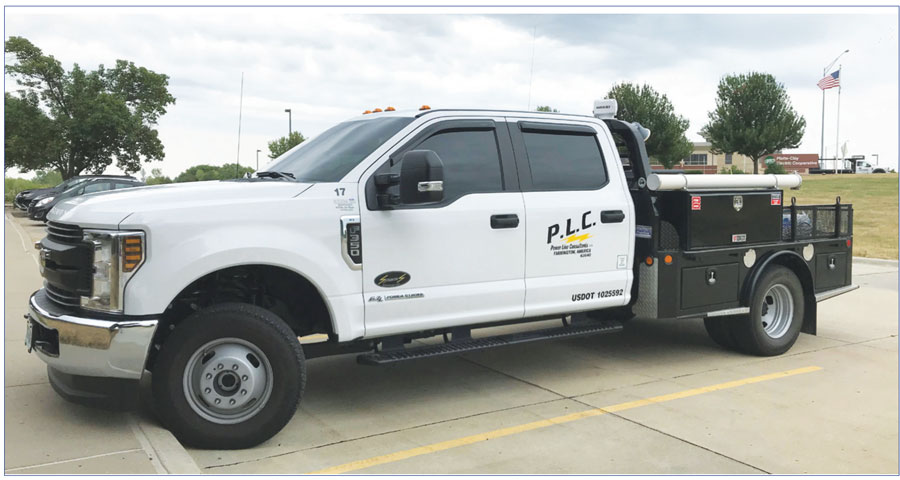
Because of increasing construction demands, as well as repairs for other co-ops that have sustained extensive weather-related damage, Platte-Clay has added P.L.C. (vehicle shown above) to assist the co-op. Members will be familiar with the two trucks below.

Platte-Clay’s long-time contractor R & M Pole Line Construction.

Sprague Excavating provides underground and directional boring services.
All have excellent credentials and workmanship and we are happy to have them working for Platte-Clay.
Proper planting helps keep the lights on
In spite of the hot, dry summer, we’re holding out hopes that we’ll get a break and can save some of our plants for next year and this fall replace those that didn’t survive the summer.
So now is the time to start doing research on what plants and trees can tolerate the hot weather and tolerate a dry summer.
We want to leave you with two important takeaways:
First, using plants that are native to the area are easier. They need less assistance and have evolved to tolerate our climate.
Second, plant in places that make sense.
For instance, don’t plant anything that’s going to interfere with the electric lines.
Even though you may be long gone from that home in five or ten years, the new occupants may not appreciate Platte-Clay crews cutting limbs, even trees at times, to keep them out of the electrical rights of way and more important, out of the electric lines.
This is important because trees in lines are the number one cause of outages and keeping trees out of electric lines is included in Missouri Statutes.
For those interested, the electrical space is protected by Missouri Revised Statutes, Chapter 537, Torts and Actions for Damages, Section 537.340.
For those who want the short version, this is it:
“Every electric supplier that operates electric transmission or distribution lines shall have the authority to maintain the same by trimming, removing and controlling trees and other vegetation posing a hazard to the continued safe and reliable operation thereof.”
The statutes say that Platte-Clay can cut or trim trees back 30’ from the centerline of electric lines and can take down any trees that could fall into the lines. The distance is farther away for higher voltage lines.
Platte-Clay trims trees by methodically working across all three Districts.
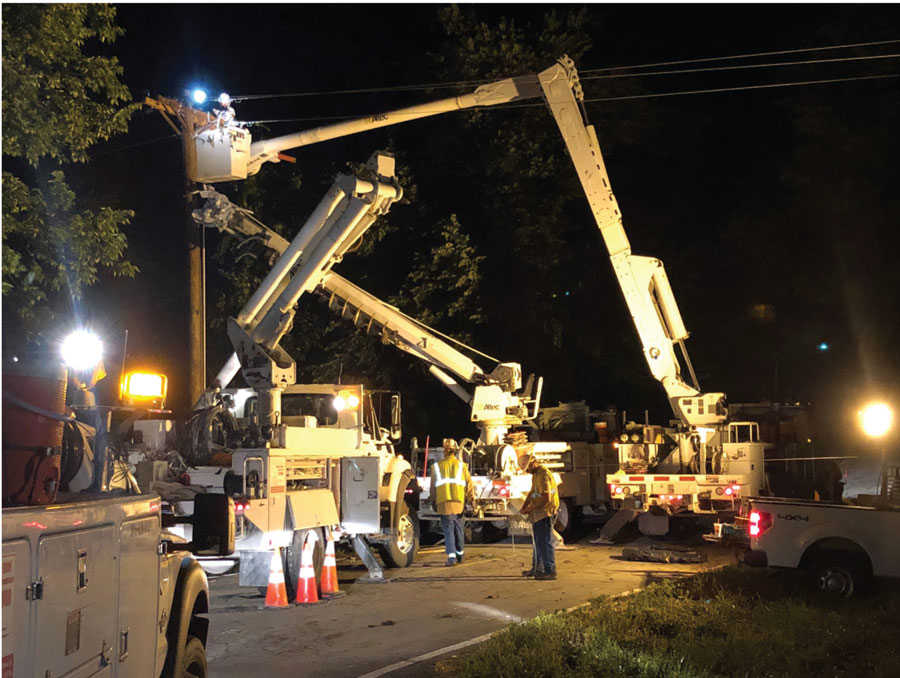
A large tree fell across the lines near Five Corners about 8:30 p.m. on June 20 putting nearly 400 members in the dark. A line crew of seven working with Northwest Tree Service, the co-op’s tree contractor, cut the tree out of the lines, replaced the pole and reattached the electric lines. Service was restored to all at 2:30 a.m.
By working in the daylight on a systematic tree and vegetation maintenance plan, the co-op saves money, reduces outages and crews are safer.
And that brings us back to co-op members understanding their part in system reliability.
It’s important that we do our homework and select and plant trees and shrubs and other vegetation, such as decorative grasses, that won’t come in contact with the electric lines or other equipment, such as ground-based transformers.
Generally speaking, most members aren’t overjoyed when a crew shows up with chain saws.
But we also won’t be happy next winter when branches, weighed down with ice get in the lines and cause an outage and we’re sitting in the cold and dark.
Most of us are familiar with the importance of calling before digging or planting (1-800-DIG-RITE) so we avoid underground electrical lines.
It’s just as important to look up for electrical lines and stay away from them too.
Hot June Weather
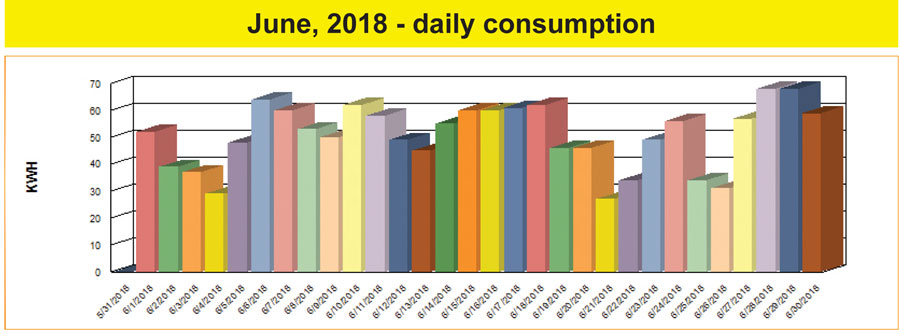
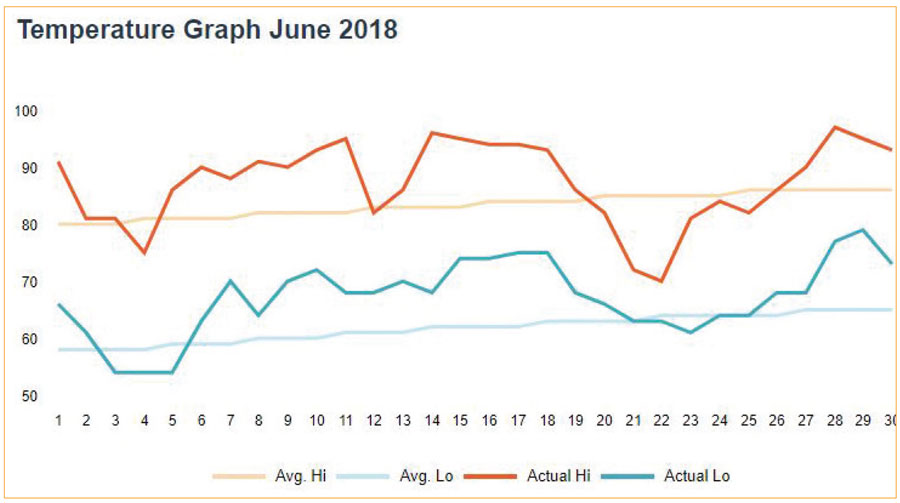
No real surprise here – June was hot–hotter than it’s been since 1934, during the Dust Bowl. See how the energy use tracks with the temperatures (below). Some members, because of the weather and billing date, may have bills that seem much higher than a neighbor’s. If you feel an energy audit would be helpful, please call the office, 628-3121 and we’ll send along a questionnaire and set up an appointment to review how to improve your home and save on energy bills. The energy audit is $50, which is returned when the recommended improvements are made, up to a maximum of $500.
Who doesn’t like free?
 Platte-Clay offers free consulting services when building or adding on to a structure within the service area. Free wiring information, free information on heating and cooling units (HVAC), free HVAC sizing, free home construction information, free lighting information, free security recommendations. Look for the HVAC and business lighting rebates at pcec.coop
Call 816-628-3121 to set an appointment to review everything from house plans to safe, worry-free landscaping.
Visit pcec.coop for the online version of Platte-Clay, follow us on Facebook for info and activities.
Good for members to know
 DIYers note: water heater installations must meet National Electrical & Plumbing Safety Code
First, put down the pipe wrench. Second, keep reading.
Platte-Clay and its contractor must enforce the National Electrical and Plumbing Safety Codes for all water heater installations performed by the co-op’s licensed technician.
When Platte-Clay performs an installation, the technician will inspect the water heater and associated plumbing and wiring to ensure it is up to date on all relevant safety codes.
The National Electrical & Plumbing Safety Code requires the following: installation of properly pressurized, sized thermal expansion tank; installation of a pressure-reducing valve (PRV); drain pan when tank is installed on upper floor of structure and 30 amp breaker with 10/2 gauge wire.
Tank manufacturers clearly state the warranty will be voided without this compliance. Platte-Clay will not install a water heater unless the facility meets all code criteria.
Platte-Clay renewable energy credit program
 When a member becomes part of the Platte-Clay renewable energy credit program, AECI, Platte-Clay’s power provider, assigns a Renewable Energy Credit (REC) based on the number of units purchased.
The cost is an additional .025 cents/kilowatt hour, or less than 3 cents a kWh on top of Platte-Clay’s inexpensive rates.
The process is reviewed by Associated’s internal and year-end financial audits.
Once those numbers are finalized, Platte-Clay provides an annual certificate showing the amount of clean energy attributed to each member.
The certificate is suitable for framing.
The Northland Connection is published monthly by Platte-Clay Electric Cooperative, Inc., 1000 W. 92 Highway, Kearney, MO 64060. Postmaster: Please send address changes to: Northland Connection, PO Box 100, Kearney, MO 64060 or mail@pcec.coop.
Platte-Clay is an equal opportunity employer.