


October 2018 | Volume 80 | Issue 10
National Co-op Month
Community engagement

Dave Deihl, General Manager
From the General Manager
One of Platte-Clay’s six strategic goals is to increase the co-op’s involvement with all communities within the service territory – an expanse from just west of Richmond to near Weston, from about 36 Highway on the north to just north of Liberty.
In fact, the strategic goal, developed with the co-op staff and Board is “create and execute a plan focused on increasing PCEC’s involvement with all communities within its service territory.”
And that’s a lot of territory, stretching across and touching seven counties, several chambers of commerce, any number of civic and charitable organizations, and most important, co-op members.
Because of the diversity of co-op members, we are pleased to help organizations that represent a variety of interests and that touch our communities.
As important as modest annual sponsorships is a new initiative, the Platte-Clay Employee Ambassador Program. Sometimes having volunteers to assist with an organization or an event is even better than dollars.
 The Ambassador Program supports the co-op’s commitment to community service, encouraging employees to work for nonprofit civic and charitable organizations.
The formal employee policy “supports and encourages employee volunteerism, involvement and participation in civic affairs, community organizations, charitable causes, educational programs and events that support community needs and enhance the quality of life in our local service area.”
Employees may volunteer up to 16 hours of normal working hours during a calendar year with time away approved by the supervisor.
Representative organizations qualifying for employee assistance include Adopt-A-Highway; American Red Cross Blood Drive; community band or choir; elderly, handicap or youth volunteers; Habitat for Humanity; hospice; local high school booster clubs; local chambers of commerce; local church volunteers; local community festivals, fairs, parades; local government board, commission member; mentoring programs; Rotary Club, Kiwanis Club, Lions Club, Masons; school volunteer, Special Olympics; sports association and youth coaching and other organizations that support and improve the quality of life in the co-op service area.
The employee community service initiative is another way your co-op works to improve the quality of life in the Northland and another reason to celebrate National Co-op Month.
We’ll be serving refreshments on Fridays in October, we hope you can stop by for a visit. And if you have questions or concerns, we’ll be glad to help.
As always, if you have questions or concerns, please let me know.
Please e-mail generalmanager@pcec.coop
It’s starting to get dark earlier, so it’s a good time to start wearing reflective clothing and to remember to watch for Trick or Treaters.
Youth Tour rocks DC
Here’s a great essay subject that’s absolutely current and (bonus!) you may get to drive or ride in an electric vehicle – What should the co-op’s role be in the future of electric vehicles?
Ladies and gentlemen: start your laptops.
The national statistics indicate that there are more electric vehicles being produced and being driven. Although Missouri isn’t exactly a hotbed of trendy products and services, we are seeing more electric vehicles (EVs) around. Tesla just built a new office. The electric-powered Bird scooters are popping up like electric dandelions in Kansas City.
So what should Platte-Clay be doing to foster electric vehicle growth? An EV probably will be good for the co-op, as it would be a steady charge overnight, and not put additional demand on the system, as most will be charged overnight.
Plugging in at an office or using a solar trickle charger could help with those who need to go more than 200 plus miles a day – or about half a tank for most gas-powered cars.
Here are a couple of tips:
https://www.dmv.org/mo-missouri/green-driver-state-incentives.php
https://www.dmv.org/buy-sell/new-cars/buying-an-electric-vehicle.php
https://eaa-1967.clubexpress.com/content.aspx?sl=969660557
https://insideevs.com/five-fastest-selling-used-cars-hybrid-electric/
https://newatlas.com/tag/electric+motorcycle/
We’re guessing that once students, and maybe parents, start reading about electric vehicles we may have more on Platte-Clay lines.
And once the essays are in, we’ll have a good perspective on how Platte-Clay can take the next step into the future with electric vehicles.
The Youth Tour essay rules are on the co-op web site, pcec.coop – in the Educational area and the deadline is Feb. 14 – because who wouldn’t love an expense-paid trip to Washington, D.C., June 14-20 or a trip to an award-winning leadership conference in Jefferson City July 17-19?
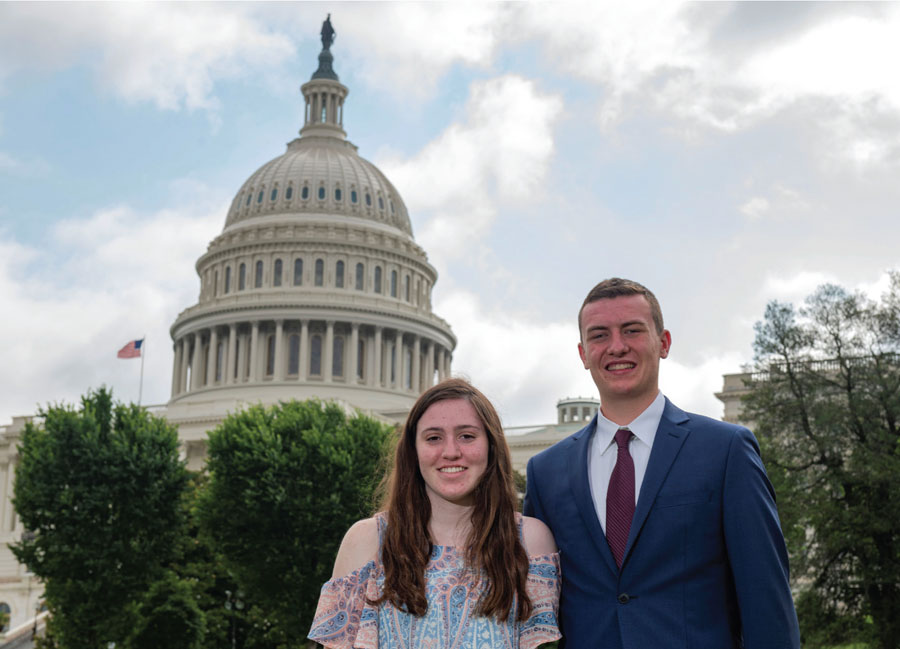
These North Platte High School students took top honors in the 2018 Youth Tour essay contest. L-R, Brianna Spiers and Truman Byergo. They were among 1,800 students who toured historic sites and museums in our nation’s capital.

2018 Chevy Bolt – EV. Photo courtesy Edmunds.com
Lineman’s Rodeo – focus on skills, safety
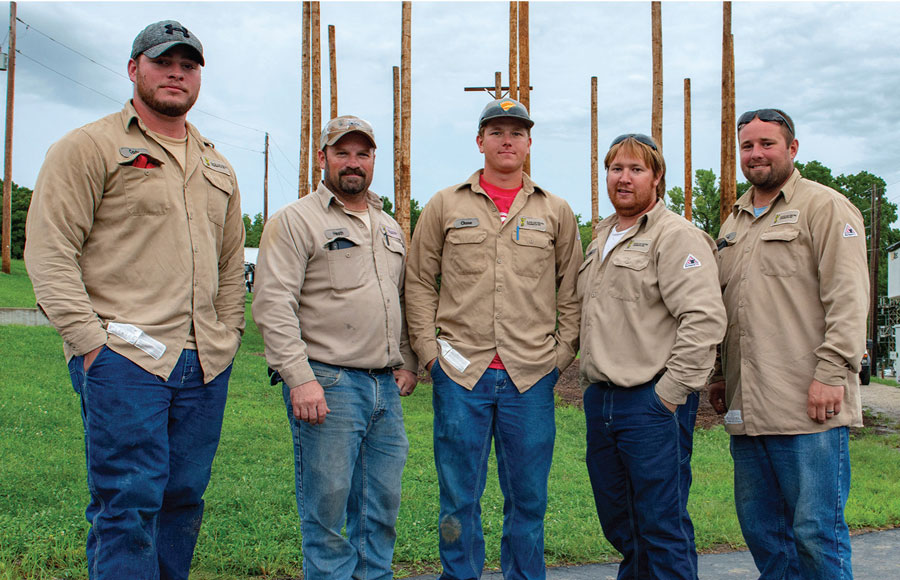
The A Team. L-R: Cody Sellers, Heath Buckler, Chase Tyne, Jake Rose and Brad Mick, who took third in the Journeyman Category, competed in Platte-Clay’s first Lineman’s Rodeo.

Chase Tyne changing out hardware. Dan Smithson, foreman, served as a judge.
7 Cooperative Principles
1. Voluntary and Open Membership — Cooperatives are voluntary organizations, open to all persons able to use their services and willing to accept the responsibilities of membership, without gender, social, racial, political, or religious discrimination.
2. Democratic Member Control — Cooperatives are democratic organizations controlled by their members, who actively participate in setting policies and making decisions. The elected representatives are accountable to the membership. In primary cooperatives, members have equal voting rights (one member, one vote) and cooperatives at other levels are organized in a democratic manner.
3. Members’ Economic Participation — Members contribute equitably to, and democratically control, the capital of their cooperative. At least part of that capital is usually the common property of the cooperative. Members usually receive limited compensation, if any, on capital subscribed as a condition of membership. Members allocate surpluses for any or all of the following purposes: developing the cooperative, possibly by setting up reserves, part of which at least would be indivisible; benefitting members in proportion to their transactions with the cooperative; and supporting other activities approved by the membership.
4. Autonomy and Independence — Cooperatives are autonomous, self-help organizations controlled by their members. If they enter into agreements with other organizations, including governments, or raise capital from external sources, they do so on terms that ensure democratic control by their members and maintain their cooperative autonomy.
5. Education, Training, and Information — Cooperatives provide education and training for their members, elected representatives, managers and employees so they can contribute effectively to the development of their cooperatives. They inform the general public, particularly young people and opinion leaders, about the nature and benefits of cooperation.
6. Cooperation Among Cooperatives — Cooperatives serve their members most effectively and strengthen the cooperative movement by working together through local, national, regional, and international structures.
7. Concern for Community — While focusing on member needs, cooperatives work for the sustainable development of their communities through policies accepted by their members.
Our first baby pictures

We were very happy to find several Monarch caterpillars “cats” in the Platte-Clay Monarch gardens.
Platte-Clay is within the Monarch flyway, in the U.S., basically I-35. It is the route trip between Mexico and Canada that Monarchs take each year, which adds to the importance of planting milkweed in our area and the likelihood that a mother Monarch will find the plant.
The co-op planted native plants and milkweed from nurseries that sell plants without neonicotnoids, a systemic pesticide found in many flowering plants that kills Monarchs and other pollinators.
Because milkweed is the only food Monarch caterpillars eat, the co-op established the gardens to provide safe habitat for them as part of its community activities.
Pesticides, vegetation practices that kills milkweed and weather anomolies have reduced Monarch and other pollinators’ habitat and as a result, population has dropped precipitously.
The co-op registered its gardens with Monarch Watch, a Lawrence, Kans.-based organization that helps schools, organizations and individuals learn about the Monarch migration and the challenges to the species.
 This generation of Monarchs will fly will fly 2,000 to 3,000 miles south to overwinter west of Mexico City. We’ll see Monarch migration through the area during October.
For more information, visit monarchwatch.org and monarchbutterflyusa.com
Who Powers You Contest

Please visit www.whopowersyou.com and follow the contest rules.
We encourage Platte-Clay members and organizations to enter – what could be better than being rewarded for your good work?
Prizes are first place, $5,000; second, $2,000; third, $1,500; and honorable mention, $500.
Every three years Platte-Clay participates in a member survey, called the American Consumer Satisfaction Index.
If you get a call or e-mail, please spend a few minutes with them – we use member feedback to improve operations.
Please call if you have questions – 628-3121, 24 x 7 x 365.
Monarch Butterfly Migration

Monarchs run a pesticide gauntlet through industrial agriculture areas on their migration route, which reduces the population. Individual gardens and beneficial state DOT policies can help increase pollinator habitat.
Also heading south is long-time Communications Director Cheryl Barnes who is “graduating” from Platte-Clay, others call it retiring, to work on community activities. She lives in Kansas City.
The Northland Connection is published monthly by Platte-Clay Electric Cooperative, Inc., 1000 W. 92 Highway, Kearney, MO 64060. Postmaster: Please send address changes to: Northland Connection, PO Box 100, Kearney, MO 64060 or mail@pcec.coop.
Platte-Clay is an equal opportunity employer.