




Your Feedback Helps Light the Way
 This fall, our cooperative will once again be participating in a national customer satisfaction survey, and your voice could play a vital role in shaping our future.
Not every member will receive the survey, as it is sent to a statistically significant and diverse group selected at random. But if it happens to land in your inbox, I strongly encourage you to take a few moments to complete it. Your feedback helps guide important decisions and keeps our co-op moving in the right direction.
We take member satisfaction seriously. In fact, it’s at the heart of everything we do. We’ve worked hard to build one of the top performing cooperatives in the country, and the survey gives us a clear view of how we’re doing. In our last survey conducted in 2024, we were proud to earn an 86 on the American Customer Satisfaction Index (ACSI). That score placed us among the highest-performing co-ops, both in our state and across the nation.
Of course, the survey is just one tool we use to understand our members’ needs and priorities. Throughout the year, we also gather input through focus groups, community engagement and events. This fall, we’ll be hosting several member appreciation gatherings. These events are a great opportunity for you to visit with our leadership team and board of directors. If you see one in your area, we’d love to see you there.
Every two years, our co-op holds a strategic planning session with the board and leadership team. This year’s session is coming up in August, and we’ll be diving into the most recent survey results, along with insights from employees and board members. It’s part of a larger effort we began in 2017 when I became general manager—to establish clearly defined goals, revisit them regularly, and ensure everyone is pulling in the same direction. Strategic planning used to be more informal, but now it’s structured, intentional and includes the voices of members like you.
When I reflect on my 30-year career with the co-op, I’m amazed by how much things have changed. In my early days, it wasn’t uncommon to receive member feedback through a postcard. We would even get mail letting us know about a member’s outage — hoping we could come by when we had time to fix it. Outages were often much longer then, too. Today, thanks to advanced technology and modern infrastructure, we can respond in real-time and restore service faster than ever — often within hours. Our last multi-day outage from a storm dates all the way back to 2008.

Member appreciation events serve as a valuable opportunity for members to meet and visit with co-op leaders about the cooperative.
Electricity plays a different role in our lives now. It’s not just about lights and appliances anymore. Electricity fuels our internet access, mobile devices and the technology we rely on every day. Our members expect and deserve reliable, responsive service, and it’s our job to deliver on that promise.
We know we’ll never get everything perfect, but that doesn’t stop us from trying. Our survey score gives us a valuable measuring stick to see where we’re succeeding and where we need to improve. Ultimately, our goal is to continue raising the bar. We want to listen carefully, respond thoughtfully and deliver the kind of service that continues to earn your trust.
So if that survey shows up in your inbox this fall, please spend some time on it. It’s your chance to help guide your cooperative into the future. And if you don’t receive the survey, know that your voice still matters. Whether through a handshake at a fish fry, a phone call to our office or simply by staying engaged, we’re listening and committed to serving you better every day. And that’s what being a cooperative is all about. Neighbors helping neighbors, working together to build something stronger than any of us could do alone.

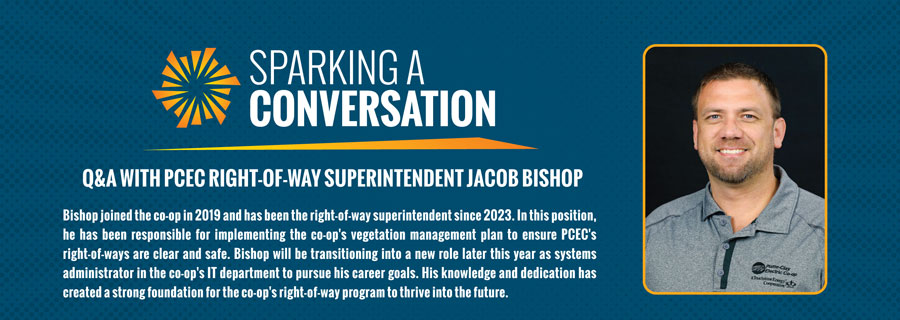
Q. What is the cooperative’s overall strategy for prioritizing areas for right-of-way (ROW) clearing and maintenance?
A. PCEC’s priority is to have safe and reliable power at an affordable cost. The ROW program’s strategy to achieve this goal is by creating management cycles that systematically address every overhead line through a five to six year trimming cycle.
One issue that we are addressing specifically is the issue of regrowth after spending the money to clear a right of way. Trees and brush can reach the line within a couple years, meaning that they would need to have a two to three year cutting cycle, which would create a large financial burden for PCEC leading to an increase in our power bills.
The solution is to create a spray cycle where we address the low vegetation growth under the power lines. This application is focused on woody plants in unmaintained areas and is applied as needed. The benefit of this program is that it will promote grass growth in these areas and protect the investment that we have made in trimming. For more information and an interactive map, you can visit our website for more details.
Q. How has the right-of-way program evolved over the last two years?
A. Since 2023, as part of our ongoing efforts to improve and maintain the integrity of the system, we have put in place measures to better communicate and ensure we are providing the best service possible:
We continue to expand our communication efforts with members by sharing information through multiple channels, including our website, which features our ROW policies, procedures and an interactive map outlining scheduled application areas.
We are utilizing advanced digital mapping systems that provide interactive maps for both our members and contractors. This allows us to identify and adjust sensitive areas when necessary. Our team maintains weekly communication with contractors to reinforce expectations and address any concerns raised by our members.
We limit the use of products to lower vegetation within the right-ofway areas, minimizing exposure beyond designated zones. Every vegetation management crew includes professional, licensed applicators to ensure all work is performed in compliance with regulatory standards. Only EPA registered products are used to control undesirable vegetation, and our contractors are required to follow all application guidelines as outlined on product labels. This is a continuing effort to ensure contractors are good stewards of the products they are utilizing.
Contractors are also offered training opportunities throughout the year to stay current with national best practices and safety requirements.
Q. What benefits are you seeing for the cooperative with regards to reliability and safety?
A. Safety is the key driver in managing our right-of-way. Tragedies continue to occur around the world, such as young people climbing trees and getting into power lines. PCEC has a huge liability to consider here, and it is of utmost importance that we maintain our power lines so they are safe for both our workers and the public that lives around them.
Reported outages, due to trees, have been falling steadily over the past couple of years. While trees remain a threat to our power lines, the continued effort to remove the hazards remains high on our priority list.
Q. How do you assess and balance reliability, cost, environmental impact and landowner concerns?
A. This is arguably one of the most complex and challenging aspects of our job. Missouri state statutes allow us to manage “danger trees” — those that are within 5 to 15 feet of power lines and could potentially fall into them. At PCEC, we’ve worked hard to find a practical balance between what we are legally permitted to do, what our insurance company requires, and the diverse expectations of our members.
The reality is that vegetation management is one of the most significant costs we face. To make this process efficient and sustainable, we need to be systematic in our approach and follow a cycle to ensure we are addressing our power lines as a whole.
We fully understand that every member has different concerns — some prioritize environmental preservation, others are most concerned with reliability, and some are primarily focused on cost. Our role is to weigh all of these factors and make decisions that reflect the long-term best interest of the cooperative and its members.
In the end, our primary goal is to do what the membership as a whole has requested — to keep the lights on and costs to a minimum. Reliability, cost, environmental impact and landowner concerns are all important. It’s our job to find a balance that serves the entire community.
Q. What’s the most common misconception members have about ROW work?
A. Many members think that brush is not a hazard under our power lines. There are two major issues with unmaintained brush under power lines. One issue is in unmanaged areas where trees can grow between the bushes. Some trees can grow 7 feet per year, and in a matter of a couple of years be in the power lines again. The other issue is if our line is broken off the pole and falls to the ground. Brush can prevent the line from grounding out, creating a serious risk for people passing by.
Each primary line transports over 7,000 volts, always seeking the nearest path to the ground. Trees can become that path, posing a serious danger to anyone around them. Our goal is to ensure safety, and while we recognize the beauty and environmental benefits of trees, those in inappropriate locations are hazardous and will need to be removed.
Q. What do you share with members if they have a concern about vegetation management on their property?
A. I try to help explain the importance of our work in a relatable context. Most people maintain the home they live in. Sometimes that means cleaning out the gutters so that they don’t overflow and cause damage to your roof and siding. Left unmanaged, plants will take root and even trees can start to grow. If you don’t do anything about it, then those plants will slowly destroy your property. This is what we are doing trying to maintain the PCEC membership’s investment. We do this while trying to consider as many scenarios as possible, but at the end of the day we work to keep our lines clear of the things that cause outages and create serious risks to the public.
If you don’t want PCEC to maintain the trees and brush under power lines on your property, the best solution is for members to keep these areas mowed and maintained. I would always suggest that if you have a serious concern then give us a call and see if we can meet to discuss the situation in person. One of your benefits of being part of a local cooperative is that there are people here who are willing to talk through the concerns and hazards that might be present.
Right-of-Way Maintenance Taking Place Throughout Service Area
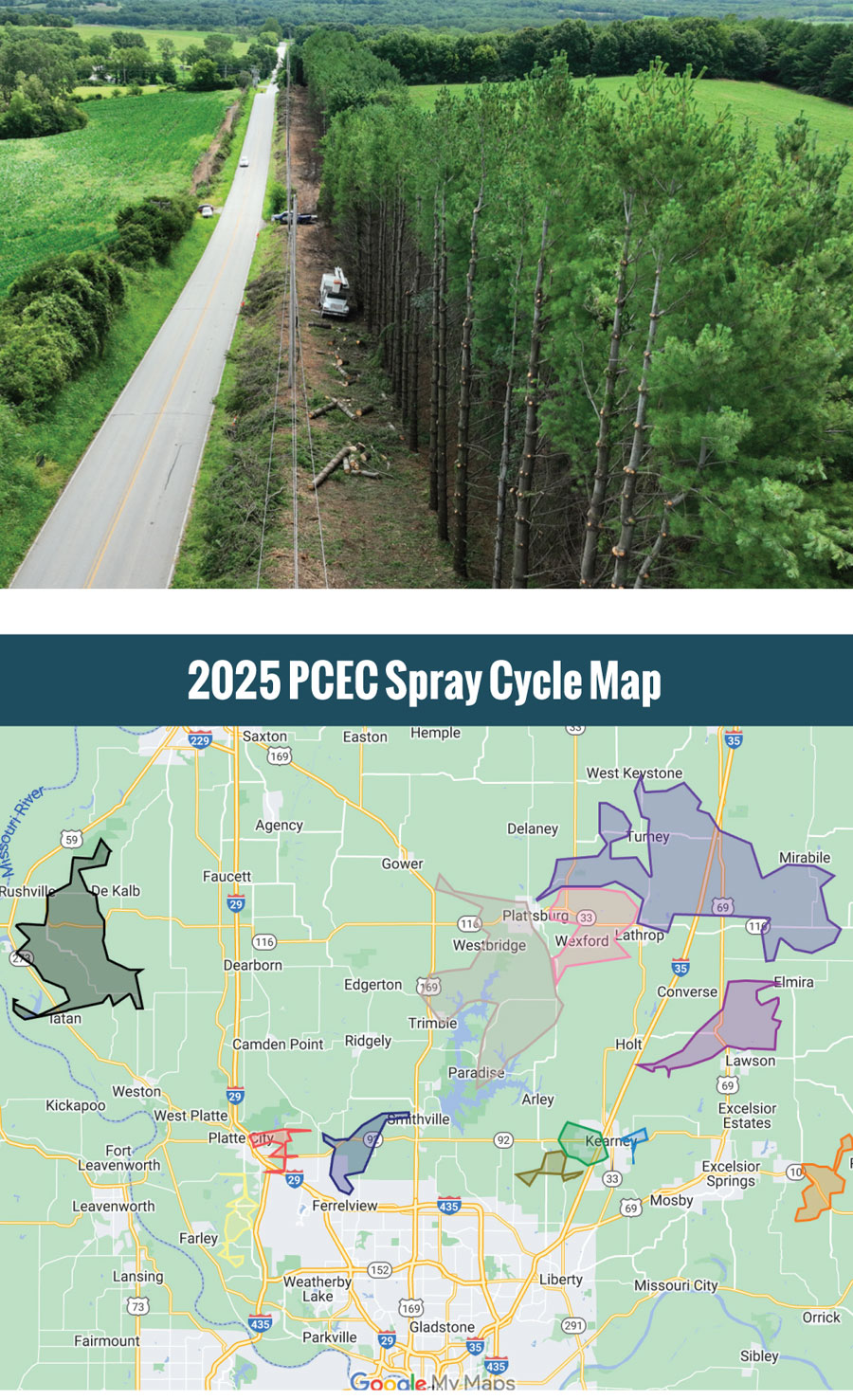
PCEC is committed to continuously improving system reliability for our members. To support this effort, you may see contractors spraying herbicide and clearing right-of-ways throughout our service area over the next few months as part of our ongoing vegetation management program.
This vegetation management maintenance is necessary for ensuring safe and reliable power in our communities. PCEC has created an interactive map,where you can see if we will be in your area. Please use the QR code below or visit https://pcec.coop/services/reliability-right-of-way/ to view the map and learn more about right-of-way maintenance, PCEC polices and state statutes.
Platte-Clay has contracted with Northwest Missouri Tree Service, Mitchell Tree Company, Jesse James Tree Service and Poorboys Tree Service to apply EPA registered products to prevent growth or regrowth of undesirable vegetation in and along our right-of-way easements. These products will be applied in a foliar application by highly trained and licensed professionals, ensuring effective treatment while prioritizing safety for people, animals and the environment.
If you have any questions or concerns about the application of products or other line clearing activities, please don’t hesitate to contact PCEC at (816) 628-3121.

Contest Winners Represent PCEC at Youth Tour in D.C.

PCEC Youth Tour delegates Dominic Santulli and Katelyn Wright.
One hundred and eight high school students participated in Missouri’s 62nd annual Missouri Electric Cooperative Youth Tour to Washington, D.C., June 15-21. Local delegates sponsored by PCEC were Katelyn Wright, from Kearney, and Dominic Santulli, from Smithville. The delegates were the winners of the co-op’s annual Youth Tour essay contest earlier this year.
Youth Tour takes the best and brightest high school students from Missouri’s rural schools on an all-expense-paid trip to our nation’s capital. The seven-day tour provides an action-filled week for the students, offering them opportunities to learn firsthand what it is like to be involved in politics, leadership positions, community service and today’s pressing issues while having fun touring the many monuments.
“The Youth Tour is the highlight of the summer for many students and we’re proud to send our best and brightest to our nation’s capital to participate,” said Chris Massman, vice president of Member Services for the Association of Missouri Electric Cooperatives. “Each of these delegates meet someone or see something that inspires them, and in some cases will create a path to their future career.”
Highlights of the trip include visiting representatives from their congressional districts, touring monuments, the Smithsonian Institution’s museums, Arlington National Cemetery and the International Spy Museum. The group also took a sightseeing and dance cruise on the Potomac River one evening with the delegates from five other states.
“Youth Tour was such an eye-opening experience for me,” said PCEC delegate Santulli. “Going into it, I really thought that it would just be an educational experience, but I was very wrong. I toured historic monuments during the day, and got to go on a cruise on the Potomac River at night. It was such a memorable experience, and I could not be more honored and happy to have been selected for the trip. The experiences I have made not just with the tour, but as well as my many new friends will last a lifetime. I couldn’t be more grateful.”
Other events of the week included participation in the Electric Youth Day, during which a special program coordinated by the National Rural Electric Cooperative Association brought together over 2,000 Youth Tour delegates from across the United States. The delegates enjoyed featured speeches by government leaders and motivational speakers, such as Mike Schlappi, an inspiring four-time Paralympic medalist and two-time world wheelchair basketball champion.
Since 1958, the nation’s cooperative electric utilities have sponsored more than 60,000 high school students on this trip of a lifetime. PCEC’s 2026 Youth Tour contest for current high school juniors will begin in December. For more information about the Missouri Electric Cooperative Youth Tour program, please go to www.moyouthtour.com.


 Replace your cooling system’s filter regularly to maintain strong airflow and boost energy efficiency. A clean filter means your system doesn’t have to work as hard, saving energy and lowering your utility bills. Factors like allergies and pets in the home can impact how often filters should be replaced. Check the filter every month and replace it as needed. Changing filters regularly also reduces wear and tear on your cooling system, helping extend the life of the unit.
Source: energy.gov



The Northland Connection is published monthly by Platte-Clay Electric Cooperative, Inc., 1000 W. 92 Highway, Kearney, MO 64060. Postmaster: Please send address changes to: Northland Connection, PO Box 100, Kearney, MO 64060 or mail@pcec.coop.
Platte-Clay is an equal opportunity employer.