


March 2016 | Volume 78 | Issue 3
Get ready–spring storms are coming
There is no doubt that at some point in time our lights are going to go out.
A tree is going to fall on the lines. Someone is going to be driving too fast, lose control of their vehicle and hit a pole, knocking it down.
Lightning is going to strike equipment.
A flock of migrating birds is going to land on the lines, causing them to sag, touch and the electronics to short out.
In the spring and fall, grass fires are a concern.
A major tornado or sustained straight-line winds could cause widespread infrastructure damage.
The lights are going to go out for any number of reasons.
To prepare for that time, here are some suggestions on how to deal with no power, especially if the power is out for longer than a couple of hours.
 Solar lights. We now can buy strings of solar lights, the friendly garden lights and Mason jars with a small solar panel in the lid. Candles always are always an option, but they also bring the possibility of fire and must be used carefully, especially around children.
A bouquet of garden solar lights kept in a south-facing window will be ready to provide hours of light.
Taken individually, each will provide about the same amount of light as a candle and can serve as a nightlight. For kids who like nightlights, the solar lights are a great mobile resource.
A string of lights could hang along a south-facing window to stay charged and available when necessary. No electricity means no electric can opener, so having a battery-operated or handheld can opener and/or canned food with pull-top tabs will make meal preparation easier.
Grills provide all kinds of cooking opportunities, from roasting vegetables, a healthy and even trendy menu option, to warming a baby’s bottle in a pan of water and even cooking oatmeal for a healthy start in the morning.
Fireplaces, fire pits and a safe fire also offer cooking options. Those with wood stoves have an opportunity to cook and heat as our grandparents and great grandparents did in years past. For some adventurous families, it may an opportunity to one camping skills.
In the event of an outage, call 816-628-3121.
Things will take longer, so it’s best to take a deep breath and simply cope.
Platte-Clay crews will be working until everyone has service restored.
Managing Change

Mike Torres
From the CEO
Spring brings a sense of renewal to the land. I am always glad to see longer days and more moderate temperatures.
Just as the Platte-Clay annual meeting each year is an opportunity for members to learn about updates at the co-op and issues that affect us, the National Rural Electric Cooperative Assoc. (NRECA) holds an annual meeting for its members, the management of the nearly 900 rural electric cooperatives throughout the U.S.
The national meeting is led by industry experts other thought leaders. This year the meeting truly lived up to its 2016 theme, “The Next Greatest Thing.”
There’s a lot going on in the electric utility industry and important changes in industry practices. While it’s not always easy to be a leader, it’s always important to manage your co-op’s resources in a way that will keep Platte-Clay in good stead for the next 75 years.
The featured speaker was the acclaimed global futurist Jack Uldrich. Practical and upbeat, he provides tips on how businesses, in general and rural electric co-ops specifically, can adapt to change.
I am pleased to share that most of the issues he says should keep utility executives up at night either are resolved or are being introduced and managed at Platte- Clay. That is a tribute to your Board of Directors and the staff.
For example, Mr. Uldrich—the futurist—mentioned the importance of renewables and solar energy; your co-op built a community solar array. He mentioned wind turbines; some of our energy comes from Missouri’s first wind farm. He mentioned do-it-yourself home energy producers; Platte-Clay has a member-friendly net metering policy.
He mentioned itemized utility bills; we’ll see those in November when we show the customer change, usage and demand.
And from a practical point of view, he mentioned how fast change is happening in an industry not known for making rapid changes, both an opportunity and a challenge for Platte-Clay in introducing new concepts and practices.
So with that in mind, we began in January to introduce the concept of a three-part, itemized bill beginning next November—11 months from the first announcement of the change.
We’ll continue explaining the benefits of pulling out the cost of demand from the cost of usage so electric service is priced fairly for all members. Further, co-op members have the opportunity to manage those two elements of the bill (demand and energy) to “lower” their monthly bill.
It’s important to note that showing the three elements of the bill, usage, demand and customer charge, is revenue neutral for the co-op, and will have a minimal, if any, impact on most members.
Further, as a nonprofit cooperative, all monies left over after expenses are returned to co-op owners—members—as their portion of the “profits” as a capital credit check.
In fact, last year Platte-Clay returned just over $1 million to co-op member-owners in our communities, not shareholders in distant cities. Member-owners who live in Plattsburg and Platte City, not Pittsburg, Pa.; members in Excelsior Springs and Edgerton, not Eugene, Ore.; Weston, not Wichita Falls, Texas; Dearborn, not Dallas or Denver; Kearney, not Kalamazoo, Mich. You get the picture.
We’re a local rural electric cooperative and our commitment is to provide reliable, affordable power to the co-op owners, the Platte-Clay members.
As always, if you have any questions or concerns, please let me know.
Annual Meeting Note
Prior to the 7 p.m. business meeting May 12, Platte-Clay will host an educational seminar on the new three-part billing to take effect with November bills. Bills will be based on October usage, including the 4% rate increase, and new for Platte-Clay members, show the individual peak demand rate separated from the energy rate. The co-op will continue to show the customer charge, the third portion of the Platte-Clay bill. Doors open at 4 p.m. for a light meal, prize registration and displays.
$750/ton geothermal rebates help co-op members save
A ground source heat pump is one of the most energy efficient means of heating and cooling a home. You may have seen the units abbreviated as GHPs or called GeoExchange, earth-coupled or water source heat pumps. Whatever they’re called, a ground source heat pump is incredibly efficient, operating at between 300 percent to 500 percent during the winter.
While it sounds amazing, it is because the Earth’s temperature below ground in Missouri is about 55o F year around. In the winter that means a heat pump only has to bring the heat up from 55o to, say, 72o, drawing the warmer 55o air out of the Earth and into homes via a ground heat exchanger.
To encourage energy efficiency, another piece of good news about ground source heat pumps is that the Federal Government provides a 30 percent tax incentive through 2016.
Also to encourage energy efficiency, Platte-Clay provides a $750 a ton rebate for new ground source heat pumps and $150 a ton for replacement units.
More good news, depending on the manufacturer, a ground source heat pump has an expected service life of 15 to 20 years.
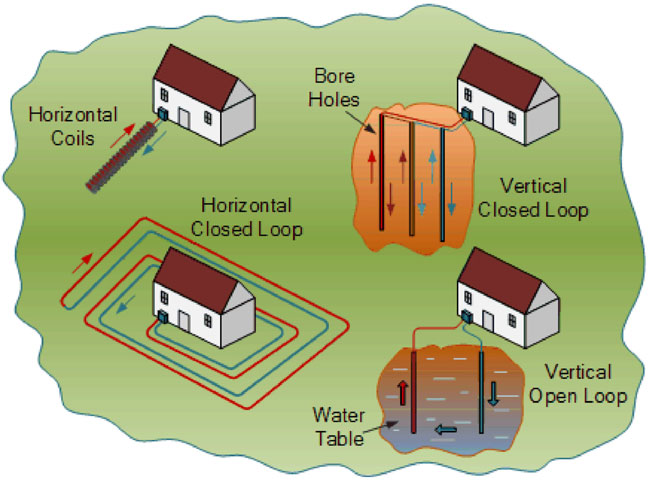
Image courtesy Alternative Energy Tutorials
Members who are considering a heat pump will find three common types of ground loop systems— horizontal, vertical and a pond or lake closed loop system—used in our area. The risk with a pond closed loop system is the possibility of a drought, which would mean, in addition to no water, no heat. Members who have an adequate supply of relatively clean water and can meet local codes for groundwater discharge may consider an open-loop system, possibly on a private lake, although not common in northwest Missouri.
Once the decision to go ground source is solid, there are other considerations.
First, look for a unit that meets or exceeds Energy Star certification for energy efficiency (www.energystar.gov).
Second, determine which type of loop will work best for your home or business in the space available.
Third, interview several contractors to develop a sense of comfort and their ability to properly size and install your system, meet your schedule and complete and provide the paperwork for the IRS and Platte-Clay.
Time is of the essence: the tax credit ends in 2016.
The Platte-Clay rebate forms are on the co-op web site, pcec.coop
Platte-Clay’s geothermal heat pump rebate qualifications include an Energy Efficiency Rating (EER) of 19.1 and a COP of 3.3. The ground source heat pump must be installed with a Delta T of 80, to be corroborated with a Manual J Calculation. (Eyes rolling? Your installer must be able to explain this to you.) Homes also must have attic insulation of R-38, R-13 wall insulation and use an electric storage water heater.
2016 Remodeling and Garden Show – American Royal Building Feb. 12-14

The Platte-Clay Members 1st booth attracted members and visitors to discuss products and services. The energy efficient Marathon water heater generated the most interest during the show. Congratulations to the co-op members who received tickets through their Platte-Clay Facebook page posts.
Budget billing helps members manage costs
Budget billing can help members save on energy costs by leveling out the monthly costs over a year, also called “levelized” billing.
Members may qualify for budget billing by:
1. Having their account current for the past six months
2. Having service at the same location for 12 months so there is a history of consumption.
Members who meet those qualifications can have their bills based on the “levelized” energy charge based on the previous year’s service divided by 12 months.
At the end of the 12-month period, or if the member moves or leaves the service area, the account will be “trued up.” Trued up means that the billing amount will be adjusted up or down depending on the member’s energy use.
For members moving out of the service area, the final bill will reflect the amount of energy used and either unpaid because of higher usage or overpaid because of lighter usage. If overpaid, the co-op will issue a check.
Members moving within the service area may go back on budget billing after developing 12 months’ history at the new location.
Beginning in November, 2016, co-op members’ bills also will show demand, one of the three billing components.
2016 Annual Meeting
Thursday evening, May 12 – Doors open 4:00 p.m.
Kearney Office, 1000 W. State Route 92
Board of Director election – one from each District
By-Law changes for member approval
Some members simply must have a generator
For some households the idea of being without power for any length of time is unacceptable. The reasons range from inconvenience to life-saving medical equipment that relies on backup power.
And that’s where a generator can help members. As a service to members, Platte-Clay sells and services Kohler generators and can assist with installation.
Generator sizes required range from a basic household to commercial-sized models.
If a generator sounds like a good addition to your home or business, start with finding the appropriate size.
The first thing to determine is the size of the house / office.
The next thing is to determine which appliances and circuits your family needs, first, and wants, second.
Typically the most important circuits to consider are those for emergency medical equipment, followed by sump pump, well pump, air conditioner, furnace, electric range-burners, electronic chargers, televisions and computers, depending on the household.
For a more detailed analysis, please visit the Kohler web site, www.kohlergenerators.com/home-generators/selector
The sizing chart provides a fairly comprehensive list of appliances and devices to help determine the correct size of generator.
For the detail-minded, there is a list of commonly-used household items that shows power requirements; there’s also a general, one-size-fits-all calculator.
Members who don’t want to take any chances on being without power may call the office and Platte-Clay will be glad to assist with installing a Kohler generator.
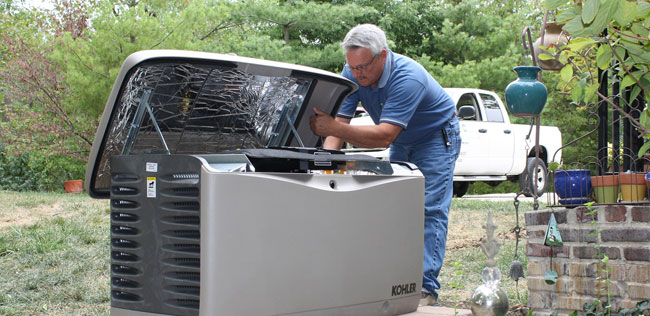
In addition to the generator, members will need to determine the fuel, such as propane or natural gas, and purchase a transfer switch to go from Platte-Clay to generator and back to Platte-Clay safely. Generators self-test periodically. Excerpt of Kohler calculator below.


Why are you changing co-op bills to show demand? No other utilities are doing that.
 Platte-Clay is breaking out demand from Energy Usage to be fairer to all Platte-Clay members.
Platte-Clay’s wholesale rates are based on total co-op demand, the rate at which electricity is used, and the total energy consumed.
Some members create more demand by using more appliances at the same time and as a result, a higher individual demand for electricity.
And the second point, the industry and many utilities are beginning to see a need to move to a three-part bill, with a demand charge, energy usage charge and a customer charge, which some utilities call a facilities charge, access charge or other term to clearly identify the cost components. In the past, it was easier and cheaper to simply bill metered kWh usage.
With affordable technology available today to capture demand, it makes sense to unbundle demand and make sure everyone pays their fair share, removing past subsidies among ratepayers, the Platte-Clay members who are our neighbors.
For more information, visit pcec.coop
The Northland Connection is published monthly by Platte-Clay Electric Cooperative, Inc., 1000 W. 92 Highway, Kearney, MO 64060. Postmaster: Please send address changes to: Northland Connection, PO Box 100, Kearney, MO 64060 or mail@pcec.coop.
Platte-Clay is an equal opportunity employer.