


March 2018 | Volume 80 | Issue 3
Bolivia – 2018
Since 1962, when NRECA International and the U.S. Agency for International Development (USAID) signed an agreement, NRECA has been taking the lessons learned from building in the remote and rural areas of America to developing countries.
Over the course of more than a half century, co-ops have improved the quality of life for more than 126 million people in 43 countries.
 No group of workers is better prepared to serve developing nations than the hard-working co-op crews the state co-op associations and NRECA International fields.
It was an honor for Platte-Clay’s Jake Fain to be a part of the crew who worked to bring electricity to the Bolivian village of Chapasirca. The Association of Missouri Electric Co-ops worked with NRECA International to organize and field the Missouri team who built lines in early February.
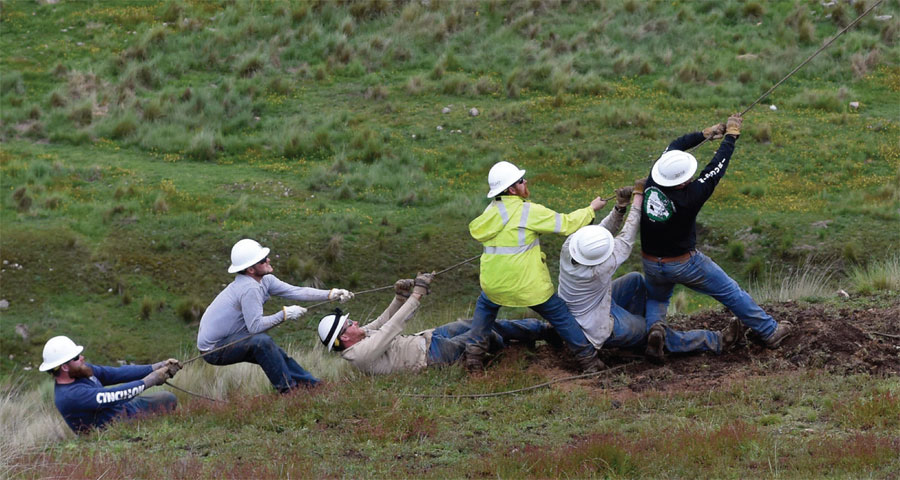
Some things never change. The Missouri crew relied on tried and true methods from decades ago of tightening the line with brute strength.
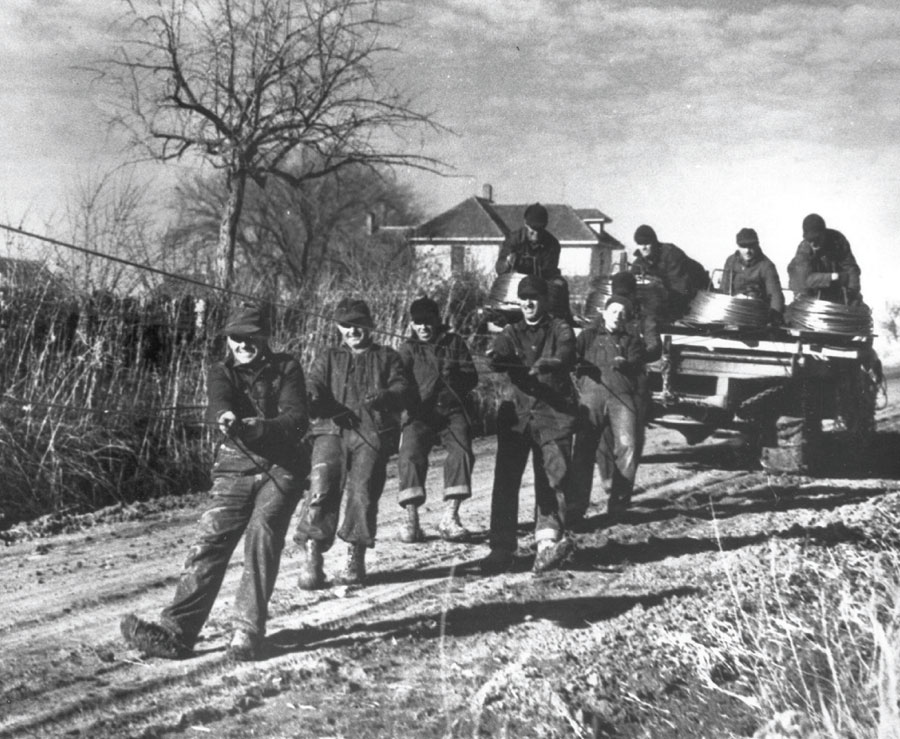
A historical photo from the late ‘30s or early ‘40s–working in a rural area and tightening a line with brute strength.

Village women presented Platte-Clay’s Jake Fain, shown, and other co-op linemen with hats, a necklace of flowers and showered them with confetti as part of the thank you ceremony.
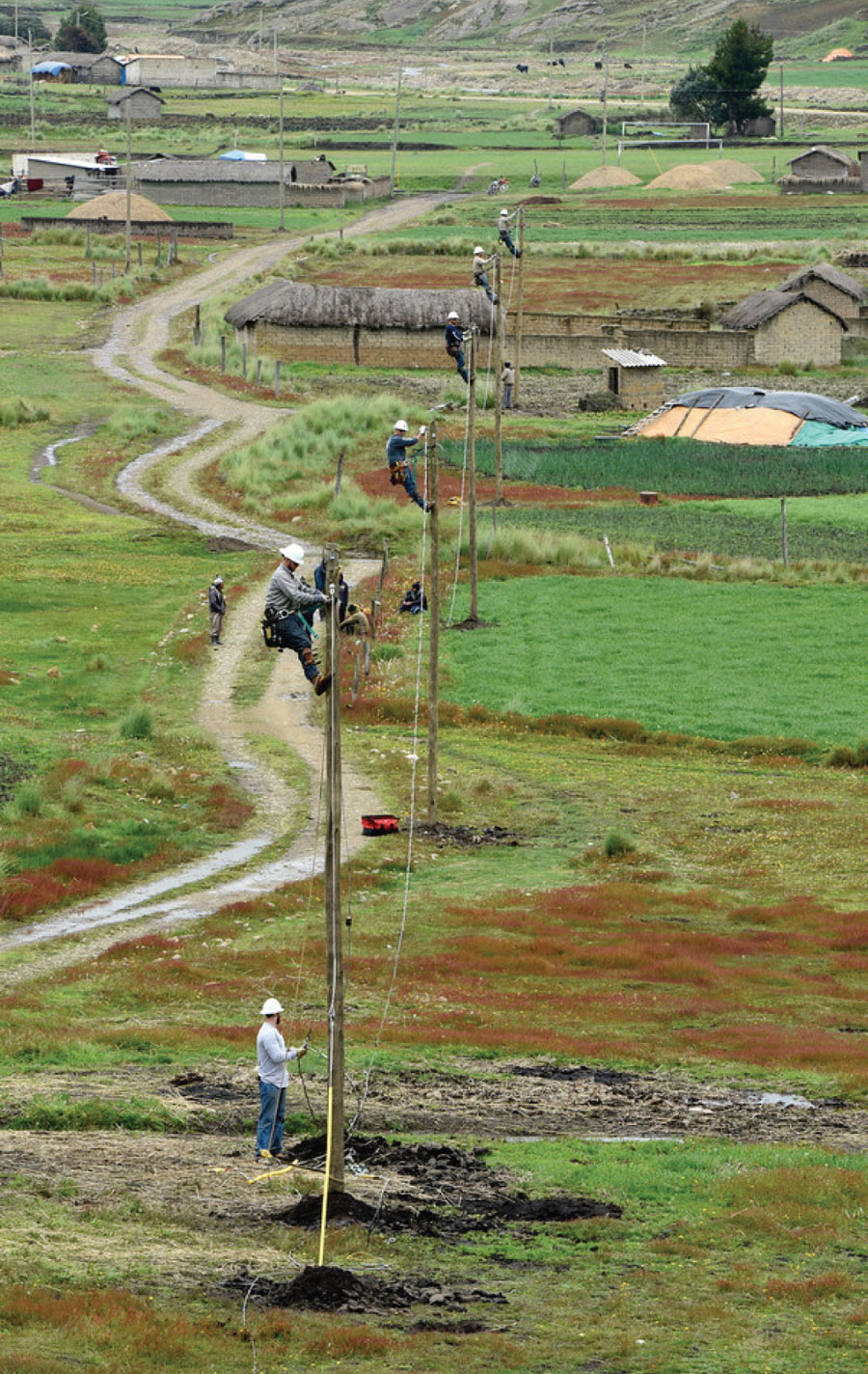
A row of poles crews built stretching into the village of Chapasirca.

One of the Chapasirca village helpers in the native, colorful caps.
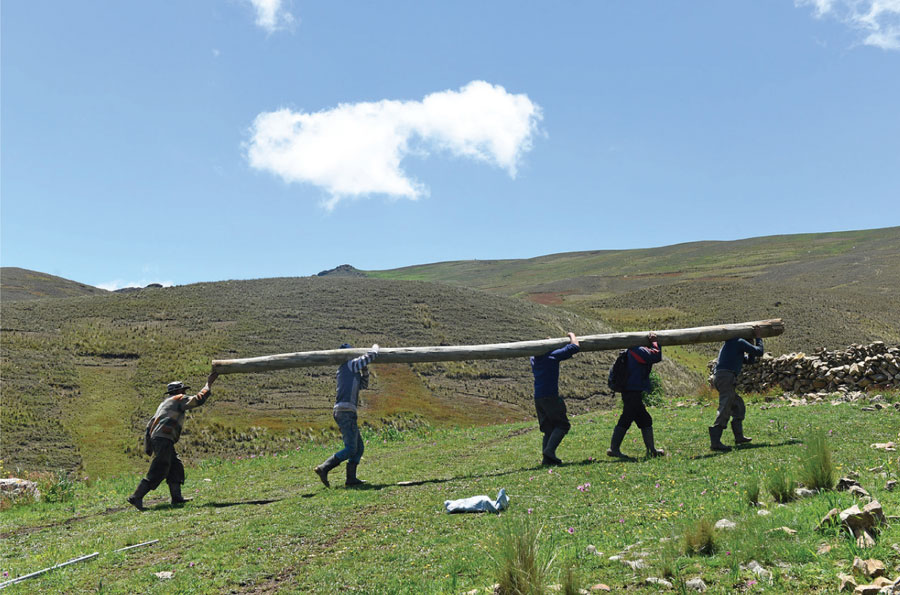
Building in remote rural areas is similar to the way Platte-Clay and other rural electric cooperatives have built lines with little motorized assistance. Shown, village helpers carrying a pole.
For more photos, visit the Brighter Bolivia Facebook page, https://www.facebook.com/MissouriElectricCoops/
Working like a well-oiled machine

Dave Deihl, General Manager
From the General Manager
The hottest days in summer and the coldest days in the winter are the hardest on an electric utility. And they’re typically the hardest on a household budget.
The really cold weather during the first weeks of January required Associated Electric Cooperative (AECI), the co-op’s power producer, to bring all power plants on line—the traditional baseload coal, natural gas, and hydro, wind and the natural gas “peakers,” used during peak loads.
Fortunately, having all of those resources in place met demand and AECI didn’t have to go to the energy markets to buy expensive power for co-op members—at 4.5 times the cost of in-house generation costs.
2018 started off unseasonably cold: Associated Electric set four peak records in January—Jan. 1, Jan. 2, Jan. 16 and Jan. 17. Before 2018, Associated’s peak demand was Jan. 8, in 2015; Jan. 6, in 2014, and Jan. 7 in 2010.
And an important side note is that one of the benefits of the nonprofit, three-tier cooperative system—distribution co-op, transmission co-op and generation co-op means that co-op members come first. There is no incentive to charge more than necessary because any monies left over, after good business practices, are returned to members in the form of capital credits.
Every year when the temperatures either drop or increase significantly, members call with questions and concerns about their bill. By breaking out demand, members now can control a significant portion of their bill by not using all appliances and devices at the same time. It’s just that simple.
 Demand is a bit like buying a new combine for a farm that you use only two months of the year, but pay for it all year long. By contrast, demand is billed at 50 percent of rolling peak demand over the past 11 months or current demand, whichever is more. By being careful and not increasing demand, members can lower their bill as high months drop off.
We have had a few requests for online billing data and a mobile app and I want to let you know that it’s in the works. Platte-Clay is among the first 50 U.S. co-ops to break out demand billing and we have two challenges.
First, our billing company is in the process of being acquired, so it will take time to blend and roll out the new software platform. And second, we are in the process of wrapping up the new meter installation. For those members who want to see their monthly/daily demand, we will be glad to compute and send to you.
We anticipate the app, meter and software upgrade rollout will be next year. We’ll keep you posted.
If you have questions or concerns, please e-mail me at generalmanager@pcec.coop
Geothermal Tax Credits preserved in ‘18 tax bill
There’s good news for those shopping for an energy-efficient heating and cooling system: the geothermal tax credits, which can save co-op members thousands of dollars, has been preserved.
The credits are stepped, with homeowners saving 30 percent for systems installed between 2017 and 2019, dropping to 26 percent in 2020 and 22 percent through 2021.
Homeowners concerned about clean energy and saving money with the efficient units were concerned that the tax credits wouldn’t make it through the final tax bill.
In addition to the 30 percent tax credit, Platte-Clay provides a $750 per ton rebate, bringing the new unit pricing close to a traditional HVAC system and saving on energy costs.
Visit pcec.coop for co-op rebate information.
Regional energy leaders pair up to provide wind energy
Associated Electric Cooperative, Inc., (AECI) Platte-Clay’s power provider has signed a 25-year agreement with Tenaska, an Omaha, Nebr.-based regional independent power producer to buy 236 megawatts (MW) of wind from a new wind farm near Maryville, Mo.
Tenaska anticipates the farm, named Clear Creek Wind Energy Center, will begin generating power in 2020.
“We are excited to be starting a new relationship with Associated, a relationship that will bring more renewable generation and significant economic benefits to the region,” said Greg Kelly, president and managing director in Tenaska’s Strategic Development and Acquisitions Group.
“We look forward to completing development and construction of Tenaska Clear Creek and putting this project into operation.”
It will be the seventh power purchase agreement for AECI, which began with the Bluegrass Ridge wind farm in Gentry County, Mo., in 2007, the first utility-grade wind farm in the state.
The Tenaska Clear Creek project dovetails with the Missouri co-ops’ Power for Progress, a commitment to rural economic development.

Missouri wind map.

Clear Creek will join the other northwest Missouri wind farms producing renewable power.
Initial estimates show that local landowners will receive some $1.2 million annually through lease payments and governments will receive the same amount through tax revenue.
A stable 25-year income and diversifying the land use are additional benefits that will accrue to the area from the new wind farm.
With the new tax legislation extending the federal production tax credit and improving turbine technologies, Tenaska now is expanding its renewable wind projects.
Consistently ranked among the largest private U.S. companies, Tenaska also is involved with natural gas marketing, power marketing, power generation, capital management and strategic development.
Member Viewpoint
 I find your new demand charge to be grossly unfair.
You base this charge on the moment of highest usage that could only exist for a split-second.
In addition, you use the highest usage as a minimum charge for the rest of the year. Thus, we get charged a significant amount every month, potentially for an entire year, based on what could be a momentary event.
I do not believe it is in any way related to your productions costs.
Instead, it strikes me as a windfall for you and a method to build in additional revenue that is unrelated to the total amount of KWs used by your customers.
I object to the Demand Charge as an unfair billing method.
— Aaron Johnson
Here’s why demand billing is fair
Demand billing is fair to all members. Before demand billing was rolled out to the membership in November, 2016, low-demand members were subsidizing high-demand members.
Demand costs were averaged across the membership base and wrapped into simple kilowatt hour charges.
However, because Platte- Clay’s power producer bills on overall co-op peak demand based on the the past year, high demand members caused the co-op’s wholesale costs to rise–at the expense of low-demand members.
Now, by breaking out demand member households can see and control their costs and ultimately help control wholesale power costs.
Because co-op member demand is determined over an hour’s measurement, timing is important.
Household members must understand that when they’re using multiple devices at the same time they may be creating high household demand. For some members, it’s an issue; for others, not.
There’s absolutely no reason to overcharge co-op members: any monies left over after good business practices are returned annually as capital credits.
For example, a typical small home, with members actively managing their demand by not using multiple appliances at the same time will be billed at between 4-6 kW.
A medium size home will draw some 8 kW demand on average and a larger or busier home tends to be billed at 12- 15 kW demand per month.
Demand is directly related to wholesale power costs.
Associated Electric Cooperative (AECI) plans to produce enough power to cover peak demand, usually the hottest and coldest days of the year.
In early January, for example, Associated set four peak records producing energy for the 51 co-ops it serves.
A power producer operates a bit like the Boy Scouts: always be prepared.
For a power producer, that could mean buying energy from the wholesale market or adding power-producing capacity to avoid black outs or brown outs. The new wind farm is an example of planning ahead for growth and increasing capacity.
To learn about the effect of appliances, please visit the web site calculator, pcec.coop to get an idea of individual and collective device demand. In addition, members may call in, 628-3121, to find out what day and time the household set peak demand.
Youth Tour Winners – What it means to be a servant leader
The top six finishers in the 2018 Youth Tour essay contest are: North Platte High: Truman Byergo, Brittnie Depper and Brianna Spiers. Platte County High: Alexandra Cline and Logan Kennell. Smithville High: James Larson. The two top-scoring students will receive an expense-paid trip to Washington, D.C., June 8-14, and the other four students will trip to a leadership conference, July 18-20 in Jeff City.
PCEC Security
 Keep your family and home safe with a PCEC Security system.
Get an alert when your children get home from school, use the video capabilities to see who’s at your door.
Call 628-3121 for more information on how PCEC Security can give you peace of mind.
Board candidates – time’s (almost) up
Most board candidate deadlines have passed:
Feb. 22 to discuss requirements with a member of the nominating committee.
March 1, to submit a petition signed by 15 co-op members to be placed on the ballot.
The last chance for consideration is to be nominated by a member during the business meeting portion of the annual meeting – which isn’t recommended.
In fairness to all co-op members, it makes sense to share interest, qualifications and any concerns ahead of time to allow for informed voting during the annual meeting.
Further, there’s no candidate campaigning or speeches during the annual meeting.
For information on Board requirements, please visit the co-op’s web site, pcec.coop and review the by-laws in the About section.
A list of candidates will be posted at each office on April 20.
Candidates, including a photo, brief biography and candidate statement will appear in the May issue of the Rural Missouri, sent to everyone, which serves as the official annual meeting notice, this year, May 10.
Doors will open late afternoon and members will be able to enjoy a light supper, carnival rides for kids, information booths and to pick up capital credit checks.
The Northland Connection is published monthly by Platte-Clay Electric Cooperative, Inc., 1000 W. 92 Highway, Kearney, MO 64060. Postmaster: Please send address changes to: Northland Connection, PO Box 100, Kearney, MO 64060 or mail@pcec.coop.
Platte-Clay is an equal opportunity employer.