




Strengthening Our Democratic Foundations
New director election changes for 2026
 As we approach the end of another productive year, it’s remarkable to see how quickly time moves when we are focused on building a stronger, more resilient cooperative. Before long, we’ll find ourselves entering a new membership election cycle at the start of 2026. These elections are one of the most important ways our members directly participate in shaping the future of our co-op, and next year’s process will bring several meaningful updates following bylaw amendments approved during the 2025 election.
These changes, adopted unanimously by the membership, represent a significant step forward in ensuring that our elections remain fair, open and accessible to all. They reflect the values at the core of our cooperative: transparency, member participation and accountability.
The first major change affects how candidates for the board of directors are nominated. Starting with the 2026 election, the traditional nomination committee will no longer be part of the process. Instead, all interested director candidates will now qualify by submitting a petition with at least 15 member signatures.
This adjustment was designed to level the playing field for everyone whether you’re a first-time candidate or a current board member seeking reelection. The petition process ensures that all candidates demonstrate direct member support from the very beginning. It also makes the nomination process simpler, more transparent and more member driven.
The petition deadline for the 2026 election will be February 17, 2026. Our team will be available to help answer questions about the new process, and more detailed election information will be posted on our website in the coming months.
The second major update, approved earlier this year, strengthens our commitment to transparency and accountability. With 95% approval from members, the co-op adopted a new bylaw amendment requiring all board candidates to disclose campaign contributions or any form of third-party support they receive.
Each candidate will now be required to submit four campaign finance reports at designated times leading up to the election. These reports will be made available to members on our website, ensuring everyone has access to clear, consistent information about campaign funding and support.
Additionally, a new board policy implemented as a result of the new bylaw will set a $500 cap on total campaign contributions, including both monetary and in-kind support. This limit was introduced to ensure that all candidates compete on equal footing and that no one candidate can gain a substantial advantage through outside funding. The goal is to keep campaign efforts member-focused and aligned with cooperative principles.
The campaign contributions and reporting changes originated from a motion presented by a member at our 2024 Annual Business Meeting, reflecting our membership’s increasing interest in fair and open election processes.

PCEC General Manager/CEO Dave Deihl visits with members at the Smithville pancakes in the park member appreciation event.
Together, these updates highlight how our co-op approaches governance. They were shaped not by outside pressure, but by our own members who care deeply about how decisions are made and who is empowered to make them.
By implementing both disclosure requirements and contribution limits, we are setting a new standard for openness and fairness in our election process. Members deserve to know how candidates are supported, and candidates benefit from a process that is equitable and accountable.
These reforms reflect the cooperative spirit that has guided us since 1938. Transparency builds trust and that trust is essential to progress. As we move into 2026, we can take pride in knowing that our election process will be one of the most open and accountable in our co-op’s history.
As these updates take effect, our focus remains on strengthening trust in our governance and ensuring every member’s voice is heard. Fair and transparent elections are the cornerstone of cooperative leadership. By setting a higher standard for openness and fairness, we’re ensuring that the decisions shaping our future are made with clarity and trust. These changes reaffirm that our co-op is not only owned by its members but also guided by their values.


Platte-Clay Hosts Annual Blood Drive During National Co-op Month

Platte-Clay Electric Cooperative members and employees came together once again to give the gift of life during the co-op’s annual blood drive on Oct. 8, partnering with the Community Blood Center to support local hospitals and neighbors in need.
This year’s drive brought together 68 donors and resulted in 69 units of blood collected, including 11 first-time donors.
Each donation has the potential to save up to three lives, meaning this effort could help more than 200 people in local hospitals across the Kansas City metro area.
The event was held as part of National Co-op Month, a time to celebrate the nation’s not-for-profit, community-led electric cooperatives. Platte-Clay is proud to live out the cooperative principle of “concern for community,” which supports the health and well-being of the members and neighbors we serve.
Thank you to everyone who donated, volunteered, and helped make this year’s blood drive a success.


PCEC Shines Bright: A Season of Awards and Achievements
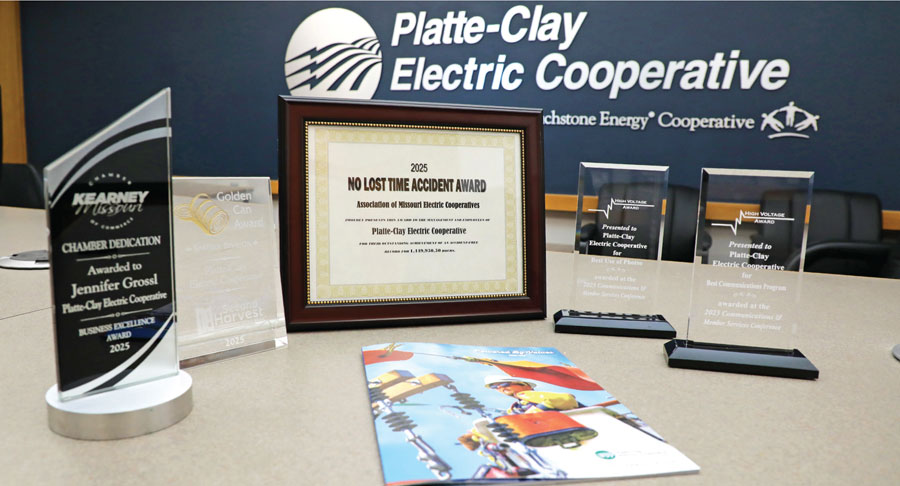
It’s been an extraordinary few months for PCEC, with employees and departments recognized across the state for excellence in safety, communications, community involvement, and leadership.
Safety First and Best in Class
At the Association of Missouri Electric Cooperatives’ (AMEC) 88th Annual Meeting held Oct. 1, PCEC was recognized as best in class, ranking No. 1 with 1,449,950 hours worked without a lost-time accident.
“This achievement is a testament to the commitment each of our employees show every day in keeping safety at the forefront of our work,” said PCEC General Manager and CEO Dave Deihl. “Their dedication to maintaining a strong culture of safety makes accomplishments like this possible. I am truly proud to work alongside such exceptional employees.”
AMEC, based in Jefferson City, serves as the statewide service organization for Missouri’s 47 electric cooperatives.
Top Honors in Cooperative Communication
Just weeks later, PCEC’s communication team brought home two honors from the 2025 High Voltage Awards, presented by Rural Missouri magazine on Oct. 16. The cooperative earned an award for Best Use of Photos and the publication’s top overall recognition — Best Communications Program among Missouri’s electric cooperatives.
“Communication is at the heart of the cooperative difference,” said Rural Missouri Editor Sara Schafer. “Missouri’s electric cooperatives continue to find creative, effective ways to connect with members — from print and digital storytelling to social media outreach. It’s inspiring to see how they’re using every tool available to keep members informed and engaged.”
Rural Missouri, the statewide member magazine produced by AMEC, is mailed monthly to nearly 600,000 cooperative members across the state.
Charged Up to Fight Hunger
In September, PCEC employees joined Second Harvest’s Corporate Food Fight, the organization’s signature fundraising and food drive competition for businesses in Northwest Missouri. Competing in the Spatula Division (for employers with 51–100 employees), PCEC earned the Golden Can Award. Together, employees donated over $1,600 and 43 pounds of food to support local families. Across the region, 62 participating teams contributed approximately $30,000 and over 10,000 pounds of food.
Leadership and Dedication Recognized
Jennifer Grossl, PCEC’s manager of communications and marketing, was honored at the Kearney Chamber of Commerce Gala on Sept. 25 with the Chamber Dedication Award. The recognition celebrates individuals and organizations that demonstrate outstanding commitment to the Chamber through service, support, and long-term involvement.
A Cooperative That Leads by Example
From statewide safety honors and communication excellence to community impact and personal achievement, these recognitions reflect PCEC’s deep commitment to its members, employees, and the communities it serves.
“Each award reminds us that the cooperative spirit of safety, service, and connection continues to guide everything we do at Platte-Clay,” Deihl said.

ALL ABOUT BLINKS: Brief Power Interruptions Explained

Kevin White
PCEC Staff Engineer
Simply put, a “blink” is a brief power interruption in the electrical grid caused by a fault that activates protection devices in attempts to prevent an outage. Blinks are usually caused by something contacting the power line that affects the flow of electricity (fault), lasting only a few seconds to a minute. In result, you may experience a temporary interference of electric service such as your lights turning off and then right back on automatically.
WHAT HAPPENS WHEN A BLINK OCCURS?
Blinks are evidence that something interfered with the normal flow of power and your electric grid is actively working to allow that interference to clear itself out to prevent a potential outage. You may have even experienced several blinks within a short timeframe. Rest assured that your electric grid is working properly! When an interruption of power occurs on the power line, an electrical protection device called an “oil circuit recloser” (OCR) responds to the fault. This device is designed to enhance system reliability by temporarily disconnecting a faulted section of the grid and then attempting to restore service without the need for manual troubleshooting. Think of an OCR like the electrical breaker in your home, except it resets itself automatically. So how do the OCRs trigger a blink?
Fault Detection: The OCR detects an irregular flow of electricity, indicating a fault. These faults can be caused by various sources encountering power lines such as storms, animals, trees or even planned maintenance.
Circuit Opening: Once the fault is detected, the OCR opens automatically, interrupting the flow of electricity to isolate the faulted section.
Reclosing Attempts: After a brief delay, the OCR attempts to close and restore power automatically. This may happen multiple times based on the cause and pre-configured settings set by your cooperative.
Fault Clearance: If the fault is cleared, the OCR successfully restores the power.
Failure to Clear: If the fault remains, the OCR will continue to isolate the faulted section and stop trying to reclose after a few attempts. At this point, this has turned into an outage situation and your cooperative will dispatch a maintenance crew to manually repair the fault.
5 COMMON CAUSES OF BLINKS:
Birds and Small Animals – It is not uncommon for critters to fly or climb onto power lines. Unfortunately, if these creatures become grounded when touching the power line, it can shock them and create a fault on the electric grid causing a blink.
Tree Branches contacting Power lines – When tree branches contact the power lines due to high winds it can trigger a fault. This is why cooperatives often prioritize right-of-way clearing to help mitigate tree branches or vegetation from interfering with power lines to enhance grid reliability.
Weather – Heavy snow and ice weighing down the power lines or strong winds swaying and throwing debris onto the power lines can trigger a fault on the grid resulting in blinks.
Lightning Strike – Have you ever heard the crack of thunder and simultaneously experienced your power shut off then turn right back on? Lightning can hit power lines or equipment, causing a blink.
Planned Maintenance – Your cooperative may intentionally open or close switches to conduct routine maintenance. This is often a planned procedure necessary for grid reliability. During this process blinks may occur, although these are typically brief and scheduled in advance with members who will be affected.
DEBUNKING MISCONCEPTIONS ABOUT BLINKS
Blinks are not outages – Though blinks can still be an inconvenience, it is a sign that the protective equipment on the electric grid is actively working to prevent an outage when a fault occurs! A blink is a brief power interruption that typically lasts only a few seconds to a minute and restores itself automatically. It’s usually caused by protective systems responding to a minor fault. Outages are a prolonged disruption of electricity when faults are not stopped and become grounded, lasting several minutes to hours. Outages require manual troubleshooting due to larger issues.
Blinks do not damage home appliances – When you experience your power turn off and back on abruptly you may think to yourself, “will this damage my appliances?” There is a misconception that surges, or voltage spikes are caused by blinks. This is simply not true. A blink itself won’t damage home appliances. However, surges (voltage spikes) could occur if the fault is not stopped which can potentially harm sensitive electronics. To protect against this, it’s recommended to use surge protectors for devices like computers, TVs and other valuable electronics.
HOW SHOULD I RESPOND TO A BLINK?
- Wait to see if you’re experiencing a blink or an actual outage. Blinks are typically very short, often lasting just a few seconds to a minute. Try waiting a minute to see if the power restores automatically.
- If you experience frequent blinks, contact your local electric cooperative to report the ongoing issue. Your cooperative has technology to investigate areas that experience increased blink counts. Letting them know when you experience frequent blinks could help your cooperative determine the areas affected by an ongoing fault.

Friday, Dec. 5 • 8 a.m. – 4:30 p.m.
Chili Lunch: 11:30 a.m. – 1:30 p.m.
Join us on Friday, Dec. 5 at the PCEC offices in Kearney or Platte City for our annual Holiday Open House. We will serve a free chili lunch between 11:30 a.m. – 1:30 p.m. and have holiday treats available all day.
To assist those in need in our community, please bring a donation of gently-used or new coats and non-perishable foods. We will continue to collect these throughout the month of December.
PCEC Kearney Headquarters:
1000 W. 92 Highway, Kearney, MO
PCEC Platte City District Office:
15055 Bethel Road, Platte City, MO 64079
 To maximize your fireplace’s efficiency, always keep the damper closed when the fireplace is not in use. An open damper is like an open window, allowing warm indoor air to escape and cold air to enter. Consider installing a fireplace insert, which improves heat output by circulating warm air into the room rather than letting it escape up the chimney. Also, burn only seasoned hardwood to ensure a hotter, cleaner burn. Regularly clean and inspect your chimney to maintain safe and efficient operation.
Source: energy.gov



The Northland Connection is published monthly by Platte-Clay Electric Cooperative, Inc., 1000 W. 92 Highway, Kearney, MO 64060. Postmaster: Please send address changes to: Northland Connection, PO Box 100, Kearney, MO 64060 or mail@pcec.coop.
Platte-Clay is an equal opportunity employer.