


October 2013 | Volume 75 | Issue 10
October is National Co-op Month
There’s something remarkable and enduring about the cooperative business form of business: it began when a group of citizens decided to work together for the common good.
Building a co-op is much like building civilization: humans realized they gained a lot by working together.
In 1761, the earliest record of a co-op forming, a group of weavers in Scotland formed the Fenwick Weavers’ Society. Those early weavers developed the co-op to work for a better standard of living, to buy food at a reasonable price, and for a more secure future by cooperating with one another.
In 1844, a group called the Rochdale Society of Equitable Pioneers developed the Seven Cooperative Principles, still in use by cooperatives, around the world, including at Platte-Clay. Because of these sound principles, co-ops are a proven and time-honored business model.
The Seven Cooperative Principles
1. Voluntary and Open Membership
Cooperatives are voluntary organizations, open to all persons able to use their services and willing to accept the responsibilities of membership, without gender, social, racial, political or religious discrimination.
2. Democratic Member Control
Cooperatives are democratic organizations controlled by their members, who actively participate in setting policies and making decisions. The elected representatives are accountable to the membership. In primary cooperatives, members have equal voting rights (one member, one vote) and cooperatives at other levels are organized in a democratic manner.
3. Members’ Economic Participation
Members contribute equitably to, and democratically control, the capital of their cooperative. At least part of that capital is usually the common property of the cooperative. Members usually receive limited compensation, if any, on capital subscribed as a condition of membership.
Members allocate surpluses for any or all of the following purposes: developing the cooperative, possibly by setting up reserves, part of which at least would be indivisible; benefiting members in proportion to their transactions with the cooperative and supporting other activities approved by the membership.
4. Autonomy and Independence
Cooperatives are autonomous, self-help organizations controlled by their members. If they enter into agreements with other organizations, including governments, or raise capital from external sources, they do so on terms that ensure democratic control by their members and maintain their cooperative autonomy.
5. Education, Training and Information
Cooperatives provide education and training for their members, elected representatives, managers and employees so they can contribute effectively to the development of their cooperatives. They inform the general public, particularly young people and opinion leaders, about the nature and benefits of cooperation.
6. Cooperation Among Cooperatives
Cooperatives serve their members most effectively and strengthen the cooperative movement by working together through local, national, regional and international structures.
7. Concern for Community
While focusing on member needs, cooperatives work for the sustainable development of their communities through policies accepted by their members.
Promises Kept
 From the CEO
Each year rural electric cooperatives celebrate National Co-op Month, but in 2013 at Platte-Clay it’s been a year-long event.
We’ve taken this year to remember our beginnings in 1938. We hope you’ve enjoyed learning a little bit about where your cooperative came from, what getting electric service meant to members and how your co-op continues to be an innovative community partner.
Co-op Month gives us an opportunity to talk about the products and services we offer to the members in the seven Missouri counties we serve—Buchanan, Caldwell, Clay, Clinton, DeKalb, Platte and Ray.
But more important, Co-op Month is a good time to talk about the promises, hopes and dreams Platte-Clay has delivered.
Both the courage and the promise of those first community leaders who decided to go forward and build the electric infrastructure in the Northland.
The promise from putting that first pole in the ground; the promise when those first homes and barns were lit with electric power in the late ‘30s.
The promise when Platte-Clay paid off its first loan from the Rural Electrification Agency (REA), one of the highly successful publicprivate partnerships.
And the succeeding loans and repayments as your co-op expanded to build lines; the electric infrastructure that today we take for granted.
There’s also that promise between co-op members, who own Platte-Clay, a private nonprofit utility, and the work the co-op does.
We’re proud that co-op members gave Platte-Clay high marks for reliable electric service, because that was the original promise, and one your co-op works at every day.
The promise made 75 years ago to those rural families and businesses resonates today when we flip a switch and a light, or a computer, or the washing machine comes on.
There aren’t many organizations that can look back over its history and say that it kept its promises.
Your co-op is one of them and National Co-op Month is a good time to celebrate promises kept.
If you have any problems or concerns, please contact me.
The Industry
U.S. exports coal and co-op clean coal technology to China
A Minnesota-based generation and transmission co-op that developed clean coal technology has entered into a 10-year agreement with a Chinese coal-processing company.
The process, called Dry-Fining, reduces emissions and improves efficiency at coal-based power plants.
Great River Energy developed the DryFining technology as part of the Department of Energy’s Clean Coal Initiative. The process uses residual or waste process heat to reduce the amount of water in lignite coal. A refining component removes higher density compounds that contain higher levels of sulfur and mercury.
Tangshan Shenzhou Mfg. Co. (TSM) provides coal processing equipment that serves mines and utilities in China.
The Minnesota co-op will serve as technical consultant for TSM and assist with design and integration at Chinese power plants that purchase the technology.
In September, the Chinese government announced a major plan to reduce emissions caused by industrial expansion.
Plant the right tree in the right place
There are no winners when trees fall into the lines and cause outages.
Most will agree that we all truly appreciate trees: they provide shade, food and shelter for humans and animals, a visual screen, they delight in the spring with the first sign of buds and for some, flowers; they add value to our property.
But when trees are planted in the wrong place and grow into the electric lines, they need to go, or at a minimum, be cut back away from the lines. Because it’s probably only a matter of time before the wind comes whipping through the Northland and they cause an outage—either from intermittently touching or tugging at lines and causing a short (blinking lights) or from limbs or trees falling into the lines.
It gets worse: trees can conduct electricity and could electrocute someone.
And then there are all of the neighbors who call in, wondering why they don’t have electric service during a rain or snow storm—the most difficult and dangerous time for crews to work on the lines. And the reason could be outside of your window or planted along your property line.
Fall is a wonderful time to plant trees. The ground is warm from summer heat and with cooler temperatures there’s less stress on the plants.
The Arbor Day Foundation (www.arborday.org) is a wonderful resource, and allows us to shop and learn about trees from the comfort of our computer, tablet or smart phone.
Local nurseries have a great selection of trees and shrubs that will thrive in Missouri’s weather and have practical experience with the varieties they carry. Plus at this time of the year, while the selection may be somewhat diminished, the prices also may be lower.
Here are some guidelines.
First, take a walk around your property and determine the space available. For those inclined, it’s a good time to do a sketch of places to plant trees or mark the areas available for large landscape additions.
It’s always good to plant deciduous trees (those that lose their leaves) on the south and west side of the house to provide shade during the summer and allow the sun to warm the building during the winter. If there’s not enough room for trees, it’s a great opportunity to use smaller shrubs or vines on a trellis to help cool the building in the summer.
Evergreens make wonderful windbreaks and help move the cold northern winds over the house, so they’re a good choice on the north and north-west side of a building.
Always note the space available, because electric lines must have at least 25’ of clearance on either side of an electric line. Do get a tape and measure and plant carefully: Platte- Clay’s crews will trim trees or kill vegetation in the rights of way.
Missouri law requires contractors and homeowners to call Digger’s Hotline (1-800-Dig-Rite) at least three days before digging. And it may be helpful to call early on in the landscaping plans: it’s better to know where landscaping can’t be planted to begin with, rather than trying to fudge the planting area. It’s very simple: electric lines can kill so we need to stay away from them.
For those who want to plan and keep their ideas on the computer, there are several helpful landscaping design software programs.
Ranked first is Realtime Landscaping Plus. The software allows home owners to design landscaping and view projected projects by season or time of day. It includes help with selecting the right plants for our region (now Zone 6) and will show what the trees will look like in 5 and 20 years in the future. It’s an important program feature, because as trees grow larger they provide more benefits and more value to the landscaping.
The software offers templates and some 10,000 realistic objects that include region-specific plants, deck and pathway materials.
There are other programs with favorable reviews including software called Landscape Deck & Patio, Home & Landscape Design, Home Designer Landscape and Deck and the HGTV Home & Landscape Platinum Suite. The design software varies in price from around $10.00 to around $100; some include free trials.
One of the most common complaints is that some programs don’t offer helpful templates that provide ideas for plant combinations. For that, local nurseries, friends, gardening clubs, Master Gardeners, the Flower & Garden Show and magazines are good resources.
Once that’s done, it’s a great opportunity to visit area nurseries, tour gardens and visit facilities such as Powell Gardens, Loose Park or the Overland Park Arboretum to see their trees and shrubs. Area nurseries have wonderful selections and can make suggestions and help with planting trees and other landscape features.
With proper planning and planting, everyone will enjoy our Northland trees for decades to come.
Powell Garden Recommendations
Shagbark Hickory; Bur, Chinkapin, Northern Red and Post Oak.
Limber Pine and Eastern Red Cedar.
Crape Myrtle, Fringetree, Hazelnuts, Saucer Magnolia, Fig, Ninebark, Peach, Persimmon, Redbud and Witchhazel.
Plant shade and large evergreen trees about 60’ away from electric lines.
Plant shrubs and small trees about 25’ away from electric lines.
Co-op Update
Old fashioned service combines with social media
 A little bird told me. Now a little bird can tell you too.
Platte-Clay has a Twitter account, and from time to time will be “tweeting.”
Feel free to follow your co-op: @PlatteClayEl
The easiest way to see your co-op’s tweets is to go to pcec.coop and scroll to the bottom of the page.
There you can click on the Twitter logo and read (and respond) to the co-op tweets.
 Curious about Facebook? New to Facebook? Click on that logo and you’ll see the co-op posts.
When there’s co-op news or outages, we’ll go directly to social media so members can conveniently receive information on smart phones, tablets and computers.
The outage map on the website will show current outage information –
https://pcec.coop/services/platte-clay-area-outage-map/
pcec.coop gets facelift
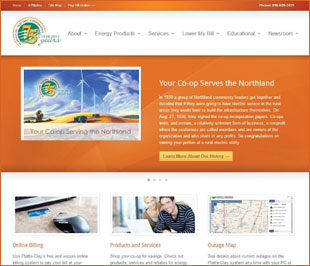 Technology is a moving target and nowhere is that more apparent than with computers, tablets, smart phones and other electronic devices.
Between the thousands of software developers and intense competition among manufacturers, there’s always something new available–the latest and greatest.
When Platte-Clay decided to refresh its web site, the co-op looked for innovative trends and technology and selected a program that would properly display the web site on the most widely-used electronic devices: personal computers, including laptops; tablets and smart phones.
The software that makes it possible for the site to display properly on all of those devices is called “responsive design,” and means that the site expands or contracts to be more horizontal or vertical depending on the device and the axis of orientation.
While many are comfortable with older cell phones, more than 60 percent of Americans now use a smart phone. For the most part, it’s easy, intuitive and serves as a portable computer.
To help with customer service, the web site serves as the electronic version of the co-op, also working 24 x 7 x 365.
The new design puts the most frequently-used areas, online billing, products and services and the outage map on the front page with links to the appropriate pages.
However, within a week of rolling out the co-op’s website, Samsung announced a smart watch. At this point we don’t think there’s any web site software for it. But we’ll keep watching.
Classified Ads
To submit an ad, complete the ad form, use the website, pcec.coop, or send in a brief ten word description of the item you wish to advertise no later than the 15th of the month, to Platte-Clay Electric Co-op, PO Box 100, Kearney, MO 64060, Attn. Northland Connection.
Ads run on a first come, first served basis.
Ads should be about 10 words or less and include a phone number. Please indicate the category, i.e., for sale, giveaway, wanted, and the topic, such as car or boat.
Please type or print your ad. If your ad does not appear, you may resubmit it for the next available edition. Ads are for Platte-Clay members only. No business or commercial ads. If your ad is for a specialty item or is time sensitive, we suggest using one of the local ad-supported or specialty publications.
Members may pick up an ad form at the PCEC office in Kearney or Platte City or use the website, https://pcec.coop/newsroom/classified-ad-submission/ or send directly to mail@pcec.coop
The area code is 816 unless otherwise noted.
For Sale
Lawn mower: ‘75 John Deere, new motor, good cond. $500. 781- 3408.
Straw: $3 bale. 580-7083
Garage door and opener: 16 ft x 7 ft, plus extras. $375. 351-7274.
Trailer: 16’ flatbed. Dual axle, elec. brakes, deck good cond. Good 10-ply tires.Wiring, springs, suspension recently rebuilt. Overall good cond., $1250. 830-6142.
Car: ‘08 Mercury Grand Marquis, Palm Beach. Loaded. 74k miles, $12,900. 215-6210.
Refrigerator: Whirlpool, 33” wide, top freezer, black, exc. cond. $400 255-4395.
Instant hot water heater: New, Titan, 220V, never been used. $450. 351-7274.
Wanted
Book: Bosch and Reineke Clans by Elizabeth Smith. 858- 4782.
Master hand tool sharpener willing to teach the skill. 781-9654.
Antique wrenches, implement, tractor, adjustable and unusual. 640-2940.
3 pt., 2 bottom plow in exc. shape or rolling cutter for Dearborn plow. 274-2194.
Services
Home or office cleaning, 20 yrs. exp. Affordable. 350-9124.
I teach Chinese to children and adults in local library, $30-$45 an hour. 686-9638.
Carpet cleaning: 3 rooms, $90. 628-4801.
Bounce house: Castle Moonwalk, 15’ x 15’. Rent for parties, add pizzazz to your events. 769-2931.
Safety Tip
Don’t overload outlets.
The Northland Connection is published monthly by Platte-Clay Electric Cooperative, Inc., 1000 W. 92 Highway, Kearney, MO 64060. Postmaster: Please send address changes to: Northland Connection, PO Box 100, Kearney, MO 64060 or mail@pcec.coop.
Platte-Clay is an equal opportunity employer.