


October 2016 | Volume 78 | Issue 10
If it’s October, it’s Co-op Month
 Some people think of cooperatives as old fashioned, as a kind of business similar to a general store in some small, one street country town.
They wouldn’t be thinking about today’s cooperatives that provide services across a broad swath of the economy—starting with your co-op, one of about 9,000 rural electric cooperatives in the U.S., for example.
Other industries served by the cooperative business model include credit unions; other utilities including telephone and telecommunications co-ops; housing, food, health and nursery-child-care cooperatives, for example.
Cooperatives can be found throughout the world where there are open markets: Australia, Belgium, Brazil, Canada, Denmark, Finland, France, Germany, India, Ireland, Italy, Malaysia, New Zealand, the Netherlands, Norway, Spain, Sweden, Switzerland, Taiwan/China, the United Kingdom and the U.S. And other countries may have established co-ops since the International Co-operative Alliance released its report in 2014.
Locally-owned and governed
Cooperatives work well because the members, those served by the co-op, are the owners. And we’re happy to brag about being a cooperative, and sharing profits with our owners—our Northland friends and neighbors.
Rural members may be familiar with MFA, a cooperative that provides a variety of products and services for farmers.
Younger members who have moved to the exurban areas may be more familiar with the Community First Credit Union, a local financial cooperative happy to talk about the benefits of being involved with a credit union that’s a cooperative (www.communityamerica.com).
Board of Directors
Members guide the co-op. During the annual meeting, for instance, Platte-Clay members elect three Board representatives, one from each District, North, South, West, to serve a three-year term. All members vote on all of the Directors.
Any qualified member in good standing who wishes to run for the Board may contact the office to be included in the 2017 slate of candidates. For information on running for the Board, please visit pcec.coop
A member of the Nominating Committee will contact interested members after the first of the year, when the nominating committee becomes operational.
Rebates and Savings
And there are co-op membership benefits that help with savings. A $750 per ton geothermal rebate. A $150 per ton dual fuel heat pump rebate. Member pricing on energy efficient water heaters and water softeners. Members can find great Ritchie Waterers pricing and Kohler generator pricing with turnkey installation.
The Co-op Connections Card that provides discounts and special pricing for prescriptions and is especially beneficial when traveling. Members can print off a card from the co-op web site—click on the Services tab at the top and go to Co-op Connections. There’s a mobile app to make it even easier for members to take their discounts with them.
Platte-Clay has a supply of plastic cards for those who prefer to have one of the discount cards in their wallet or purse.
78 and counting

Mike Torres
From the CEO
October. The skies are blue, the sun is bright and the temperature invites us outdoors. Orange pumpkins, golden mums and dried cornstalks start appearing on doorsteps and the younger set begins to dream of bags of candy and chart out the generous houses.
And it’s National Cooperative Month. All reasons to celebrate in many small, but significant ways.
Your cooperative, Platte-Clay Electric Co-op, will join in this annual celebration of what is one of the best ways to organize a business: a cooperative.
It is cause for celebration because Platte-Clay members are owners of the co-op—you are an owner. (See web site, pcec.coop and bylaws for details.)
Big deal, you say—but in how many other businesses that you patronize are you an owner?
And furthermore, because your co-op is a nonprofit, any profits left over after good business practices are paid back to the owners every year!
Member-owners can participate and gain an understanding of how Platte-Clay operates in a variety of ways.
The Pathfinders, a group of women volunteers who we see at the co-op public events, helping out, greeting members, and at the annual meeting and open house, assisting and serving food. They meet quarterly over the lunch hour and learn about co-op activities.
The focus group, which also meets quarterly, provides feedback on a variety of topics which is then shared with the Board of Directors at their monthly meeting.
From time to time, the co-op may organize a special interest committee, such as the solar committee, which met as the co-op was rolling out Solartech, your community solar array.
The Board of Directors themselves, nine co-op members, three from each District, North, South and West, who meet monthly to review operations and activities.
The members have three-year terms, with one member from each District up for election each year. The process provides both continuity and an opportunity for other members to run for the Board.
Board members also take on additional responsibilities, representing Platte-Clay on other industry group’s Boards, which helps them stay current on issues and make informed decisions for your co-op.
If you’re interested in any of these member activities, please call the office, 628-3121 and we’ll put you in touch with the correct department.
With the dynamics of a changing industry, your co-op has taken a long view on where the industry is heading—so we can successfully serve the Northland for another 78 years.
As always, if you have questions or concerns, please feel free to contact me.
 If you have questions about the new three-part billing showing demand and can’t find an answer to your question in the FAQs on the web site, pcec.coop, please send an e-mail to mail@pcec.coop or call the office, 628-3121. We’ll be glad to help.
7 Cooperative Principles
1.) Voluntary and Open Membership
Cooperatives are voluntary organizations, open to all people able to use its services and willing to accept the
responsibilities of membership, without gender, social, racial, political or religious discrimination.
2.) Democratic Member Control
Cooperatives are democratic organizations controlled by their members—those who buy the goods or use the
services of the cooperative—who actively participate in setting policies and making decisions.
3.) Members’ Economic Participation
Members contribute equally to, and democratically control, the capital of the cooperative. This benefits members in
proportion to the business they conduct with the cooperative rather than on the capital invested.
4.) Autonomy and Independence
Cooperatives are autonomous, self-help organizations controlled by their members. If the co-op enters into agreements with other organizations or raises capital from external sources, it is done so based on terms that ensure democratic control by the members and maintains the cooperative’s autonomy.
5.) Education, Training and Information
Cooperatives provide education and training for members, elected representatives, managers and employees so they can contribute effectively to the development of their cooperative. Members also inform the general public about the nature and benefits of cooperatives.
6.) Cooperation Among Cooperatives
Cooperatives serve their members most effectively and strengthen the cooperative movement by working together through local, national, regional and international structures.
7.) Concern for Community
While focusing on member needs, cooperatives work for the sustainable development of communities through policies and programs accepted by the members.
Cooperatives around the world generally operate according to the same core principles and values adopted by the International Cooperative Alliance in 1995. The International Cooperative Alliance is a global membership association of co-ops and co-op support organizations. Cooperatives trace the roots of these principles to the first modern cooperative founded in Rochdale, England, in 1844.
Demand Billing Begins With November Bills, October Usage
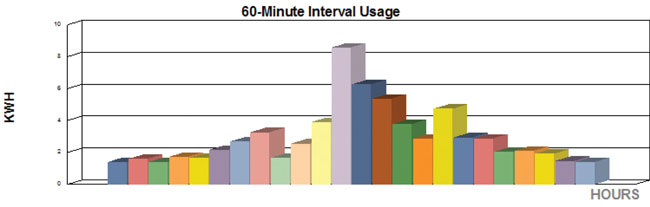
Above: one member’s usage over the course of 24 hours showing peak usage at noon and tapering off as the day went on.
New with the November bills, members will see demand shown on page 2 of the bill.
Members will see:
- Current month Demand
- Peak Demand
- Billed Demand
Demand will be billed at the greater of the current month demand or half of peak demand determined over the past 11 months.
AMEC 17-day work trip to Bolivia
The Association of Missouri Electric Cooperatives, AMEC, organized a 17-day work trip to Bolivia for volunteers from Missouri and Oklahoma. Crews built power lines in unserved areas of the country.

Above, Craig Moeller, a former lineman for who now works for AMEC and his “helpers.”
PCEC Community Blood Drive
November 1, 1-6 p.m.
Platte-Clay Offices
15055 Bethel Rd.,
Platte City, 64079
1000 State Rte 92
Kearney, 64060
Do U send txt msgs? Txt pcecnews to 22828
 Platte-Clay has developed a new service for members who rely on their phones for information.
Your co-op will send e-mail highlights of the Northland Connection to members with a link to the co-op’s web site, pcec.coop
The purpose of the electronic notification is to keep the increasing number of mobile members informed and co-op information easily accessible.
All Platte-Clay needs is a current e-mail address for the monthly newsletter e-mail blast.
Members who sign up for electronic notification also will be notified of stories of interest in the Rural Missouri.
In addition, from time to time, the co-op may send out urgent co-op announcements, such as information on a major outage to supplement ongoing Facebook posts, special event invitations and co-op member offers.
Members can sign up using the link from the slider on the home page of the web site, pcec.coop in addition to texting pcecnews to 22828
Platte-Clay announces new rates, 3-part bills
Rates effective with November bills, October usage
- Customer charge $25.38 – (Currently shown on bill)
- Energy – .079 /kWh – (New lower rate effective w/Oct. usage)
- Demand – $2.50/kW – (New, will be shown on November bills with October usage instead of included with energy)
The Northland Connection is published monthly by Platte-Clay Electric Cooperative, Inc., 1000 W. 92 Highway, Kearney, MO 64060. Postmaster: Please send address changes to: Northland Connection, PO Box 100, Kearney, MO 64060 or mail@pcec.coop.
Platte-Clay is an equal opportunity employer.