


September 2018 | Volume 80 | Issue 9
PCEC Community Blood Drive
The Community Blood Center needs 500 donors each day for our area hospitals
Please join us Wednesday, Oct. 10 at either office
Platte City, 15055 Bethel Rd., 1-5 p.m.
Kearney, 1000 W. State Rte. 92, 1-6 p.m.
Busy schedule? Make a reservation by going online –
- Go to the following link: https://pcec.coop/newsroom/community-blood-drive/
- Click on the link for Platte City or Kearney to schedule a time at that office
- Question? Call the office, 628-3121
- Donors will receive a mini-server as a thank you gift and two lucky donors wil receive a $100 Platte-Clay fuels gift card.
Keeping the lights on

Dave Deihl, General Manager
From the General Manager
I’d like to report that we have all of the answers and that’s why your lights are on 99 percent of the time. But we don’t.
What we do have is a great staff that takes advantage of all of the resources within the three-tiered system of rural electric cooperatives, a carefully researched group of contractors and suppliers, a commitment to looking to the future and we put best practices in place.
That helps us keep the lights on 99 percent of the time and to get ready for the next 10 or 20 years.
We don’t talk a lot about the other factors outside of those that affect a rural electric cooperative’s operations, because many, like lightning, are just beyond our control.
Disruptive technologies, for instance, may change the way we, and other industries, do business.
For example, the Shell Oil CEO said that the company must plan for the time when major economies move away from oil and to electric vehicles. Shell anticipates peak oil consumption during the 2030s, possibly the 2020s. That decade starts two years from now.
For Platte-Clay, the Shell analysis means growing electric vehicle demand and the importance of building the electric infrastructure to serve members and the Northland during the same timeframe. Builders now are wiring garages to accommodate electric vehicles, coming to showrooms and garages near us soon.
Platte-Clay is planning to be able to serve whatever co-op members decide to plug into the grid.
 The Internet of Things, IoT, is another interesting development for Platte-Clay, and in fact, for all households. More and more “things” have plugs and require electric power. Anything with an on and off switch that can connect to the Internet becomes part of IoT.
Alexa, the “smart” speaker is part of the IoT. Any smart TV is part of the Internet of Things. It’s the system of “things” with data-collecting technology that allows them to communicate with one another via the Internet. While it sounds techy, we’re already seeing and many of us are using IoT. In fact, IoT can provide considerable convenience and even safety benefits.
Health professionals now use a program that notifies a doctor when a pacemaker, for instance, isn’t performing correctly, or an individual’s blood sugar drops.
So, more plugs, more electric service consumption as sensors and intelligent devices become more common in our everyday devices.
And here’s another quiet change that is affecting utilities: the Department of Labor says that some 50 percent of utility employees will retire over the next 10 years. Their statistics say that 10,000 Baby Boomers, who make up 13 percent of the population, turn 66 each day, making them eligible for full Social Security benefits. For many that means signing the retirement papers and leaving jobs. These Boomers are the group born between 1943 and 1954, with the full Social Security benefit age gradually increasing to 67 for those born in 1960 or later.
We’ve seen several retirements at Platte-Clay and as a result, now have a younger group making up our line crews and filling other positions. We’re working to make sure the transition, like all of the other factors involved in operating Platte-Clay, doesn’t adversely affect co-op members or co-op operations.
So in addition to working to keep the lights on, we’re also working at keeping the operations humming along.
As always, if you have questions or concerns, please let me know.
Please e-mail generalmanager@pcec.coop
Transportation that makes ¢ents
Shopping is always an adventure and it’s the same when shopping for another or a new vehicle, two or four wheels.
But for the 2019 automobile category, there are a growing number of hybrid and electric vehicle (EV) choices from nicely appointed sedans to sports cars to SUVs from any number of car manufacturers.
For many, the distance a car will go without requiring a charge is a prime consideration – which generated a new term, “range anxiety.” The good news is that manufacturers are making great commuter vehicles that for most of us will easily take us to work and back, along with normal errands on the weekend.
New to the electric vehicle market, legacy manufacturer Jaguar is rolling out its I-Pace, a five passenger performance SUV. It is positioned as a competitor to Tesla’s high-end Model X.

2019 Tesla Model 3
The new Jag has electric motors at both axles powered by a lithium-ion battery, making it an all-wheel drive vehicle. And to get a bit technical: the motors generate a combined 394 horsepower and 512 lb.-ft. of torque and will go 0 to 60 mph in 4.5 seconds plus a full electric range of 298 miles. A rapid 100kW DC charger will clock a 0 to 80 percent charge in 40 minutes; a home AC wall box will need 10 hours to recharge the battery to 80 percent.
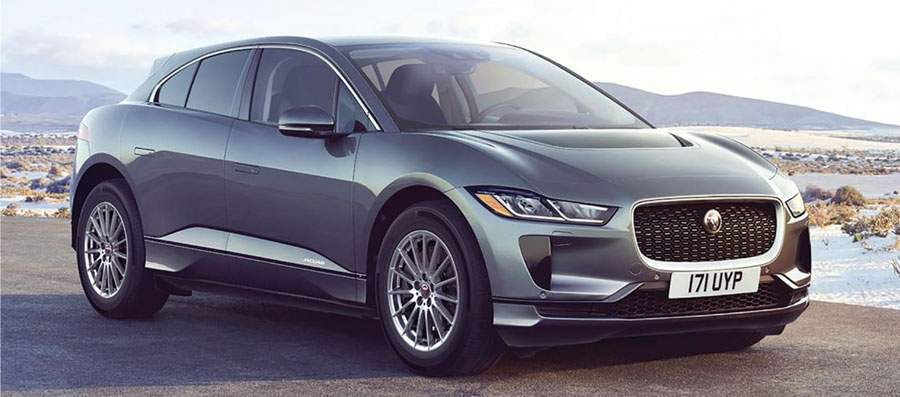
2019 Jaguar I-Pace
For the rest of us it has lots of creature comfort built in including a dual touchscreen infotainment system, navigation and a driver information screen.
The artificial intelligence technology remembers driver preferences and will adjust the vehicle for the weather conditions.
Alexa and Echo’s Internet of Things (IoTs) capability connects the car to a home, allowing owners to check on the battery status, organize driving routes and change the climate in the vehicle.
“This is the first big change in the last 100 years in the motoring industry,” said Ian Callum, Jaguar’s director of design. “It is a challenge for us. We decided to go into electric drive early on as our history is about innovation and we’re not frightened to continue with this.”
The luxury vehicle comes with a 5 year/60,000 mile limited warranty and an 8 year/100,000 mile battery warranty. Look for the new electric car at the end of the year, which will run from $69,000 to $86,000, depending on electric vehicle tax incentives.
While some of us may be waiting on the new Jaguar, Car and Driver has reviewed its pick of the hybrids and EVs: getting the top ranked five stars is the Chevy Bolt EV. The enthusiasts’ magazine says it gives Tesla a “run for its money.”
That ringing endorsement is followed by the hybrid Chevy Volt, with a solid four stars. Prices start at $37,495.
Hyundai’s Ioniq is available as a hybrid, an EV and a plug-in version. The EV model has an estimated 124-mile range. The plug-in has a gas engine and a 27-mile range on battery only. Prices start at $23,085.
The Golf EV is rated at just over four stars with its 100-kWh electric motor, an estimated 125-mile range and a fuel rating of 119 MPGe.
Prices start at $31,345.
More mainstream, and new for 2019, Hyundai is introducing the limited production Kona Electric that will come in three prices for the three trim levels.
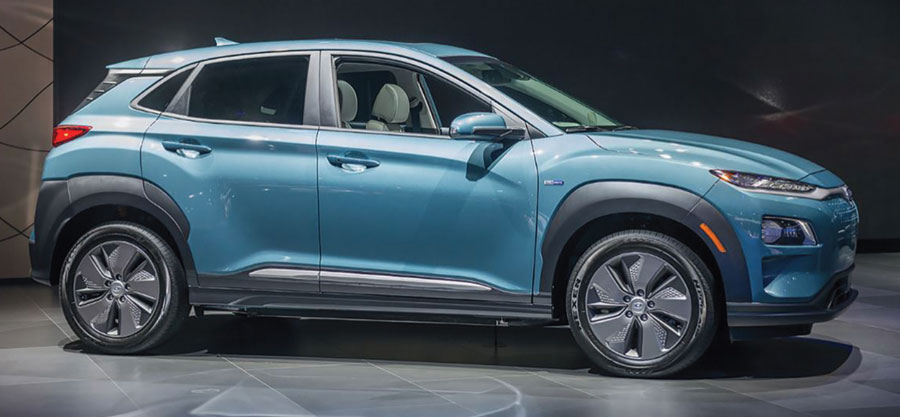
2019 Hyundai Kona
The SUV has a 250-mile driving range with a fuel equivalency rating of 117 mpg.
Tesla, the best-known EV car manufacturer, gets a solid four stars for its Model 3, known as the “affordable electric sports sedan.” The optional long-range battery provides a 300 mile plus range compared to the standard range of 220 miles. Prices start at $50,200.
Ford says to stay tuned, that it will have a new Ranger in 2019 and an entirely new lineup by 2020, many of which will be hybrids and EVs.
In the meantime, Ford said it is going all-in on hybrids; all new Ford vehicles will have 4G LTE connectivity by the end of 2019.
“Throwing a charger in the trunk of a vehicle and sending customers on their way isn’t enough to help promote the viability of electric vehicles,” said Sherif Marakby, vice president, Autonomous and Electric Vehicles. “In addition to expanding our electric vehicle lineup, we are redesigning the ownership experience to ensure it addresses customer pain points that currently hold back broad adoption today,” he said in a Ford announcement.
Get a power assist
And it’s back to basics but with a twist.
If electric bikes and prices are more in line with transportation and recreation, there are several choices, in fact trends for the two-wheel set to get from home to office or school.
Long-time bicycle manufacturer Specialized has a top-rated electric pedal-assist model, the Turbo Vado 6.0, which sells for a listed price of $5000. Designed to be a commuter bike, the Vado will run 80 miles on a single charge with a top speed of 28 mph.
Raleigh, another well-known bicycle manufacturer has jumped on the ebike bandwagon and offers the Redux IE Diamond Frame for a list price of $2,700. Top speed is 28 mph and it too has an 80-mile range. This commuter bicycle looks more like a traditional bike.
For those who are into long rides, the best road bike, according to Digital Trends, is Giant’s Road E+1, which lists for $4130. The reviewer notes that during lengthy training sessions the electric battery boost helps prevent muscle fatigue. The bike comes with four power assistance levels.

eSpin bicycle
If those prices seem daunting, there’s the eSpin Sport, listed for $1888. A no-frills bike, it has 20-inch frame with a luggage rack that will carry up to 55 lbs. of gear. The motor is rated for up to 50 miles with a removable battery for easy in-home or office charging.
Stay tuned, there’ll be more.
Who Powers You Contest

The annual Who Powers You contest recognizes local heroes, the individuals who inspire us by making our communities a better place in which to live.
We’re certain there are a number of individuals and organizations Platte-Clay serves who are eligible for this contest, which runs Oct. 1-Nov. 4.
Please visit www.whopowersyou.com and follow the contest rules.
We encourage Platte-Clay members and organizations to enter – what could be better than being rewarded for your good work?
Prizes are first place, $5,000; second, $2,000; third, $1,500; and honorable mention, $500.
Board Corner
 Sometimes we tend to think that once we get out of school that we’ve learned the skills we need for the rest of our lives. That’s not the case when it comes to serving on the Platte-Clay Board of Directors. There’s always something to learn, and the learning curve is steep, especially in the first term of joining the Board.
This past summer, Debi Koechner, Kendall Davis and Theresa Wren attended Summer School for Cooperative Directors that consists of six and a half full days of courses providing an in-depth understanding of cooperative governance, financial statements, financial status evaluation and planning, legal issues, personnel practices, strategic planning and member service.
With this knowledge, smarter decisions based on strategic questions and discussion can be made that benefits the membership’s best interest. Furthermore, in board meetings when staff is presenting reports, there is a greater understanding and analysis of cause and effect and long- and short-term consequences of decisions.
As in all industries and services, change is the only certainty, and technology advances and cybersecurity are increasing concerns.
The many advances and changes require an active Board that stays current, stays focused, takes responsibility and devotes time to learn in order to represent you, the membership, in making decisions. The decisions we make help keep Platte-Clay Electric Cooperative financially solid and consistently able to meet your varying electric energy needs at an affordable and competitive rate.
In addition, Debi Koechner, Steve Adkins, Kendall Davis, Dennis Fulk, Larry Leachman and Gary Shanks attended Associated Missouri Electric Cooperative Committee meetings and their monthly meeting. We learned about the depth and value of the services provided to PCEC and Missouri cooperatives such as employee training, legislative communications and updates, employee on-site safety feedback and insurance.
Another way Board members learn is through conferences where speakers address advances, trends and options in the electric service area that reflect the Seven Cooperative Principles.
Included in the meetings is the opportunity to network with directors of other cooperatives to learn how they are addressing challenges and improving service to their members.
This not only gives us a chance to evaluate ways to improve our co-op, but also is a good way to reflect on the added value that we bring to a conference on behalf of PCEC. I must say that we are right up there with the progressive, visionary co-ops and often are providing innovative ideas in our collaboration.
In conclusion, your Board members take the responsibility of continuous learning through many channels: reading electric professional publications, taking director education courses, and attending affiliated cooperative meetings and conferences.
Cooperatives are a democracy with elected directors to represent the membership’s interests, and this representation involves much more than just attending a monthly meeting.
I am reminded of a quote, “A group of caring and knowledgeable people makes a better decision than one caring and knowledgeable person.”
The key words, caring and knowledgeable, are required for the group to make the better decisions.
The Board is a group of very caring individuals who continuously work to increase their knowledge of electric service and the cooperative principles.
The Northland Connection is published monthly by Platte-Clay Electric Cooperative, Inc., 1000 W. 92 Highway, Kearney, MO 64060. Postmaster: Please send address changes to: Northland Connection, PO Box 100, Kearney, MO 64060 or mail@pcec.coop.
Platte-Clay is an equal opportunity employer.