


June 2022 | Volume 84 | Issue 6
2022 PCEC Scholarship Winners

Left to right: Katelyn Mayne, Jakob Scroggins, Cole Matthews.
Every year, PCEC awards a $1,000 scholarship to one high school senior in each of the co-op’s three service districts. The recipients of the $1,000 scholarships this year were Katelyn Mayne of Lawson, Jakob Scroggins of Platte City and Cole Matthews of Smithville.
The scholarship program focuses on students pursuing degrees that can be used in the electric power industry. Platte-Clay Electric Cooperative supports Northland schools throughout the year by hosting learning experiences, giving electrical safety demonstrations, sponsoring school events and extracurricular activities, and investing in STEM teacher development.
Exciting New Ways You Can Use Electricity For Your Benefit

Dave Deihl, General Manager
From the General Manager
If you listen carefully, you can hear a quiet transformation happening. Electric appliances and equipment are becoming more popular among consumers.
Advancements in technology and battery power combined with decreasing costs are winning over consumers looking for comparable utility and versatility. A bonus is that use of electric equipment is quieter and better for the environment.
Inside the home, consumers and homebuilders alike are turning to electric appliances to increase energy efficiency and savings. Whether a traditional electric stove or an induction stove top, both are significantly more efficient than a gas oven. That’s because conventional residential cooking tops typically use gas or resistance heating elements to transfer energy with efficiencies of approximately 32% and 75% respectively (according to ENERGY STAR®).
Electric induction stoves, which cook food without any flame, will reduce indoor air pollution and can bring water to a boil about twice as fast as a gas stove. Robotic vacuums are also gaining in popularity. Fortune Business Insights attributes the growth and popularity of robotic vacuums like Roomba to a larger market trend of smart home technology and automation.
More tools and equipment with small gas-powered motors are being replaced with electric ones that include plug-in batteries. In the past few years, technology in battery storage has advanced significantly. Hand-held tools with plug-in batteries can hold a charge longer and offer the user the same versatility and similar functionality as gas-powered tools. For DIYers and builders, national brands like Makita, Ryobi and Milwaukee offer electric versions of their most popular products such as drills, saws, sanders and other tools. In addition, consumers can now purchase a wider array of specialty tools that plug-in such as power inverters, air inflaters and battery chargers.
A case in point is the increased use of electric-powered tools and equipment, with more national brands offering a wider selection including lawn mowers, leaf blowers, string trimmers and snow blowers. The quality of zero- or low-emissions lawn equipment is also improving.
Electric equipment also requires less maintenance, and often the biggest task is keeping them charged. In the future, autonomous lawn mowers (similar to the robotic vacuum cleaners) will be seen dotting lawns across the Northland.
Another benefit of using electric appliances or equipment is that by virtue of being plugged into the grid, the environmental performance of electric devices improves over time.
In essence, electricity is becoming cleaner through increases in renewable energy generation, so equipment that uses electricity will have a diminishing environmental impact over time. Quite a hat trick––improving efficiency, quality of life and helping the environment.
Teen’s Encounter With Downed Power Lines
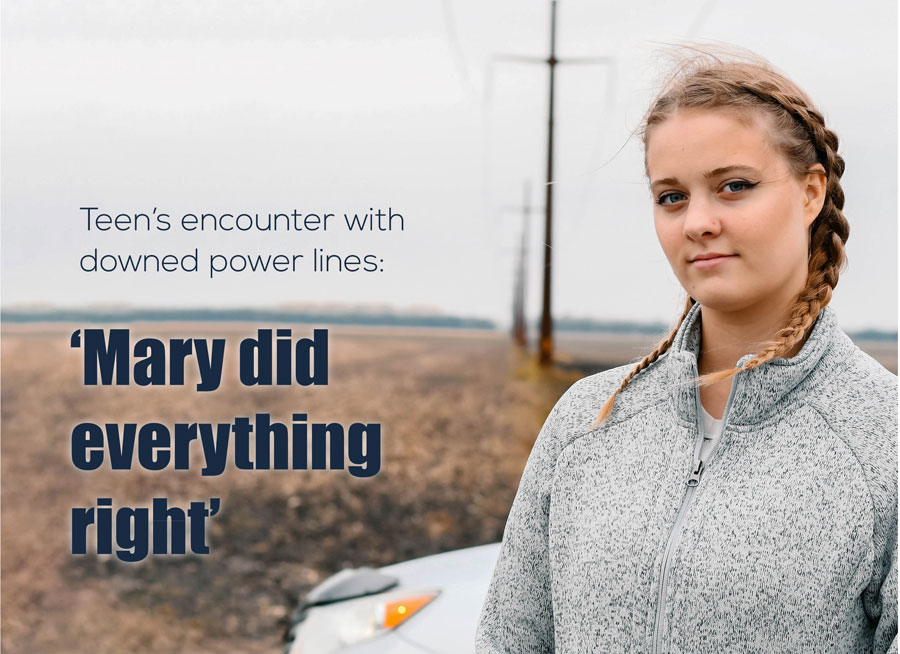
Most teenagers are quick on their feet, and Mary Gehrig is no exception.
Mary was having a good time hanging out with a friend. Realizing that a storm was brewing, she pulled the weather card and used it as an excuse not to leave. As teens often do, Mary led with her most compelling reason. “Oh no, I can’t come home right now. It’s dangerous,” referring to the half-hour drive.
Her mom, however, was not buying what Mary was selling. Karen Gehrig’s maternal instinct kicked in, and like moms everywhere, she wanted her daughter home before the skies opened. Mary reluctantly headed home around 9 p.m.
On any other evening, 17-year-old Mary’s protest about coming home mixed with a smidge of teenage attitude might have been nothing out of the ordinary. Everyone in the family would be safe and sound and come morning, they would make small talk over muffins and orange juice. However, on this night, the evening unfolded in a way that no one would have anticipated.
Her ride home started fine. It was raining, but nothing Mary couldn’t handle. “I’ve never really been afraid to drive in storms; I’m pretty good with them,” she explained.
But as she got closer to home, things took a turn for the worse. Mary recalls that many cars had pulled off to the side of the road due to low visibility caused by torrential rains, but since she was almost home, she thought she would keep going.
However, the storm took a drastic turn and got so bad that she was driving blind.
After she made one of her last turns onto a county road, she said that flashes of lightning illuminated glimpses of white lines in the distance, but she could not tell what they were. As she got closer, she realized that there was nothing small about the linear obstructions strewn across the roadway.
“By the time I realized it’s on the road, it’s big and I was not going to (be able to) drive over it. I was like, I am going to hit this,” Mary recalls. She slammed on the brakes and her car struck whatever was in the road. She said her next thought was, “Oh my gosh, what did I do.”
What she hit was a massive, high-voltage transmission power line that was no longer hung from tower to tower in its proper place. The wrath of the storm had damaged several structures and brought down large lines. It was as if nature’s fury was in the ring with metal transmission towers, and Mother Nature won the match, bending many of them in half with her unapologetic wind shear.
Although transmission towers are designed to withstand all kinds of conditions, many of them were irreversibly damaged due to the storm system that took on a life of its own, becoming much more volatile than originally forecasted.
“You’re looking at all these towers, and they’re doing toe touches,” said Chris Gehrig, Mary’s dad.
After Mary’s car came to a stop, she says it began malfunctioning and was rendered undrivable. It was a life-changing moment that could have gone either way, depending on what she did next. Fortunately, Mary’s next thought was to call her parents.
“When we learned that she had hit a power line,” her dad Chris recalls, he told Mary in no uncertain terms to, “Stay put. Don’t move. Don’t do anything. Call 9-1-1.” Luckily, her phone’s charge lasted an hour or so after she hit the power line.
Fire chief Rich Schock, who was on the scene that night, said, “Those are large transmission lines with a lot of volts in them, and this could get bad fast.”
Although Mary experienced a full range of emotions while waiting in her car, she could not get out and first responders could not approach it until it was confirmed that the power lines were deenergized. This process took some time since the transmission lines were not local and spanned several states. Her local electric cooperative worked closely with the company that owned the transmission lines to ensure that no one would get hurt.
If Mary would have gotten out, which she admits she did consider doing at one point, her body could have become the path to ground for the stray voltage and she could have been electrocuted. However, Mary stayed put, and the Gehrigs hope that others will learn from her experience. Her family is quick to credit everyone involved with her safe recovery.

Chris, Mary and Karen Gehrig.
“I think Mary did everything right,” Schock said, since Mary stayed inside the vehicle until it was safe to exit.
After returning home in the early morning hours, “She was very happy, probably happier than I’ve ever seen her, to be home and see us,” her mom Karen said.
“I feel like that energy and that fritz of ‘this could be the end,’ it helps you appreciate things so much more,” Mary said. “Now, I drive slower. I’m more cautious, especially in the dark. I appreciate my friends and parents more. Having that kind of death-defying moment, it gets to the core of you; it gets to your heart real quick.”
To watch Mary’s story and to learn more, visit:

Member Appreciation Events Coming to a Community Near You This Summer
 Platte-Clay Electric Cooperative will hold several member appreciation events this summer in communities throughout the co-op’s service territory. Chris Cakes Pancake breakfasts will be held with fun and games for the family and the opportunity to connect with co-op leaders and employees. Sign up for email updates on www.PCEC.coop to be the first to know about the plans for these exciting events once they are announced.

The Northland Connection is published monthly by Platte-Clay Electric Cooperative, Inc., 1000 W. 92 Highway, Kearney, MO 64060. Postmaster: Please send address changes to: Northland Connection, PO Box 100, Kearney, MO 64060 or mail@pcec.coop.
Platte-Clay is an equal opportunity employer.